

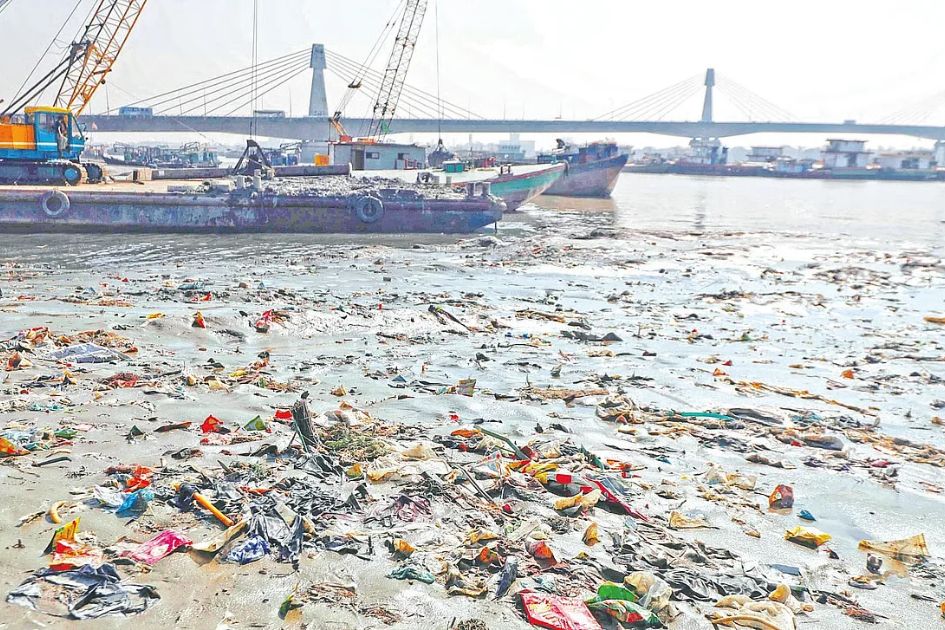



A University of Chittagong study highlights growing plastic contamination in the Karnaphuli River, with researchers warning of impacts on aquatic life and human exposure.
The Karnaphuli River, a key waterway in Bangladesh’s southeastern port city of Chittagong and a gateway for the country’s maritime trade, is facing severe pollution, with a study by the University of Chittagong finding alarming levels of microplastics in the river.
Experts said the tiny plastic particles can enter the food chain and accumulate in fish and other aquatic organisms, potentially reaching humans through consumption. They warned that exposure to microplastics could create serious health risks, including cancer.
The study found that more than 5,500 tonnes of visible solid waste enter the Karnaphuli River every day. However, according to Chittagong City Corporation (CCC) estimates, around 3,200 tonnes of waste are generated daily in the city.
The research showed that the Karnaphuli has become a major pathway carrying plastic waste into the Bay of Bengal. An earlier survey found plastic and polythene layers between two and seven metres thick on the riverbed. The latest research indicated that these accumulated plastics are gradually breaking down into microplastics.
The study was conducted under the leadership of Professor Shafiqul Islam of the Department of Soil Science at the University of Chittagong, with lecturer Mumtahina Jui overseeing the research.
Researchers collected samples from 24 locations along both banks of the Karnaphuli River. Analysis showed that surface water contained between 14.24 and 26.68 microplastic particles per cubic metre, while sediment samples contained between 75.63 and 272.45 particles per kilogram.
The study identified mainly black and blue fibre-like microplastics measuring between 0.3 and 0.5 millimetres. Chemical analysis detected commonly used plastics including polyethylene terephthalate (PET) and high-density polyethylene (HDPE).
These materials are widely used in the textile and packaging industries. The researchers said the level of microplastic pollution in the Karnaphuli is comparable to that found in some of the most polluted rivers in Bangladesh.
Chittagong City Corporation Chief Cleanliness Officer Commander Ikhtiar Uddin Ahmed Chowdhury said, “We only collect household waste. A huge amount of industrial waste remains outside our collection system and ends up in the Karnaphuli.”
Waste accumulation has also affected efforts to improve the river’s navigability. A 2019 study by the Bangladesh University of Engineering and Technology (BUET) found plastic waste layers between two and seven metres thick on the riverbed. The accumulated waste created obstacles for a major dredging project undertaken by the Chittagong Port Authority to increase the river’s navigability.
Researchers identified the city’s expanding urban and industrial areas as major sources of pollution in the Karnaphuli. The river’s banks are home to ship-breaking yards, oil depots, textile factories and densely populated unplanned settlements.
They also pointed to untreated sewage and industrial waste being regularly discharged into the river as contributing factors.
The Karnaphuli supplies around 280 million litres of treated water daily to Chittagong city through the Chittagong Water Supply and Sewerage Authority (WASA). The city’s water supply agency said its treatment facilities remove harmful pollutants, but filtering microplastics remains comparatively difficult.
Public health specialist and freedom fighter Dr Mahfuzur Rahman said microplastics could cause health risks including skin diseases, respiratory complications and cancer.
The researchers called for urgent measures, including stopping open dumping of waste into the river, expanding urban waste collection systems, enforcing bans on single-use plastics and making waste treatment facilities mandatory for industries.
They warned that without rapid action, the Karnaphuli could become a major route through which plastic waste reaches the Bay of Bengal.




