

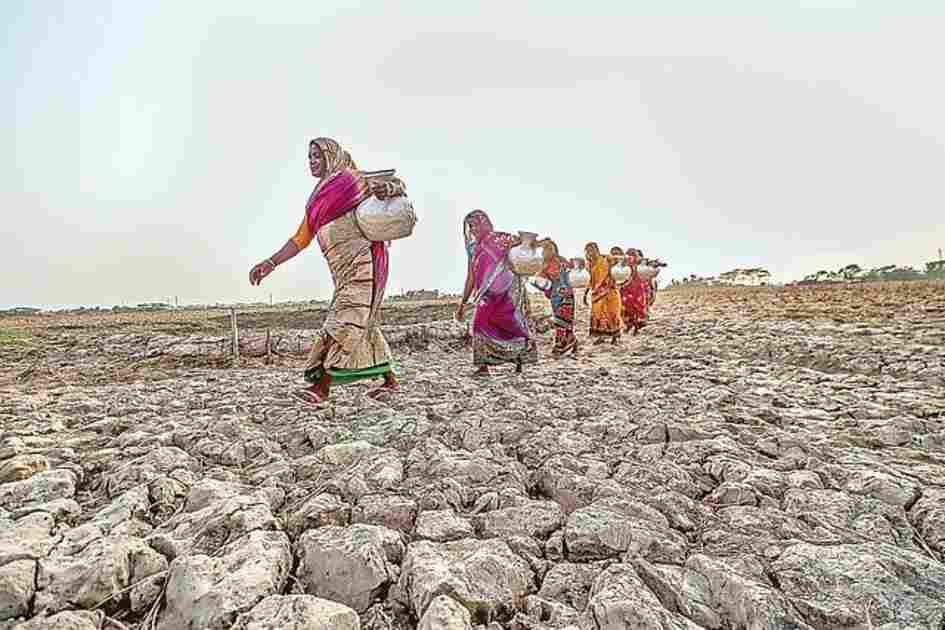



Thousands in Bhola’s remote Dhalchar Union face severe drinking water shortages as river erosion destroys tube wells, forcing women to walk long distances daily for safe water.
Thousands of residents in the remote Dhalchar Union of Char Fasson are struggling to access safe drinking water, forcing many women to walk between 30 minutes and an hour each day to collect a single container of clean water.
The isolated coastal union lies near the estuary of the Meghna River and the Bay of Bengal in Bhola, where river erosion and shifting channels frequently damage infrastructure and limit access to basic services. Local residents say urgent government intervention and climate-resilient water infrastructure are needed to prevent the crisis from worsening in the remote coastal union.
Dhalchar Union has an estimated population of around 12,000 people. However residents say only about 50 tube wells are currently functional. Government records show that around 112 tube wells had been installed in the area but more than half have been lost over time due to riverbank erosion while several others have become unusable.
With only about 50 functioning tube wells serving thousands of residents access to safe drinking water has become critically limited. Women and children are the most affected as they are primarily responsible for collecting water and are also more vulnerable to waterborne diseases.
During a recent visit to the area this correspondent found that many neighbourhoods lack nearby tube wells. As a result residents must travel long distances on foot to collect water.
Firoza Begum from Shantinagar village in Ward No. 4 said she walks nearly an hour to fetch water while Reshma Begum from Tarua village in Ward No. 5 travels about 30 minutes daily for the same purpose.
During the monsoon season the journey becomes even more difficult as muddy roads make walking challenging. At times families are forced to drink water from rivers and ponds when they cannot reach a tube well.
Shahnaz Begum another resident of Tarua village said her husband works as a fisherman and struggles to support the family. Installing a private tube well is beyond their means.
“We walk 20 to 30 minutes every day carrying water pots. No one seems to notice our suffering,” she said.
Residents near Majher Char Bazar said the situation worsens when women fall ill or when male family members leave early for work. In such cases households often rely on unsafe water sources including rivers and ponds. Many families report that children and adults frequently suffer from diarrhea and other waterborne diseases.
Local residents Md Ali and Md Jasim said the shortage of tube wells has persisted for years in Dhalchar. According to them river erosion alone has washed away more than 50 tube wells while others no longer function due to mechanical failure or lack of groundwater access.
They believe the situation could improve if the government installs at least 500 new tube wells in the union to ensure safe drinking water for the growing population.
Officials from the Department of Public Health Engineering in Bhola acknowledged the problem. Executive Engineer Md Imran Torofdar who is currently serving in an additional capacity for the district said many tube wells in Dhalchar had been lost due to river erosion.
“There is indeed a shortage of tube wells in the area,” he said. “However we currently do not have a new allocation for installing tube wells. Once funds are approved we will prioritise providing additional tube wells in Dhalchar.”
In a landmark January 2026 verdict the Bangladesh High Court declared access to safe free and drinkable water a fundamental right for all citizens under Article 32 of the Constitution. The court mandated the state to ensure this right ordering authorities to provide safe drinking water at public places within one year and to implement a 10-year national plan to ensure free and sustainable water access across the country.
Water experts say many coastal communities across southern Bangladesh are increasingly facing freshwater shortages due to erosion salinity intrusion and climate change impacts affecting fragile delta regions.
Environmental activist Sohanur Rahman Executive Coordinator of YouthNet Global said the situation reflects a broader climate justice issue affecting vulnerable coastal communities.
“Access to safe drinking water is a basic human right. The crisis in Dhalchar shows how climate impacts river erosion and lack of resilient infrastructure are pushing coastal communities into daily hardship,” he said. “Urgent government action and climate-resilient water systems are needed to ensure that women and children do not have to walk long distances just to collect safe water.”




