

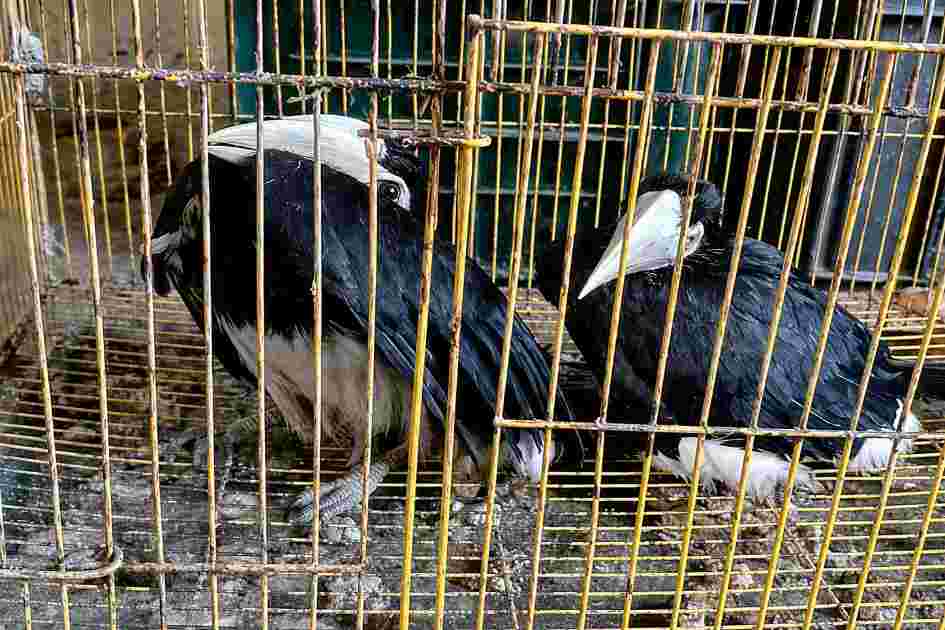



Recent Dhaka raids exposed captive hornbill chicks, mammals and invasive hatchlings, highlighting enforcement gaps at airports and border routes used by wildlife trafficking networks.
Wildlife traffickers are taking young animals from Bangladesh’s deep forests, drugging them with sedatives and smuggling them abroad, while another network is illegally bringing invasive turtles, snakes and spiders into the country, wildlife officials and researchers said.
The Wildlife Crime Control Unit of Bangladesh’s Forest Department and researchers said weak monitoring along the country’s borders was fuelling the rise in animal trafficking.
In Dhaka’s Mirpur Beribadh area, the rooftop of a house resembled a small zoo. A young great hornbill was found confined in poor conditions, while a pair of oriental pied hornbill chicks were kept in a cage. Also found were a civet, a spectacled monkey and a young porcupine. Even young eagles and owls had not been spared. The animals were recently rescued during a Forest Department operation.
The animals had been collected by a trafficker named Hadis, who was arrested in Chattogram, Bangladesh’s main port city in the southeast.
The Wildlife Crime Control Unit said young animals were being taken from deep forests across the country. They were then given sedatives, either mixed with food or through injections, before being smuggled abroad.
“When these animals are trafficked, they are given sedative injections so that they remain unconscious for eight to nine hours. This became clear after the warehouse was discovered,” said Asim Mallik, an inspector with the Wildlife Crime Control Unit.
In another recent raid, around 1,000 hatchlings of an invasive foreign turtle species were recovered from a house in Dhaka’s Mirpur area. Young foreign snakes and spiders were also found there. Officials said such invasive animals were being illegally brought into Bangladesh by air.
Dr Firoz Jaman, a professor in the Department of Zoology at the University of Dhaka, said authorities at land ports and airports needed to act more strongly to tighten management.
Researchers said many people still did not view wildlife trafficking as a crime, making it urgent to raise awareness about Bangladesh’s wildlife conservation law.
Ashiqur Rahman Shomi, a lecturer in the Department of Zoology at the University of Dhaka, said the recently passed wildlife law should be treated seriously through coordinated action by the local administration, the Forest Department and police.
Alongside air routes, traffickers are using border areas in northern and central Bangladesh to move animals. The Chittagong Hill Tracts are also being used to smuggle wildlife to Myanmar, Cambodia, Vietnam, China, Thailand and Gulf countries.
Source: The Independent




