

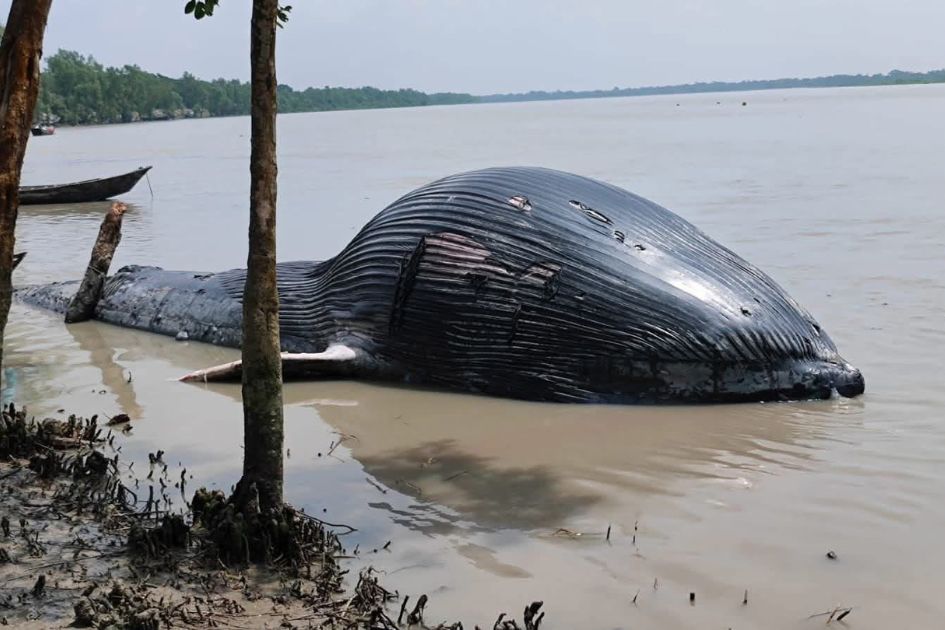



Experts say scientific examination of the carcass could help identify why the marine mammal died and strengthen understanding of Bay of Bengal biodiversity.
A dead baleen whale, measuring approximately 32 feet in length, was found washed ashore along the Andharmanik River on the coastal outskirts of Taltali upazila in Bangladesh’s Barguna district on Wednesday morning.
Local residents spotted the carcass near Harinkhola Bazar, adjacent to Charpara village in Barabagi Union, at around 7:00 am. News of the discovery quickly spread, drawing a large number of curious people to the site.
Mohammad Arafat Rahman, general secretary of the Bangladesh Biodiversity Conservation Federation, said the whale was believed to have died around a week ago. Its body had already begun to decompose, causing it to turn over in the water.
Environmental activist Arifur Rahman said the whale was initially spotted near the river mouth in the morning, but by around 11:00 am, the carcass was seen drifting toward the open sea. The matter was subsequently reported to the Forest Department.
Ziaur Rahman, range officer of the Taltali Forest Range under the Forest Department, said efforts were underway to bring the carcass toward Nishanbaria. Samples would be collected for examination before the remains are buried, he added.
Dr Mohammad Rajib Sarker, a professor at Patuakhali Science and Technology University in southern Bangladesh, identified the animal as a baleen whale. Unlike toothed whales, baleen whales have baleen plates that allow them to filter small fish and krill from seawater.
He said the presence of baleen whales in the Bay of Bengal is significant for the region’s marine biodiversity, but a proper examination of the carcass would be necessary to determine the cause of death.
Mir Mohammad Ali, assistant professor at the Faculty of Fisheries and Marine Science at Sher-e-Bangla Agricultural University in Dhaka, said that, based on photographs, the whale appeared to be a baleen whale, possibly a Bryde’s whale (Balaenoptera edeni), which is among the baleen whale species most frequently observed in the Bay of Bengal.
“The exact cause of death cannot be determined at this stage. However, several possibilities need to be considered, including entanglement in fishing nets, collision with large vessels, marine pollution and ingestion of plastic, or the whale entering shallow waters while weakened or sick,” he said.
He added that the whale may also have entered the river with the incoming tide and subsequently become stranded as the water receded, a phenomenon that has been observed in the region before.
“Determining the actual cause of death will require a proper field examination and scientific investigation,” he said.
Mir Mohammad Ali further emphasized the importance of collecting biological samples and preserving the skeleton if possible. Such materials could provide valuable opportunities for future research, education and understanding of marine biodiversity.
He also called for coordinated efforts among relevant government agencies, researchers, conservation organizations and local communities to strengthen the protection of marine biodiversity in the Bay of Bengal.




