

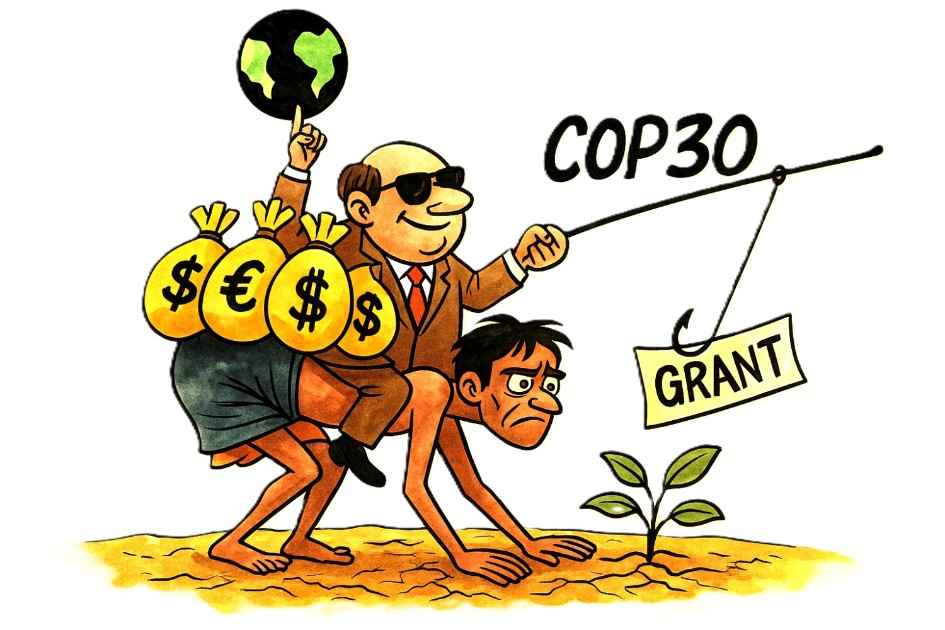

Bangladesh enters COP30 demanding real climate finance, not promises. With $8.5 billion needed annually for adaptation and only $0.4 billion received, farmers from hills to coasts call for grant-based funding, urgent Loss and Damage action and justice for the vulnerable.
In the hills of Bandarban, where the Sangu River winds through lush greenery and rugged mountains, farmer Ashish Tanchangya recalls how farming once felt different.
For generations, his family practiced jhum cultivation – the traditional slash-and-burn method of shifting agriculture common among indigenous communities in the Chittagong Hill Tracts and Northeast India.
“My father and grandfather relied on jhum,” said Ashish, adding, “It sustained us.”
But times have changed. Ashish and his family gradually shifted from jhum to cultivating rice, vegetables, and local fruits. The hope was that these crops would bring higher yields and better incomes. Instead, climate change has upended that expectation.
“Now, even rice and vegetables do not grow the way they used to,” he explained.
Rising temperatures, erratic rainfall, and degraded soil fertility have slashed productivity. What little they manage to harvest often fetches poor prices, held back by weak transport links and fragile market systems.
The result is frustration and hardship for small ethnic minority farmers like Ashish. “Even when we produce, we cannot sell properly. The price is so low, we lose hope,” he said in a voice cracking with dismay.
At global climate summits like COP, world leaders make grand promises – billions of dollars pledged for adaptation, resilience, and loss and damage. But on the ground in Bangladesh’s hill tracts, families like Ashish’s see little of it.
For them, survival itself feels like a daily negotiation with both the climate and the market. “Everyone talks about climate finance,” Ashish said, “but what about us?”
Coastal crisis
Md Alauddin Sikder, a farmer from Kuakata – the famous tourist town and beach within Kalapara Upazila of Patuakhali district in southern Bangladesh’s Barisal division – said salinity intrusion and the lack of fresh water are devastating farming in the coastal belt.
“Our rice fields no longer yield crops like before, and growing vegetables has become nearly impossible as the soil and water are poisoned with salt. Even drinking water is scarce. We depend on rainwater harvesting, but most systems are broken and too few to meet our needs,” he said.
He stressed that without repairs to embankments and sluice gates, farmers cannot survive. Preserving local seeds and directly involving farmers in adaptation projects are also crucial. “We are living this crisis every day.
“Policymakers should not only speak on our behalf at COP but take us there. If our voices are heard, the world will truly understand the struggles behind climate finance.”
Bangladesh’s demands at COP30
Md Shamsuddoha, chief executive at Center for Participatory Research and Development (CPRD), said at COP30, Bangladesh might demand a clear road map of scaling up climate finance from the current annual pledge of 300 billion to 1.3 trillion with 50% allocation commitment to adaptation.
Bangladesh also should demand immediate operationalization of the Loss and Damage fund with new funding commitments, he said.
Bangladesh also will demand predictable financing for the implementation of National Adaptation Fund (NAP) and Nationally Determined Contribution (NDC3.0), Doha added.
Finance for adaptation and transition
Shafiqul Alam, IEEFA’s lead analyst (energy) for Bangladesh said as a climate vulnerable country, Bangladesh needs finance for its transformational adaptation.
However, Alam said the country also needs an increasing volume of finance for its green transition, which is important not only for reducing its imported energy dependence but also for its competitiveness in the international market.
With increasing pressure from international buyers on the apparel sector to reduce carbon footprint, adopting renewable energy, energy efficiency and circularity is more important than ever.
“As we observe, Bangladesh meets unconditional mitigation targets easily, it should ramp up efforts to mobilise finance for activities under the conditional mitigation,” he said.
“We should prioritise work in coastal areas that continue to face problems emanating from salinity intrusion and scarcity of fresh water. Women are especially vulnerable in these areas. Climate finance is needed for projects in these areas,” he said.
Developing the capacity to mobilise an increasing volume of climate finance is important! Equally important is to utilise the increasing finance, Alam pointed out.
Of course, Bangladesh must work on accessing more grants and low-cost funding. The challenge, however, is that international public climate finance is showing a downward trend, he added.
The financing gap
Bangladesh’s average annual demand for mitigation finance is $9 billion, but annual flows are only around $3 billion, with about 30% coming from international sources. This leaves an 89% funding gap for meeting conditional NDC targets, according to the Change Initiative (CI).
For adaptation, Bangladesh requires $8.5 billion annually but receives merely $0.4 billion from external aid, forcing the government to cover nearly 90% of costs through domestic resources.
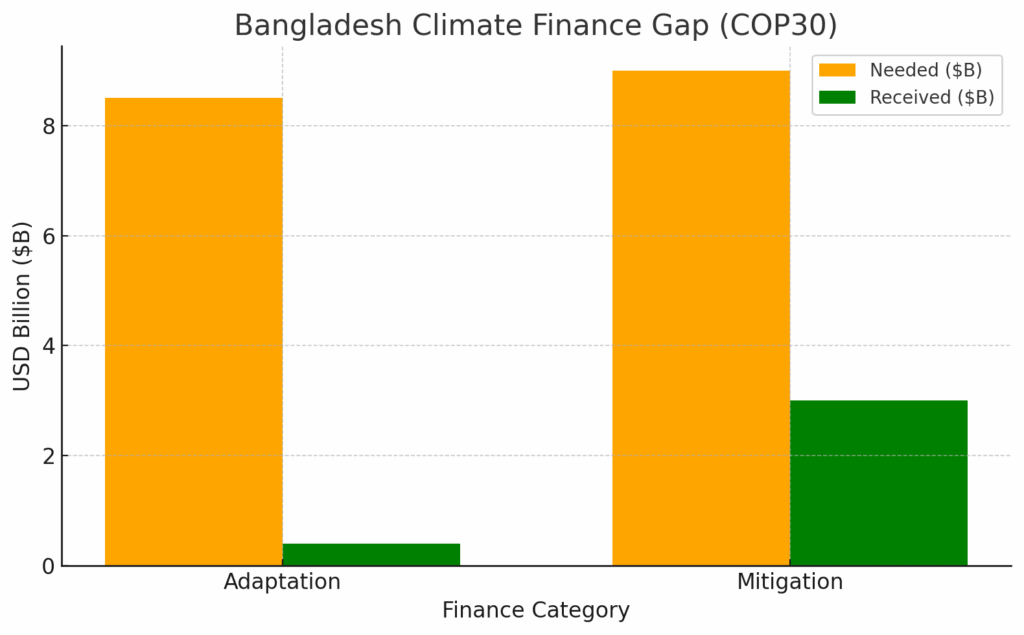
Zakir Hossain Khan, executive director of CI, said, “Bangladesh’s adaptation and mitigation finance gaps are staggering. We need $8.5 billion annually for adaptation but receive just 0.4 billion, while 90% of the burden falls on domestic resources.
“This is unsustainable. At COP30, our message must be clear – climate finance goals must reflect the real costs of implementing our NDC and NAP. Otherwise, we are only debating numbers while communities suffer.”
Position in global negotiations
Mirza Shawkat Ali, director of Climate Change & International Convention at the Department of Environment, stated that Bangladesh will press for higher climate finance, seeking more than the current $300 billion per year target by 2035, so that developing countries can better cope with climate impacts.
At the COP29 summit in Baku, wealthy nations agreed to a new goal of $300 billion annually by 2035 to help poorer countries deal with climate change.
The amount was welcomed as a step forward, but many developing countries – including India – criticized it as “insufficient” and “abysmally poor.”
They pointed out that the sum falls far short of their actual needs and challenged the outcome as overly modest given the scale of climate threats.
Ali also noted that Bangladesh is outperforming many of its Asian peers in securing climate funds. From the Green Climate Fund (GCF) and the Least Developed Countries Fund (LDCF), Bangladesh has thus far received about $250 million in concessional loans and $267 million in grants for adaptation projects.
Looking ahead to COP30, Ali said Bangladesh will raise key issues including mitigation, adaptation, climate finance, and other related matters to ensure that commitments are more equitable, accessible, and generous.
Broader climate finance context
At the COP29 climate conference in Baku, Azerbaijan, developed nations agreed to a New Collective Quantified Goal (NCQG) calling for them to mobilize at least $300 billion annually by 2035 for developing countries to combat climate change impacts.
This goal is part of a broader target to scale up overall climate finance to $1.3 trillion annually by 2035. While praised by some, the $300 billion figure was criticized by developing nations as insufficient to meet the scale of their needs.
The financing options include multilateral and bilateral scopes, as well as innovative opportunities. Multilateral Climate Funds encompass various avenues.
The Green Climate Fund (GCF), established under the United Nations Framework Convention on Climate Change (UNFCCC), is a key source that channels funds from developed to developing countries and supports projects aimed at reducing greenhouse gas emissions and strengthening resilience to climate change.
The Global Environment Facility (GEF) supports projects related to biodiversity, climate change, international waters, land degradation, and chemicals and waste management.
Post-LDC graduation challenge
Ziaul Islam of the Department of Environment said, “After Bangladesh’s graduation from the LDC category, the country still requires strong international support, especially considering its acute climate vulnerabilities.
“We need assistance that truly addresses our needs. As outlined in our Nationally Determined Contributions (NDC), Bangladesh is committed to contributing to global emission reductions. But support must come in the form of grants and concessional financing – otherwise, we risk falling into a debt trap.”
He stressed that the responsibility lies with the historical emitters and developed countries to support nations like Bangladesh, which remain among the most climate-vulnerable in the world.
“For the last seven to eight years, we have been raising the same issues as highlighted in our NDC and National Adaptation Plan (NAP). This burden is too great to handle locally. It requires genuine support from developed nations – support that must come as grants, not loans,” Ziaul added.
Islam further emphasised the urgency of scaled-up adaptation financing, “Our adaptation support must increase exponentially to address the mammoth vulnerabilities and the impacts we are already experiencing today.”
Climate finance priorities
Bangladesh’s COP30 position draws from the Implementation Plan of the NDC 3.0 and the National Adaptation Plan (NAP) 2023-2050, which jointly define its climate agenda. It calls for predictable, scaled-up climate finance across three areas: adaptation, mitigation, and loss and damage.
On adaptation, NAP mobilizes 113 interventions across eight thematic areas: water resources, disaster risk management, agriculture, fisheries, ecosystems, and urban systems.
Top-priority actions include integrated management of cyclonic polders, cyclone shelters, rainwater harvesting, climate-resilient infrastructure, and gender- and disability-inclusive disaster shelters, according to CI analysis.
With reference to mitigation, NDC 3.0 has an implementation requirement of $116.18 billion until 2030, out of which $90.23 billion is subject to international assistance.
Mitigation’s energy sector accounts for more than 90% of the total investment required, marking Bangladesh’s dedication to power sector decarbonization.
The Bangladesh delegation is expected to insist on the provision of grant-based finance as well as fast-tracking approval and disbursement processes so that these interventions can swiftly be implemented, CI analysis.
Institutional and financial readiness
Bangladesh has strengthened its capacity to manage climate finance through initiatives such as the Climate Finance Cell, the IBFCR framework, and the LAPA-based budget tagging system. These tools improve tracking and allow better targeting of funds to climate-vulnerable regions.
However, systemic challenges persist, over 70% of international climate finance is loan-based, which increases the debt burden, and only 63% of pledged funds are disbursed.
To absorb larger flows of finance effectively, Bangladesh is working on streamlining approval processes, enhancing monitoring systems, and strengthening coordination among ministries and development partners, CI analysis.
Loss and Damage Fund negotiations
Bangladesh is expected to take a leading role in COP30 negotiations on operationalising the Loss and Damage (L&D) Fund.
Its position emphasises that L&D finance should be grant-based, predictable, and rapidly disbursed, with direct access for local governments and civil society organizations.
Our country is likely to advocate clear and timely disbursement rules and simplified procedures to avoid delays, reflecting lessons from its own experience with climate-induced displacement and disaster recovery, CI assessment.
Inclusiveness for vulnerable communities
Bangladesh is mainstreaming principles of inclusiveness and accountability in its climate finance plan through tools such as IBFCR-II, LAPAs, and vulnerability indices governing budget allocations.
These frameworks attempt to funnel finance to vulnerable communities while enhancing public transparency of the use of climate finance flow.
However, independent estimates reveal that independent smallholder farmers presently benefit from just approximately 0.12% of total climate finance.
Civil society groups are advocating 15% – 20% of adaptation finance should go directly to district governments and community-based groups, especially women-led groups.
Scaling up participatory planning, monitoring, and reporting will also be essential in making sure finance gets to those who are most vulnerable, CI assessment.
On the salty coast of Kuakata, Md. Alauddin Sikder filled a broken pitcher with the day’s harvested rainwater – precious, limited, and uncertain.
“They speak about climate finance, but our thirst remains,” he said. For Bangladesh, COP30 is not just about negotiating figures; it is about making sure that farmers like Alauddin have water to drink, seeds to plant, and a future to hold onto.




