

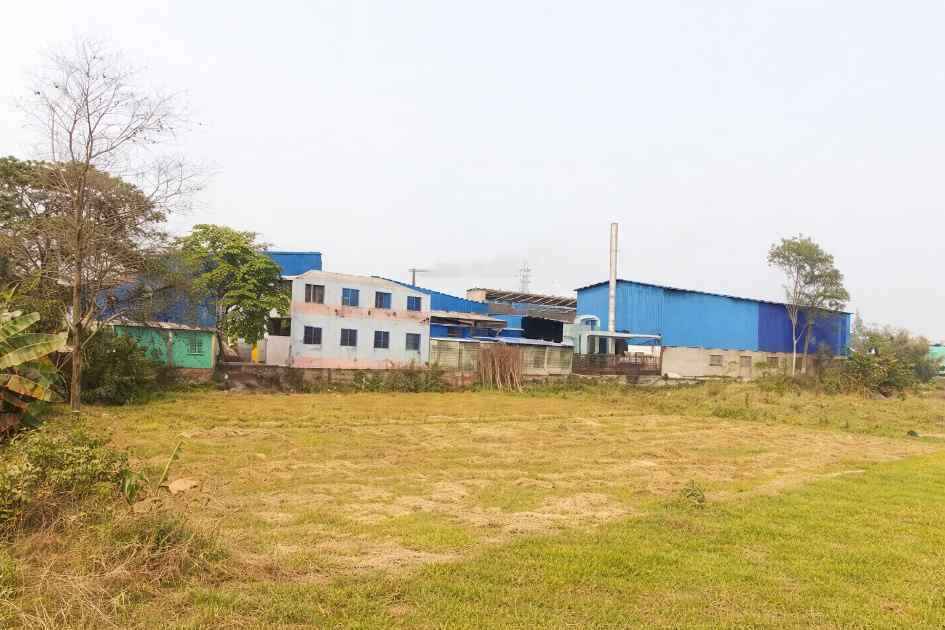

A Chinese-linked battery recycling plant in Dhamrai has been fined for operating without clearance, spotlighting Bangladesh’s growing lead poisoning crisis and its severe risks to children’s health.
Authorities in central Bangladesh have fined a lead and battery recycling plant operating without environmental clearance after years of complaints from local residents about pollution and health risks, highlighting a wider national crisis of lead contamination affecting millions of children.
A mobile court led by Dhamrai Upazila Executive Officer and Executive Magistrate Md Al Mamun conducted a raid on Saturday at Jiangsu Storage Battery Co. Ltd , a Chinese-owned lead-acid battery recycling and battery-related facility located in Belishwar village of Sutipara Union under Dhamrai upazila on the outskirts of Dhaka.
The court imposed a fine of Tk 100,000 (approximately US$820) for operating without mandatory environmental approval. Officials warned that the factory could face closure and disconnection of electricity if it fails to obtain the required clearance within one month.
Residents, however, say the penalty falls far short of addressing years of environmental damage.
According to local accounts, the facility was established nearly 14 years ago in a residential area adjacent to Mohini Mohan High School. Local residents allege that the factory was established by Chinese investors and has long been involved in processing lead recovered from used batteries, releasing toxic emissions into the surrounding environment.
Local Union Parishad member Abdul Alim Aman said he formally complained to the Department of Environment in July 2023, but no enforcement action had been taken until now.
“People have been raising concerns for years. This is the first major operation against the factory,” he said.
Residents claim that fumes from lead-smelting operations have contributed to respiratory illnesses, including asthma and breathing difficulties, while also damaging vegetation, agricultural land and local water bodies.
Eight-year-old Fatema, who lives near the facility, described the impact on her daily life.
“When I walk near the factory in the afternoon, my eyes burn and I start coughing,” she said.
A National Crisis Beyond One Factory
Environmental health experts say the case reflects a much broader problem in Bangladesh: the rapid growth of informal and poorly regulated recycling of used lead-acid batteries (ULABs), driven by rising demand for battery-powered vehicles.
According to estimates by the Centre for Policy Dialogue (CPD), Bangladesh has around six million battery-powered auto-rickshaws. The growing fleet has created a massive secondary market for used lead-acid batteries, many of which ultimately enter informal recycling chains.
Mitali Das, country director of Pure Earth Bangladesh, said informal battery recycling remains one of the country’s most significant environmental health challenges.
“Recyclers break down old batteries, remove the lead and melt it down to make new ones. They do all this in the open air. The toxic fumes and acidic water produced during the operation pollute the air, soil and water,” she said.
A study by the International Centre for Diarrhoeal Disease Research, Bangladesh (icddr,b), found elevated lead exposure among children in Dhaka, raising concerns about long-term impacts on cognitive development, learning ability and overall health.
Lead is a highly toxic metal that can accumulate in bones and teeth and cause irreversible damage, particularly in children. Health experts warn that chronic exposure can impair brain development, reduce IQ and contribute to behavioural and developmental disorders.
In 2020, UNICEF and Pure Earth identified Bangladesh as the fourth most affected country globally in terms of the number of children exposed to dangerous levels of lead poisoning. The report estimated that approximately 36 million children in Bangladesh are exposed to elevated blood lead levels, making it one of the largest childhood lead exposure crises in the world.
Despite that warning, Bangladesh still has no nationwide blood lead screening programme and major enforcement actions against industries responsible for lead contamination have remained limited.
Lead Exposure Drains Up to 9% of Bangladesh’s GDP
The economic cost of lead poisoning now rivals some of Bangladesh’s largest development challenges.
A 2024 study led by economist Bjorn Larsen and supported by environmental organisation Pure Earth estimated that lead exposure caused approximately US$28.6 billion in health and productivity losses in Bangladesh in 2019 alone. The losses are equivalent to roughly 6 to 9 percent of the country’s gross domestic product (GDP).
The study further estimated that reduced lifetime productivity resulting from childhood IQ loss linked to lead exposure costs Bangladesh nearly US$16 billion annually.
Researchers argue that, based on existing clinical evidence of lead exposure among Bangladeshi children, the situation could reasonably be characterised as a public health emergency.
Yet Bangladesh’s regulatory response to lead pollution has remained largely unchanged for decades. There is no national blood lead screening programme, informal ULAB recycling continues with limited oversight, contaminated sites remain largely untreated and blood lead testing has not been integrated into routine child healthcare services.
Researchers at icddr,b have identified several factors behind the persistence of unsafe lead recycling, including weak enforcement of existing regulations, limited political commitment, high profits from informal recycling, soaring demand for lead-acid batteries and insufficient investment in safer alternatives.
Health experts note that India, which banned leaded petrol in 2000, subsequently implemented stronger measures to address other major sources of lead contamination. They argue that Bangladesh could benefit from adopting similarly comprehensive approaches.
Lead Poisoning: A Preventable Crisis
Public health experts stress that lead poisoning is entirely preventable.
The solutions are well established: enforceable industrial standards, formalised recycling systems, elimination of unsafe smelting practices and integration of blood lead screening into primary healthcare.
Yet implementation continues to lag behind exposure.
Across Bangladesh, a growing youth-led movement is pushing the issue into the national conversation, documenting contamination hotspots and demanding a just transition that protects both livelihoods and public health.
The campaign is supported by YouthNet Global and Pure Earth Bangladesh.
Sohanur Rahman, a youth climate and environmental justice advocate and executive coordinator of YouthNet Global, said the crisis reflects a deeper governance failure.
“Lead poisoning is silently stealing the future of millions of children in Bangladesh. This is a national emergency affecting human capital, education and development. Immediate coordinated action is needed before another generation is permanently harmed,” he said.
He added that any transition must be both equitable and sustainable.
“A just transition means we cannot solve one crisis by creating another. We must protect children’s health while ensuring safe livelihoods through formalisation, clean technology and strong regulation.”
Government Response
Officials say some progress is now being made.
Dr Fahmida Khanom, additional secretary of the Ministry of Environment, Forest and Climate Change (MoEFCC), said the government is increasingly focusing on prevention and early intervention.
“Neurodevelopmental damage is irreversible, but through identification of ULAB sites and prevention, we can reduce lead poisoning. It’s all about preparedness,” she said.
A multi-stakeholder steering committee chaired by the environment secretary has been formed to coordinate cross-ministerial action, involving the Ministry of Health, the Directorate General of Health Services (DGHS), the Bangladesh Standards and Testing Institution (BSTI), food safety authorities and the Ministry of Industries.
A national strategy extending to 2035 is currently under preparation, with potential support from the Asian Development Bank (ADB).
Officials say work has already begun in several sectors, particularly in relation to lead-acid batteries and certain traditional and herbal products that have been identified as potential sources of contamination.
Critics argue that previous commitments on environmental enforcement have often failed to translate into sustained action on the ground. Whether the latest commitments result in measurable improvements remains uncertain.
The Hidden Cost of Progress
Bangladesh’s rapid expansion of low-cost electric mobility has transformed transportation and created livelihood opportunities for millions of people.
But it has also generated a parallel toxic economy that is shaping the health prospects of an entire generation.
Lead contamination rarely attracts public attention because its effects emerge gradually. The metal accumulates silently in blood, soil, dust and water long before its consequences become visible.
For communities living beside informal recycling sites, however, the crisis is no longer a warning about the future.
It is already present in their children’s bodies.
For the children growing up beside Bangladesh’s informal battery recycling sites, the cost of inaction is already being paid. The question now is whether policy action can arrive before another generation bears the same burden.




