

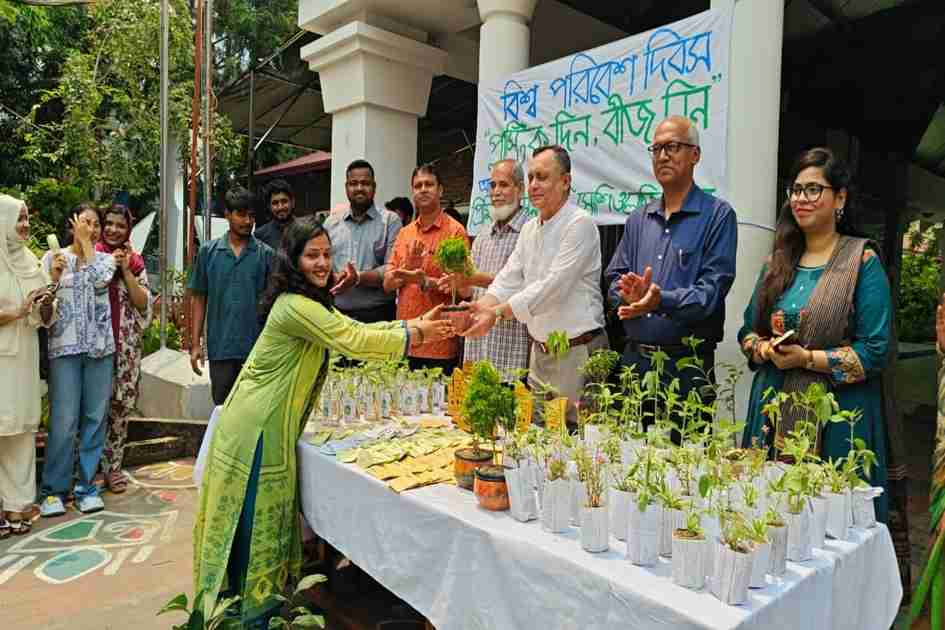



World Environment Day with a plastic-for-seeds campaign, tree planting, contests and a climate justice workshop to promote environmental awareness among students in Chattogram.
Premier University observed World Environment Day 2026 with a day-long series of environmental awareness activities at its GEC Campus in Chattogram, led by the Premier University Sociology Club under the Department of Sociology and Sustainable Development.
The programme featured a “Give Plastic, Take Seeds” campaign, tree plantation activities, environmental competitions and a special awareness workshop, drawing participation from faculty members, students, club members and participants from different departments of the university.
Vice-Chancellor Professor S. M. Nasrul Quadir attended the event as chief guest, while Treasurer Professor Dr. Jahed Hossain Sikder, Registrar Mohammad Iftekhar Monir and Proctor Md. Solaiman Chowdhury were present as special guests.
Addressing the gathering, Professor Quadir said plastic, though originally developed to make human life easier, has now become one of the most significant threats to both the environment and public health. He stressed the need to reduce plastic consumption, promote environmentally responsible lifestyles and strengthen sustainable development practices.
Professor Sikder said environmental conservation is no longer merely a social responsibility but a prerequisite for the survival of humanity. He called on students to play an active role in protecting the environment and promoting sustainable practices.
During the programme, the vice-chancellor formally inaugurated the “Give Plastic, Take Seeds” campaign, under which participants exchanged plastic waste for plant seeds to encourage environmental responsibility and sustainable behaviour.
The distinguished guests also joined a tree plantation programme on the campus and received saplings from members of the Sociology Club.
The event was presided over by Muhammad Tanzilur Rahman, lecturer at the Department of Sociology and Sustainable Development. Among those present were Dr. Sadika Sultana Chowdhury, assistant professor, and lecturers Nusrat Jahan Tani, Saiyeda Zaman and Sifatul Islam. Abdullah Al Mozahid, coordinator of the department, attended the prize-giving ceremony.
As part of the celebration, the club organised a Presentation Contest involving 21 teams from different departments of the university. After a preliminary screening round, eight teams advanced to the final stage.
Team “PUC Waste Decoder” from the Department of Computer Science and Engineering emerged champion, while Team “Crown2Crops” from the Department of Business Administration became first runner-up. Team “Light Emitting” from the Department of Electrical and Electronic Engineering secured the position of second runner-up.
The club also held an Awareness Video Contest with six participating teams. Team “Earth Voice” from the Department of Sociology and Sustainable Development won the championship, followed by Team “Nature’s Saviors” as first runner-up and Team “Green Horizon” as second runner-up.
A special workshop titled “Her Health, Her Rights, Her Environment: Advancing SRHR and Climate Justice in Bangladesh” was jointly organised by the Premier University Sociology Club and Young Power in Social Action, or YPSA.
The session was facilitated by Shyamshree Das, SRHR Project Manager of YPSA, who discussed Sexual and Reproductive Health and Rights, climate justice and the gendered impacts of environmental change. Eco-friendly sanitary pads were distributed among female participants at the end of the workshop.
The programme was jointly hosted by Khobaib Hamdan, literature and research secretary of the Premier University Sociology Club, and club member Nafisa Hanif.
Throughout the day, various awareness activities were coordinated by Club President Tahmina Akther, General Secretary Hafizur Rahman, Organising Secretary Tashrik Un Noor, Event Management Secretary Shahidul and other club members.
The organisers expressed hope that such initiatives would further promote environmental awareness, reduce plastic pollution and encourage sustainable development practices among young people.




