




Pacific island nations are demanding stronger emissions cuts and accessible climate funding, placing renewed pressure on summit leaders to turn diplomatic cooperation into meaningful climate commitments.
An unprecedented division of leadership between Türkiye and Australia is set to face a crucial diplomatic test at next month’s COP31 climate summit, raising questions over how the two countries will manage disagreements as governments negotiate contentious issues, including fossil fuels, emissions reductions and climate finance.
The 31st Conference of the Parties to the UN Framework Convention on Climate Change (COP31) will take place in Antalya, Türkiye, from November 9 to 20. Under a compromise reached at COP30 in Brazil last year, Türkiye will host the summit and hold its presidency, while Australia will exercise exclusive authority over formal negotiations.
Although both governments insist their partnership is working smoothly, differing statements about their respective authority have raised uncertainty over how the arrangement will operate when negotiations reach their most sensitive stage.
The unusual agreement ended a prolonged diplomatic standoff after both countries competed to host the annual UN climate conference and neither agreed to withdraw.
Türkiye’s Environment Minister Murat Kurum has been nominated as COP31 president, while Australian Climate Change and Energy Minister Chris Bowen will serve as President of Negotiations.
Kurum will formally assume the presidency following his election at the opening of the conference. Türkiye will also oversee the summit’s broader climate action agenda, while Australia will lead negotiations among participating countries.
Under the official partnership agreement, Australia has exclusive authority over negotiations, including selecting facilitators, coordinating negotiating processes and overseeing the preparation of draft decisions.
However, Türkiye retains the formal COP presidency, and the agreement requires both governments to resolve differences through consultation until they reach a mutually acceptable position. Climate decisions must ultimately be agreed upon by participating countries.
The arrangement has created an unusual situation in which one country holds the formal presidency while another directs the negotiations that will shape the summit’s outcomes.
Questions over the division of authority became apparent earlier this year.
In April, Kurum told Agence France-Presse (AFP) that Türkiye would remain involved in all aspects of the conference because of its presidential responsibilities. He maintained that the COP31 presidency would ultimately oversee the adoption of decisions.
Bowen, however, sought to reassure governments concerned about the unfamiliar structure.
Speaking during UN climate negotiations in Bonn, Germany, in June, he acknowledged some nervousness over the arrangement but argued that it offered opportunities for cooperation.
Asked who would deliver the final gavel at COP31, Bowen replied: “Kurum and I … Together.”
Yet in September, Kurum emphasised that Türkiye was not sharing the presidency with Australia, reiterating that the Turkish presidency retained ultimate responsibility for the conference.
Despite the differing interpretations, both ministers have repeatedly expressed confidence in their working relationship.
Their governments have pledged close consultation, transparency and cooperation throughout the summit, presenting the arrangement as an innovative approach to international climate diplomacy.
Climate policy experts, however, have warned that unclear responsibilities could complicate negotiations.
Anna Pérez Català of the Paris-based Institute for Sustainable Development and International Relations (IDDRI) told AFP that the leadership arrangement had no precedent at UN climate summits.
She suggested that the partnership could demonstrate international cooperation despite political differences, although disagreements could emerge during negotiations.
Former German climate envoy Jennifer Morgan also warned that uncertainty over presidential roles had previously distracted countries from substantive climate discussions.
The leadership experiment comes at a particularly sensitive moment for global climate diplomacy.
Countries remain divided over the pace of emissions reductions, the transition away from fossil fuels and financial responsibilities towards developing nations already experiencing severe climate impacts.
The continued dependence of both Türkiye and Australia on fossil fuels has further complicated their leadership positions.
Australia remains a major exporter of coal and liquefied natural gas despite expanding renewable energy at home. Türkiye, meanwhile, continues to rely heavily on fossil fuels for electricity generation, although it is investing in cleaner energy and has pledged to achieve net-zero emissions by 2053.
Environmental campaigners have criticised both governments for supporting continued fossil fuel production while preparing to lead negotiations intended to accelerate global emissions reductions.
International climate campaign group 350.org has urged the two countries to establish credible coal phase-out plans and clearer pathways for reducing dependence on fossil fuels.
Campaigners argue that expanding fossil fuel infrastructure risks undermining the credibility of efforts to meet the Paris Agreement’s temperature goals.
Bowen has defended Australia’s energy policies, maintaining that the country’s transition towards renewable energy could contribute to global emissions reductions.
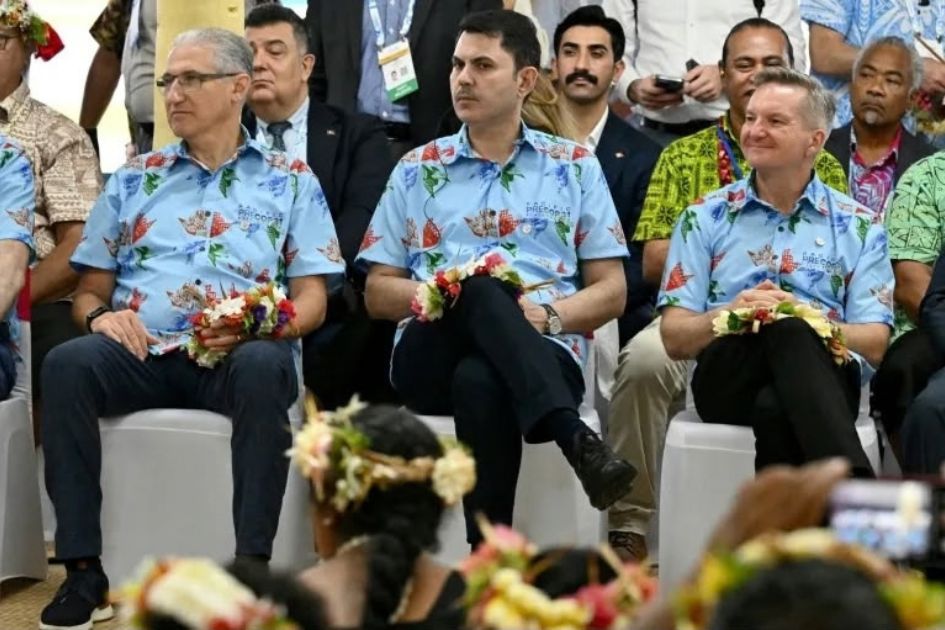
Meanwhile, the recently concluded Pacific Pre-COP31 meetings have highlighted the urgency of stronger climate commitments.
The preparatory events, held in Fiji and Tuvalu from October 5 to 8, brought together representatives from more than 50 countries and placed the concerns of climate-vulnerable Pacific island nations at the centre of international discussions.
Pacific governments pressed for faster emissions reductions, improved access to climate finance, stronger ocean protection and renewed commitments to limiting global warming to 1.5°C above pre-industrial levels.
Representatives of around 30 countries endorsed a declaration supporting deeper and sustained reductions in greenhouse gas emissions.
Addressing the closing session in Fiji on Thursday, Kurum warned that governments could no longer delay climate action, describing the 1.5°C goal as essential to the survival of vulnerable communities.
His remarks followed a visit to Tuvalu, where rising seas, coastal flooding and saltwater intrusion are increasingly threatening settlements, freshwater supplies and livelihoods.
The meetings also produced new financial commitments for the Pacific Resilience Facility, a Pacific-led fund supporting community-based climate adaptation and resilience projects.
Fiji, Ireland, Denmark and the Netherlands announced approximately $15 million in additional contributions, bringing total pledges to slightly below $200 million.
However, the amount remains far short of the facility’s initial $500 million fundraising target, highlighting the persistent gap between international financial commitments and the resources needed by climate-vulnerable communities.
The facility ultimately aims to mobilise $1.5 billion to support locally driven resilience initiatives across the Pacific.
For developing countries beyond the Pacific, including Bangladesh and other climate-vulnerable nations, COP31 will also be an important opportunity to press for predictable adaptation finance, support for addressing loss and damage and a fair transition towards low-carbon economies.
Many developing countries have repeatedly argued that stronger climate commitments must be accompanied by accessible financial resources, technology transfer and institutional capacity to implement adaptation and mitigation measures.
The Antalya summit will therefore test not only the leadership arrangement between Türkiye and Australia but also the willingness of governments to bridge longstanding divisions over climate responsibility and financing.
The two countries have presented their partnership as an opportunity to connect different regional priorities and strengthen international cooperation.
However, the practical challenge will be maintaining negotiating momentum when disagreements emerge over politically sensitive issues, particularly fossil fuel transitions, financing obligations and the implementation of previous climate agreements.
The arrangement itself does not determine the outcome of COP31. That responsibility ultimately rests with participating governments, which must reach consensus on negotiated decisions.
As world leaders prepare for Antalya, the success of the unprecedented partnership will be measured not by diplomatic assurances but by its ability to facilitate agreements on emissions reductions, climate finance and support for vulnerable countries.
Whether Türkiye and Australia can translate their unusual division of responsibilities into meaningful collective action remains a central question ahead of one of the year’s most consequential international climate negotiations.




