

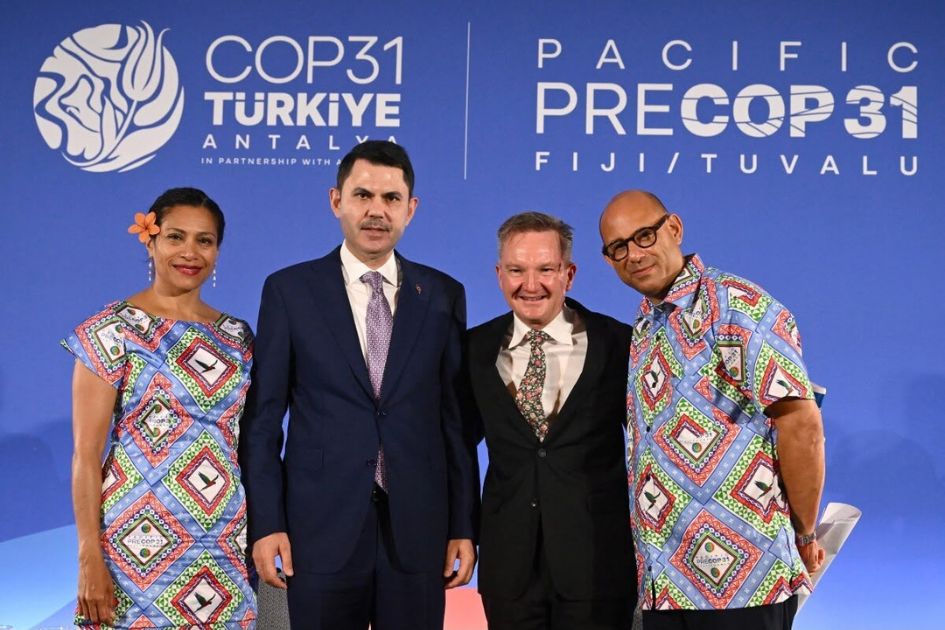



Pacific island states are pressing for urgent emissions cuts, accessible adaptation funding and a transition away from fossil fuels as questions grow over Australia’s climate leadership.
Türkiye and Australia will seek a presidency-led climate decision at next month’s COP31 summit, aiming to accelerate global climate action and build political consensus as Pacific island nations demand stronger commitments to move away from fossil fuels and safeguard their survival against rising seas.
The announcement came on Thursday as the four-day Pacific Pre-COP31 meeting concluded in Fiji, following a high-level gathering in Tuvalu that brought international leaders face to face with the consequences of sea-level rise, coastal erosion and extreme weather.
COP31 will take place in Antalya, Türkiye, from November 9 to 20. Türkiye will preside over the summit, while Australia will lead negotiations under an unprecedented partnership arrangement.
Australian Climate Change and Energy Minister Chris Bowen said the two countries would prepare a presidency-led decision for consideration by participating nations, seeking to provide clearer political direction and accelerate implementation of existing climate commitments.
“We feel that a presidency-led decision gives us the best chance of a strong and ambitious outcome at COP31,” Bowen told reporters.
The proposed decision would bring key political priorities into a common framework covering emissions reductions, adaptation, finance and implementation. However, COP31 President Murat Kurum clarified that it would not replace formal negotiations or automatically create new obligations. Its final adoption would depend on consensus among participating countries.
A central priority is accelerating electrification, replacing technologies that directly consume fossil fuels, such as conventional vehicles and gas heating systems, with electric alternatives.
The COP31 presidency has proposed increasing electricity’s share of global final energy demand from just over 20 per cent to 35 per cent by 2035. The initiative is intended to accelerate the clean energy transition, although its climate benefits will depend substantially on expanding renewable electricity generation.
Bowen acknowledged scientific warnings that global temperatures could exceed the Paris Agreement’s 1.5°C threshold, stressing that any overshoot must be kept as limited and brief as possible.
“We’ve got to overshoot it for as little and as short as possible,” he said.
Under the 2015 Paris Agreement, nearly 200 countries committed to holding global temperature increases well below 2°C above pre-industrial levels while pursuing efforts to limit warming to 1.5°C.
Scientists warn that every additional fraction of warming increases the risks of extreme weather, rising seas, ecosystem destruction and irreversible losses, particularly for vulnerable countries.
Pacific secures commitments but demands stronger action
The preparatory meeting brought together representatives from more than 50 countries, placing the priorities of small island developing states at the centre of international climate diplomacy.
One significant outcome was the Taku Pakasoa Declaration, endorsed by representatives of around 30 countries following their visit to Tuvalu.
The declaration reaffirmed the importance of the 1.5°C temperature goal and called for deeper emissions reductions, accelerated renewable energy deployment, greater energy efficiency and a transition away from fossil fuels.
Climate finance also featured prominently, with Fiji announcing a US$10 million contribution to the Pacific Resilience Facility, a Pacific-led mechanism designed to provide grants for locally driven adaptation and resilience initiatives.
The United Kingdom, Denmark, Ireland and the Netherlands also announced or reaffirmed support for the facility, while Australia outlined additional funding for renewable energy and climate-resilient infrastructure across the Pacific.
Fiji’s Climate Change Minister Lynda Tabuya welcomed the commitments, saying Pacific countries were demonstrating leadership rather than merely highlighting their vulnerability.
However, she stressed that international partners must translate political commitments into practical support for communities facing increasingly severe climate impacts.
The announcements offered some progress, but campaigners warned that the funding commitments and diplomatic declarations remained insufficient compared with the scale of the crisis.
Fossil fuel expansion raises questions over Australia’s leadership
Environmental organisations questioned whether Australia could credibly lead ambitious climate negotiations while continuing to support coal and gas production.
Australia remains a major fossil fuel exporter, and environmental campaigners argue that continued expansion of coal and gas projects undermines international efforts to limit global warming.
The criticism intensified after Australia’s High Court overturned approval for the expansion of the Mount Pleasant coal mine in New South Wales, in a ruling concerning the assessment of emissions associated with exported coal.
The decision has raised broader questions about how governments should account for the climate consequences of fossil fuel exports.
At Thursday’s press conference, Bowen declined to offer a substantive assessment of the ruling, saying court decisions represented the law of the land and that he was focused on the international negotiations.
Greenpeace Australia Pacific said the contradiction between Australia’s diplomatic commitments and its domestic fossil fuel policies threatened the credibility of its climate leadership.
“The outcomes of this week’s talks are a drop in the ocean given the scale of need, and urgency of the crisis our communities are facing,” said Shiva Gounden, head of Pacific at Greenpeace Australia Pacific.
Gounden warned that adaptation funding and electrification initiatives would remain inadequate unless governments confronted the continued expansion of coal, oil and gas production.
The organisation argued that electrification must reduce fossil fuel dependence rather than simply increase electricity consumption, with new demand met through renewable energy.
It also called for climate finance that addresses the responsibilities of major polluters and reaches communities experiencing the most severe consequences of climate change.
The criticism highlights a central challenge facing COP31: reconciling governments’ international commitments to climate action with national energy policies that continue to support fossil fuel production.
Tuvalu brings survival concerns to forefront
Tuvalu, a low-lying Pacific island nation with approximately 10,600 residents, emerged as a powerful symbol of the climate crisis during the preparatory meetings.
International delegates visiting the country witnessed the growing threat of rising seas, coastal flooding and saltwater intrusion to homes, freshwater resources and infrastructure.
The island nation has been developing long-term strategies to protect its population, territory and national identity, including coastal adaptation measures and arrangements for potential climate-related migration.
Pacific leaders warned that the consequences of continued global warming extend beyond environmental degradation to questions of sovereignty, cultural survival and fundamental human rights.
The region has contributed relatively little to historical greenhouse gas emissions but faces disproportionate exposure to climate-related disasters and rising adaptation costs.
Delegates pressed for stronger protection of marine ecosystems, improved access to climate finance and greater recognition of loss and damage suffered by vulnerable communities.
Pacific envoy questions effectiveness of climate negotiations
Despite welcoming the proposed presidency-led decision, Pacific representatives expressed frustration with the slow pace of international negotiations.
“The way that the COP process works is not great, I’ll be very frank,” said Tina Eonemto Stege, a climate envoy from the Marshall Islands, speaking to AFP.
Stege nevertheless welcomed efforts to give Pacific priorities greater prominence in the forthcoming summit.
The existing UN climate negotiation process requires countries with widely differing economic interests, development priorities and energy systems to reach agreement on complex issues.
For vulnerable countries, lengthy negotiations often delay decisions on urgently needed financial and technical support.
Climate finance remains particularly contentious, with developing nations demanding funding that is predictable, accessible and affordable to support adaptation, address loss and damage and enable a just transition towards cleaner economies.
UN climate chief Simon Stiell said the success of COP31 would depend on converting existing commitments into practical results, particularly by expanding access to affordable climate finance.
He also stressed that formal negotiations remain essential, even as the international process shifts towards implementation.
Climate security as important as national defence
COP31 President Murat Kurum urged governments to treat climate change with the same seriousness as national security, warning that rising geopolitical tensions and military expenditure should not overshadow the threat to vulnerable nations.
Referring to plans by NATO countries to increase defence spending, Kurum questioned the purpose of protecting national borders if climate change renders territories increasingly uninhabitable.
“What does it mean to spend 5% for defence if you don’t have a country to live on?” he asked.
Kurum described the 1.5°C target as essential to the survival of cultures, communities and homelands, particularly in small island developing states.
He pledged that the concerns raised by Pacific nations would inform discussions in Antalya, where governments are expected to address emissions reductions, adaptation, climate finance and the implementation of existing agreements.
The Turkish minister also emphasised the importance of ensuring that climate finance reaches vulnerable countries without excessive bureaucratic barriers.
Antalya summit faces credibility test
The proposed presidency-led decision will test whether Türkiye and Australia can turn political momentum into a meaningful outcome while maintaining the consensus-based nature of UN climate negotiations.
Although the Taku Pakasoa Declaration and new financial commitments have provided a foundation for further discussions, significant disagreements remain over fossil fuel production, emissions reductions and the responsibility of wealthy countries to finance climate action.
The credibility of COP31 will depend not only on the ambition of its final decisions but also on whether major economies demonstrate a willingness to implement their commitments.
For Pacific island nations, the stakes extend beyond negotiating procedures and political declarations.
One Pacific delegate told AFP that representatives from the region hoped their concerns would be treated equally and fairly when negotiations begin in Antalya.
“That’s the bottom line,” the delegate said. “We have a right to life, and life is a human right.”




