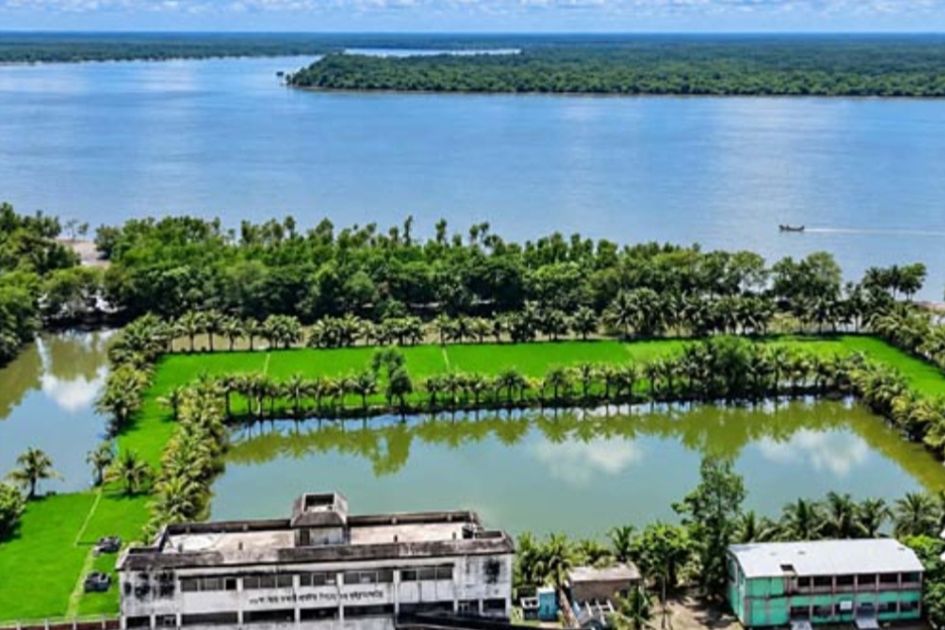



Once a lifeline after devastating cyclones, Gabura’s freshwater pond faces mounting threats from damaged embankments and salinity, prompting residents to demand urgent repairs to safeguard their drinking water supply.
A government-built, aesthetically pleasing freshwater reservoir located on the banks of the Kholpetua River in Sora, Ward 9 of Gabura Union under Shyamnagar Upazila in Bangladesh’s southwestern Satkhira district is now at risk due to a long-standing lack of maintenance.
The facility’s drinking-water pond, the surrounding government-owned canal, vegetation, a primary school, a mosque and other educational institutions are at risk from river erosion and saltwater intrusion. This raises concerns that a vital source of safe drinking water for thousands of people could be lost.
The facility was constructed in 2003, during the tenure of the four-party alliance government, as part of an “aesthetically pleasing” (drishtinandan) project, modelled after an eco-park, aimed at addressing the drinking water crisis and promoting afforestation in the Gabura area. Over time, it has evolved into a notable tourist attraction along the southern coast. However, local residents complain that, even 23 years after its establishment, no significant renovation work has been carried out at the site.
Although improved roads have been constructed in various parts of Gabura under a mega-project, this facility, situated on the banks of the Kholpetua River, remains in a precarious state. Long-term erosion of the surrounding earthen embankments has heightened the risk of riverbank collapse. There is also a danger that saline tidal water could enter the facility. Furthermore, the banks of a pond used for drinking water have deteriorated, causing the pond to become inundated during the monsoon season. Local residents fear that this will contaminate the water, rendering it unfit for consumption.
According to local sources, when the entire Gabura area was inundated by Cyclone Sidr in 2007 and Cyclone Aila in 2009, most of the local ponds used for drinking water were destroyed. At that time, the pond associated with the aesthetically striking structure became a vital source of safe drinking water for the local population. In the aftermath of these disasters, many families relied on this pond for a long period. However, this water source is now in jeopardy due to the collapse of its embankments, a lack of proper maintenance and the risk of saline water intrusion.
In the coastal locality of Gabura, the shortage of potable water is a long-standing issue. Access to safe water for the local population is repeatedly disrupted by factors such as salinity, riverbank erosion and natural disasters. Given this situation, it has become essential to protect the pond and surrounding infrastructure of this notable government-built facility. Should these fall into disrepair, thousands of people could face even greater hardship in obtaining safe drinking water.
Locals have urged the relevant authorities to take immediate action to repair the damaged embankments and pond banks surrounding the site, prevent the ingress of saline water, re-excavate government-owned canals and preserve the existing vegetation and other infrastructure. Furthermore, they have called for the implementation of a long-term maintenance plan for the site.
Locals fear that if timely renovation and preservation measures are not taken, not only will an aesthetically pleasing government structure be lost, but a vital source of safe drinking water for thousands of coastal residents could also disappear. Consequently, they have called for swift and effective action to address the risks posed by river erosion and salinity.