

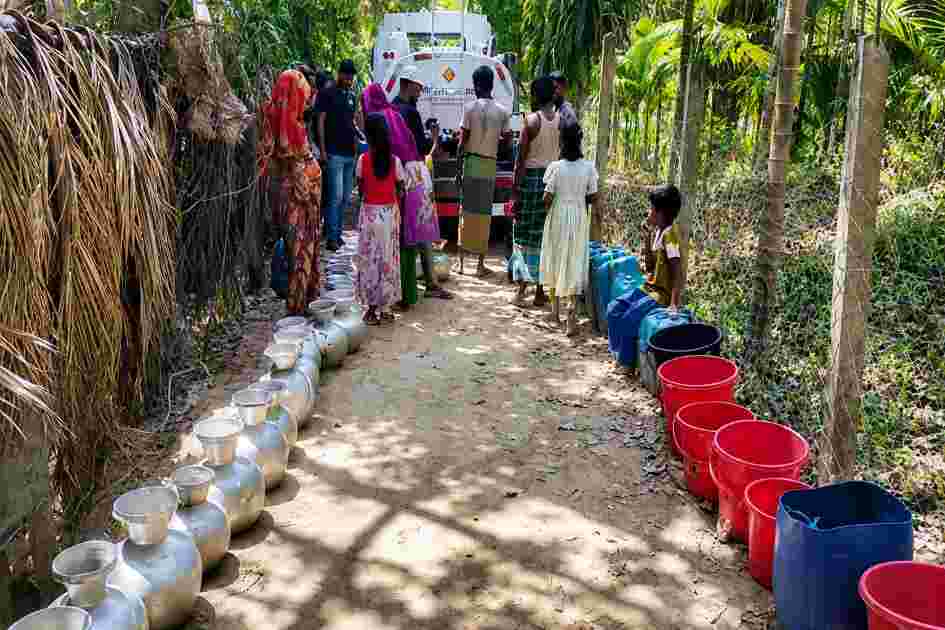

Falling groundwater, rising salinity and drying hill streams are deepening Teknaf’s drinking water crisis, forcing residents to use unsafe water and increasing waterborne diseases across the coastal upazila.
Climate change is driving groundwater levels down at an alarming rate across several parts of Teknaf while salinity is rising fast, leaving coastal residents facing an acute drinking water crisis and a growing burden of waterborne disease.
Around 45 percent of the upazila’s tube wells have turned saline over the past three years, according to local officials. On Saint Martin’s Island, drinking water was once available from tube wells at a depth of 10 metres, but now it cannot be found even at 50 metres.
Teknaf’s daily demand for drinking water is 20,000 litres. Of that, only 9,000 litres can currently be supplied from tube wells.
Md Faruk Hossain, acting sub-assistant engineer of the upazila public health department, said drinking water was being delivered by vehicle to areas facing the most severe shortages.
“If the situation continues like this, the crisis of safe drinking water will become even more severe in the future,” he said. “That is why steps must be taken now to purify saline water and to preserve water from hill streams for the installation of safe drinking water plants.”
The worst shortages of potable water are being reported in Teknaf Municipality, Sadar union, Sabrang, Hnila and Whykong, according to local authorities.
The upazila health department says residents of Rohingya-populated areas including Baharchhara, Hnila, Shamlapur, Saint Martin’s Island and Shahparir Dwip have been increasingly affected by waterborne diseases over the past five years due to climate change.
Cases of skin disease, stomach illness, fever, dysentery, cholera, typhoid, memory loss, high blood pressure and diarrhoea are rising, officials said. Arsenic has also been detected in many tube wells.
Teknaf Upazila Health and Family Planning Officer Enamul Haque said the shortage of safe drinking water in Teknaf was worsening day by day under the impact of climate change, forcing many people to use saline water.
“As a result, the number of people suffering from waterborne diseases is steadily increasing,” he said. “Arsenic has been found in the water of many tube wells in the area. Long-term use of such water creates the risk of various arsenic-related complications, which may later lead to serious health threats such as cancer.”
The Department of Public Health Engineering says water in different parts of the upazila contains salinity levels up to nine times higher than acceptable standards. In many cases, the water also gives off a foul smell.
In Hnila, drinking water used to be found at a depth of 450 metres, but now wells must go down to 650 metres. In Whykong, potable water was once available at 500 metres, but now 650 metres is needed. In Baharchhara, the depth has increased from 300 metres to 550 metres. On Shahparir Dwip, it has gone from 200 metres to 450 metres.
More than 100,000 people live in over 50 villages in remote parts of the upazila. They depend on water collected from springs, streams and small hill channels. But prolonged lack of rainfall and falling water levels have created an acute shortage in those villages. During the dry season, all hill springs, streams and channels dry up, leaving the area in water distress for nearly five months each year.
Nur Mostafa, a resident of Kanjorpara village in Whykong union, said his area was now facing an intense shortage of safe drinking water because of climate change.
“Many people are being forced to use saline water,” he said.
Chenowar Begum, a homemaker from Lechuaprang village in Hnila union, said she had to walk two kilometres to collect drinking water in pitchers.
“For bathing and cooking, we have to depend on water from the stream,” she said.
Upazila Nirbahi Officer SM Anik Chowdhury said emergency water supply measures were being arranged in the worst-hit areas.
“At the same time, there is a plan to take up a sustainable long-term project to tackle the water crisis,” he said.
This article is republished from The Daily Samakal.




