

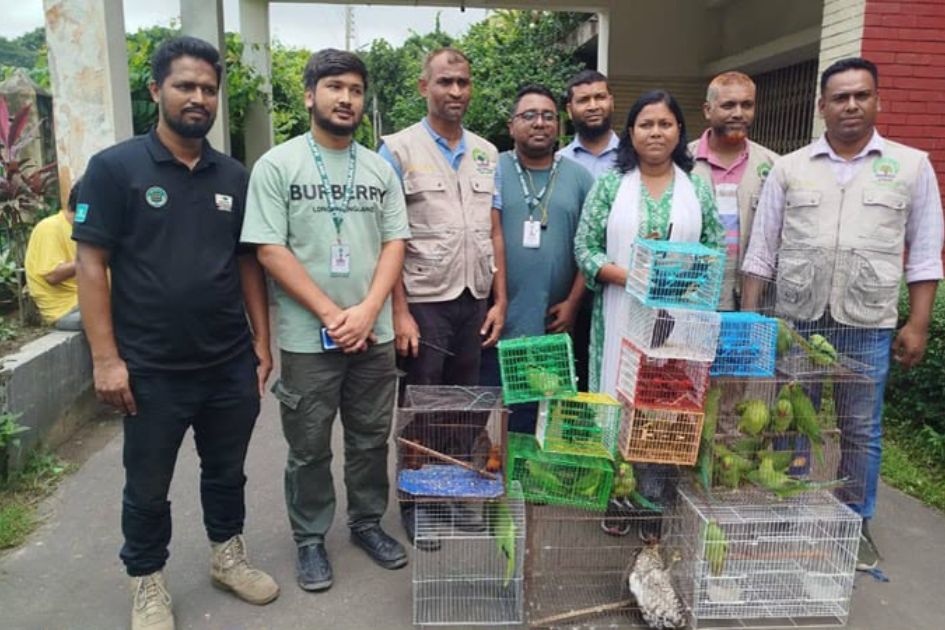



Community volunteers have become a vital force in Bangladesh’s fight against wildlife crime, but conservationists say stronger legal safeguards, security measures and institutional support are essential to sustain their work.
National award recognises citizen conservationists as youth, women and communities strengthen the country’s wildlife protection efforts. For Bangladesh’s wildlife defenders, recognition is only the beginning. As illegal wildlife trade becomes more organised, conservationists say the people protecting nature from the ground must receive greater institutional support, safety measures and a stronger voice in conservation decisions.
Bangladesh has recognised a group of unsung wildlife defenders who have spent years helping authorities rescue endangered animals, expose illegal wildlife traders and strengthen the country’s fight against poaching.
Without official authority, uniforms or government protection, a small but dedicated network of wildlife lovers has become a key partner in the Bangladesh Forest Department’s efforts to control wildlife crimes.
Working alongside the Wildlife Crime Control Unit (WCCU), a specialised enforcement unit of the Bangladesh Forest Department, these citizen conservationists provide intelligence on poachers and smugglers, trace illegal wildlife markets, assist rescue operations and sometimes work undercover to help law enforcement arrest criminals.
Their contribution, often carried out under serious personal risk, was recently recognised by the government through the National Wildlife Conservation Award 2026.

The Wildlife Crime Control Unit (WCCU) and wildlife photographer and conservationist Faisal Bin Azad, popularly known as Adnan Azad, were honoured with the award on July 9 for their contributions to wildlife conservation.
The award is among Bangladesh’s key recognitions for efforts to protect wildlife and biodiversity.
Azad, one of the pioneers of non-government wildlife conservation campaigns in Bangladesh, was among the earliest volunteers to work with the WCCU after its establishment in 2012.
Dr Nasir Uddin, president of the Bangladesh Biodiversity Conservation Federation (BBCF), said biodiversity protection requires stronger collaboration between government agencies, communities and conservation organisations.
Bangladesh’s wildlife protection efforts cannot depend only on government enforcement. Effective conservation requires both strong law enforcement and meaningful community participation.
The future of biodiversity protection must recognise local communities, Indigenous Peoples, women, youth and persons with disabilities as essential partners. Their knowledge, experiences and leadership are critical for building a nature-positive future.
The Kunming-Montreal Global Biodiversity Framework, adopted in 2022 under the Convention on Biological Diversity, provides a global pathway to halt and reverse biodiversity loss by 2030. Bangladesh’s updated National Biodiversity Strategy and Action Plan offers an opportunity to translate this global ambition into national action.
These wildlife defenders may not carry official authority, but their information, courage and commitment have helped rescue thousands of animals and disrupt illegal trade networks.
Chief Conservator of Forests Md Amir Hosain Chowdhury described volunteers as “crucial partners” in wildlife conservation.
Volunteers become key allies in wildlife crime control
The WCCU, the specialised enforcement wing of the Bangladesh Forest Department responsible for combating wildlife trafficking and illegal possession of wild animals, was established in 2012.
Between July 2012 and March 2026, the unit conducted 3,190 raids across Bangladesh. According to officials, the operations rescued 41,536 birds, 18,104 reptiles and 1,508 mammals.
Authorities also recovered 1,406 illegally collected wildlife specimens and arrested 222 people involved in wildlife crimes.
Officials said most of these operations were planned based on information provided by volunteers.
Bangladesh’s geographical position between South and Southeast Asia makes it vulnerable to illegal wildlife trade. The country serves as both a source and transit route for wildlife trafficking because of its location connecting the Indian subcontinent with Southeast Asia.
Birds, reptiles, turtles, snakes and mammals are among the species frequently targeted by illegal traders, while habitat destruction, climate impacts and human-wildlife conflict continue to put pressure on biodiversity.
Against this backdrop, citizen conservationists have emerged as an important support network for government enforcement agencies.
Building a nationwide conservation network
Abu Naser Mohsin Hossain, divisional forest officer in Tangail and the first director of the WCCU, said the department focused on community engagement from the beginning.
“We motivated village market management committees against illegal wildlife trading, conducted awareness campaigns around crime hotspots and opened a nationwide hotline to receive information from grassroots communities,” he said.
These initiatives helped expand the volunteer network beyond urban conservation groups and into local communities.
When the WCCU was established, only a handful of non-government individuals were actively involved in wildlife protection.
Azad said he was among them.
“I volunteered in various ways, rescuing wildlife, handing over animals to the WCCU and providing intelligence about trafficking and smuggling operations,” he said.
With the rapid growth of social media, more young people became inspired to join conservation activities.
“Over time, countless volunteers and nature lovers across the country began assisting the WCCU. That is how this work has continued,” Azad said.
Azad is the president of Save Wildlife and Nature (SWAN), which he founded in 2014, and also serves as convener of the Bangladesh Animal Welfare Association (BAWA), a platform of 15 wildlife and nature conservation organisations.
Women emerge as new voices in wildlife protection
The growing volunteer movement is also creating space for women conservationists, who are challenging traditional perceptions around wildlife protection.
Syeda Anannya Faria, a young environmental activist and one of Bangladesh’s first female snake rescuers, has worked to reduce human-wildlife conflict, challenge misinformation about snakes and advocate for habitat protection.
“Women’s leadership in wildlife conservation is not only about increasing participation; it is about recognising that women bring unique experiences, knowledge and compassion to protecting nature. When women are empowered to lead, conservation becomes more inclusive, community-driven and sustainable,” said Syeda Anannya Faria.
Through her work with Deep Ecology and the Snake Conservation Foundation, she has helped promote safer coexistence between people and wildlife while encouraging more women and young people to participate in conservation.
Her work reflects a broader shift in which wildlife protection is no longer limited to government officials or specialised organisations but is becoming a community-led effort involving diverse groups.
From online detection to undercover operations
Volunteers have played a key role in identifying illegal wildlife activities and supporting major rescue operations.
Describing a recent operation near Dhaka, Azad said volunteers detected an online advertisement selling tortoises through Facebook.
“After seeing the advertisement, we contacted the sellers posing as customers. They shared photographs of the animals they had,” he said.
The information was then shared with WCCU officials, who planned a rescue operation.
A volunteer acted as an undercover buyer while others followed and assisted authorities during the raid, leading to the recovery of more than 1,100 animals from a suspected wildlife trafficking site.
Azad said wildlife conservation does not always require formal academic qualifications in zoology or biology.
“Academic knowledge is important, but wildlife conservation also requires compassion, field experience and commitment,” he said.
Many young conservationists now use digital platforms, community networks and local knowledge to identify illegal wildlife activities and support law enforcement.
Protecting wildlife while facing threats
While their contribution has been widely praised, volunteers often carry out their work under serious security risks.
On June 16, WCCU officials rescued 18 native birds, including 17 mynas, from Gazipur with support from volunteers. Two suspects were detained during the operation but were released on bail the following day.
Azad said the suspects later threatened volunteers through social media.
“We regularly face such incidents,” he said.
Siddiqur Rahman Rabbi, president of the Nature Conservation Alliance and a long-time wildlife activist in Chattogram, said conservation work often involves personal danger.
“We live with death threats. But wildlife criminals also know that their activities may be exposed because information reaches us through different sources,” he said.
Rabbi added that some criminals attempt to infiltrate conservation networks to monitor their activities.
“Some of their associates also volunteer with us, which creates additional risks,” he said.
Volunteer registration raises questions
To strengthen cooperation between citizens and authorities, the Bangladesh Forest Department launched a volunteer registration initiative on November 6, 2025.
The initiative invited people to participate in forest conservation, wildlife protection, rescue activities and awareness programmes.
Since then, 1,240 people have registered as of July 9, 2026, according to Sanaullah Patwary, conservator of forests for the Wildlife Conservation Circle.
Officials expect the number to increase.
However, conservationists have raised questions about whether the registration process can effectively verify genuine volunteers and prevent wildlife criminals or their associates from entering the network.
Azad and Rabbi, despite their long involvement in conservation, have not officially applied for registration.
“I have concerns about whether the process will be able to filter out wildlife criminals or their associates. Unwanted intruders may leak sensitive information, putting genuine conservationists at risk,” Rabbi said.
The challenge now is finding a balance between expanding the volunteer network and ensuring that sensitive information does not reach wildlife criminals.
Conservationists suggest that volunteer registration should include background verification, confidentiality guidelines, safety training and a clear mechanism for recognising experienced wildlife defenders.
They also argue that Bangladesh needs clearer legal recognition and protection for wildlife informants and volunteers who assist law enforcement agencies.
Patwary acknowledged concerns over volunteer safety.
“There is no government-funded protection system for volunteers at present. But discussions must begin so that we can arrange support in the future, even through projects,” he said.
He added that the Bangladesh Forest Department plans to train registered volunteers on personal safety, security measures and responsible ways to assist law enforcement without exposing themselves to unnecessary risks.




