

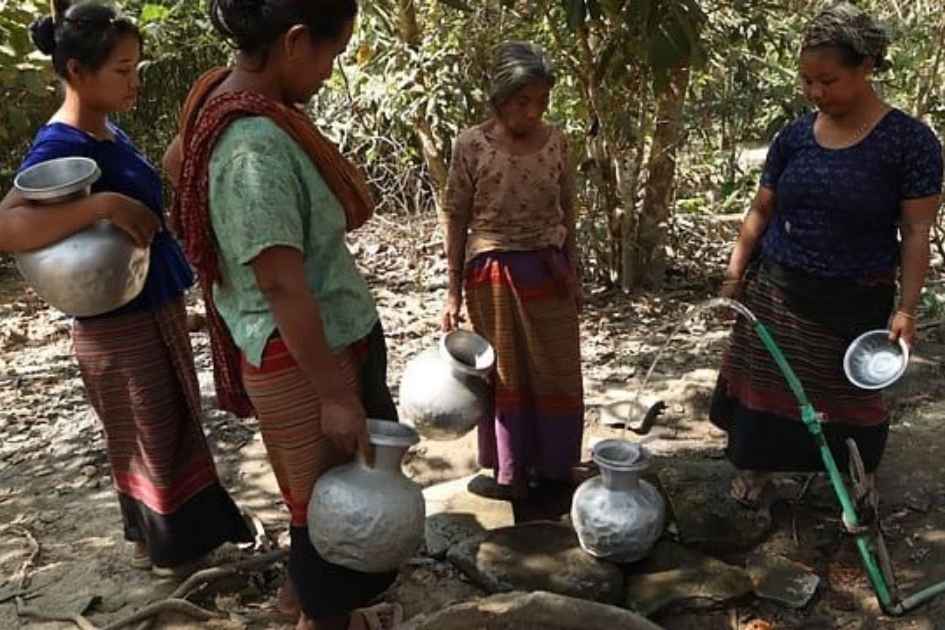



In remote Bandarban, the Tanchangya community of Shuknachari Para built a water pipeline, road and school with their own labor, showcasing self-reliance and locally led climate adaptation.
The Tanchangya indigenous community of Shuknachari Para has achieved what many thought impossible. Clean water, roads and a school have been built entirely with their own labor, resources and locally led community-based climate adaptation, without any government support.
Five years ago, women and children walked for hours along steep hill paths to collect water from small streams. Today, a community-built two-kilometer pipeline brings fresh mountain spring water directly to every home.
Binoti Bala Tanchangya, 61, said, “This water now comes straight to our courtyards. Five years ago, we struggled for every drop. No one helped us. We built it ourselves.” With water now accessible at home, residents, especially women and children, have regained hours of their day and hygiene has improved dramatically.
Shuknachari Para, about 30 kilometers from Bandarban Sadar in Ward 3 of Ruma Upazila, is home to 35 Tanchangya families. They practice traditional hill farming called jhum cultivation and rely on fruit orchards for their livelihoods. Surrounded by hills and dense forest, public infrastructure rarely reaches this remote village.
Nilboron Tanchangya, the village leader, said, “Our village is fully self-reliant. We have kept the tradition of independence alive while addressing our own climate challenges.”
The village stands as an example of community-led climate adaptation. Residents constructed a two-kilometer dirt road connecting their settlement to the main road. They built a bamboo primary school and a Buddhist monastery which also serves as a classroom. Water tanks installed at three points supply the village and each household contributes labor to maintain the system.
The community financed the project through small banana gardens and bamboo harvested from a 20-acre reserved forest. They earned around 400,000 BDT, approximately 4,300 US dollars. Nilboron Tanchangya said, “We used half the money to buy pipes and equipment and the rest to build a semi-permanent dining hall at the monastery. That hall now serves as our school.”
Before the pipeline, fetching water took two to three hours daily which limited bathing and household chores. Elderly residents and children suffered the most. The villagers laid the pipeline manually over one week with each family contributing labor and rotating maintenance responsibilities.
Mehla Ong Marma, Chairman of Ruma Union Parishad, said, “The people of Shuknachari are very united. They do not wait for the government to provide anything. They build the infrastructure for their own services and always try to remain self-sufficient.” Upazila engineer Tuhin Biswas said, “If the villagers request it, we are ready to assist in maintaining their water supply system.”
Shuknachari Para shows how a small remote community can transform its living conditions through locally led community-based climate adaptation, cooperation, innovation and determination. Binoti Bala said, “We have learned to solve our problems together. Now our children can go to school and we can have water at home every day.” Their story highlights community resilience, women’s empowerment and sustainable climate solutions, lessons that resonate far beyond Bangladesh.




