

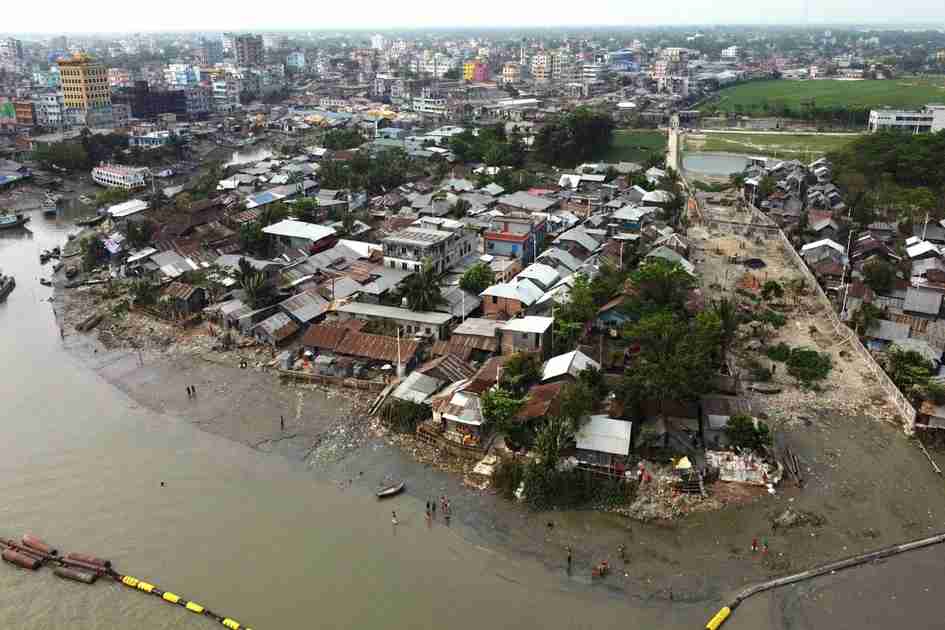



A scientific study finds Barishal is gradually sinking due to groundwater depletion and urban pressure, increasing future risks of flooding, water scarcity, climate vulnerability, and migration across southern Bangladesh.
Barishal, a major river port city in southern Bangladesh, is gradually sinking at an average rate of 1.66 millimeters per year, according to a multi-agency scientific study. Researchers caution that the low-lying urban landscape could, over time, approach sea level within the next 50 to 100 years if current trends persist, increasing the risk of chronic tidal flooding and long-term urban instability.
Experts emphasize that while the annual rate appears small, its cumulative impact, combined with rising sea levels driven by climate change, could significantly increase exposure to storm surges, waterlogging, and structural stress across the city’s infrastructure in the coming decades. They note that projections remain contingent on future groundwater use, land management, and climate trajectories.
The findings are based on a joint study by the Geological Survey of Bangladesh and Germany’s Federal Institute for Geosciences and Natural Resources, with support from the Japan International Cooperation Agency. The research combined satellite interferometry, borehole sampling, groundwater trend analysis, and field verification conducted between 2014 and 2020 across Barishal and surrounding areas.
Satellite Evidence Shows Ground Deformation and Localized Building Tilt
Officials from the Geological Survey of Bangladesh said the issue was first identified through satellite imagery, which detected vertical ground deformation in parts of the city.
A senior official said satellite analysis first indicated vertical deviations in several urban zones, including Bouddhopara, the BM College area, Bottola, and Karim Kutir.
“In simple terms, some structures appeared to show signs consistent with slight tilting. When field teams later visited these sites, they confirmed measurable ground-level deformation,” he said.
According to him, a newly constructed multi-storey building in the BM College area was also observed to have tilted several millimeters forward.
Researchers caution that while some cases may involve individual structural factors, similar patterns across multiple neighborhoods suggest broader ground movement rather than isolated construction defects.
Groundwater Depletion and Urban Pressure Identified as Key Drivers
Experts say two major factors are driving subsidence: unplanned urban expansion and excessive groundwater extraction.
They explain that the process occurs when long-term groundwater withdrawal reduces subsurface pressure, causing soil layers to compact.
“Decades of pumping water from underground have reduced the natural elasticity of subsurface layers,” an official said. “This creates voids beneath the ground and the upper soil gradually collapses to fill them.”
Heavy construction and rapid urbanization further intensify pressure on already compacting soils.
Officials from water and agricultural agencies say these findings align with long-term groundwater monitoring data showing a steady decline in water tables across the region.
Drinking Water Sources Pushed to Greater Depths
Muhammad Imran, Executive Engineer of the Department of Public Health Engineering, said access to safe drinking water has become increasingly difficult.
“There was a time when safe drinking water was available at depths of 700 to 800 feet,” he said.
“Now, depending on the area, tube wells often need to go down 1,000 to 1,100 feet to reach safe water,” he added.
Seasonal Groundwater Stress Worsening Over Time
Rabiul Islam, Assistant Engineer at the Department of Agricultural Extension, said monitoring shows a consistent downward trend in groundwater levels across seasons.
“During the monsoon season, groundwater can be found just 5 to 7 feet below the surface,” he said. “But in summer, even at depths of 30 to 40 feet, water is often unavailable.”
He added: “Eight to ten years ago, groundwater during summer was available at depths of 15 to 20 feet. Now it has dropped to 30 to 40 feet. The decline is continuing year by year.”
Daily Water Crisis Already Emerging in Some Areas
Dr. Mizanur Rahman, member secretary of Barishal civil society groups, said seasonal water stress is already affecting residents.
“Only a few years ago, tube-well water was easily available throughout the year,” he said. “But now, during Chaitra and Baishakh, there is severe water scarcity.”
In areas such as Raipasha Karapur and parts of Babuganj upazila, deep tube wells often fail during summer.
“People are simply unable to access groundwater,” he said.
He added that authorities are now exploring alternative surface water-based supply systems to reduce dependence on declining aquifers.
Experts Warn Slow Sinking Could Reshape the City’s Future
Human rights and environmental advocate Murad Ahmed said the measured subsidence, though small on an annual basis, becomes significant over longer time horizons.
“Individually, millimeters may not seem alarming, but over 50 to 100 years, the scale becomes serious,” he said.
“If this trend continues, the city’s surface level could increasingly align with sea level. Even normal high tides could then flood Barishal,” he warned.
“Storm surges and cyclones would then cause widespread damage. This is no longer a distant risk; it is a trajectory that needs urgent intervention,” he added.
What Is Manageable Today Could Become a Chronic Flooding Risk
Mohammad Anisur Rahman, Deputy Director of the Geological Survey of Bangladesh and lead researcher of the study, said the process is ongoing but not necessarily irreversible.
“We do not fully know how natural systems may behave in the future. Subsidence could slow down or stabilize,” he said.
“But currently, our data show a continuing downward trend. If this is not addressed now, what is manageable today could become a chronic flooding risk in the future,” he added.
He identified groundwater depletion as a key driver and urged a shift toward surface water use.
“Groundwater extraction must be reduced. People should be encouraged to use treated surface water from rivers, canals, and ponds,” he said. “Authorities must ensure proper treatment and supply systems, along with strict control of unplanned urban expansion.”
Climate Justice Dimension Highlighted by Youth Leaders
Sohanur Rahman, Executive Coordinator of YouthNet Global, said Barishal’s situation reflects a wider global inequality in climate impacts rooted in both physical and socio-economic vulnerability.
“Cities like Barishal are facing existential risks despite contributing very little to global emissions,” he said.
“This is fundamentally a climate justice issue linked to groundwater depletion, land subsidence, and rising sea-level pressures acting together. Without urgent investment in resilient infrastructure, sustainable water systems, and a just transition approach, millions in delta regions will remain exposed,” he added, calling for strengthened climate finance, adaptation planning, and loss-and-damage support.
Migration Pressure Linked to Climate Vulnerability
According to Bangladesh Bureau of Statistics (BBS) Census 2022 data, Barishal Division has the highest domestic migration rate to Dhaka, accounting for 18.62% of the capital’s migrant population.
A large majority of these migrants relocate to Dhaka’s slum areas due to severe Climate vulnerabilities, including river erosion, flooding, and economic stress across the coastal belt. Over time, this continuous flow of migration has significantly shaped the demographic and socio-economic landscape of Dhaka’s informal settlements, making people from Barishal one of the most prominent communities among the city’s urban poor.
A Slow Crisis Becoming Visible
Scientists caution that land subsidence is often invisible in daily life but accumulates steadily over time.
While Barishal continues to function as an active urban center today, researchers warn that continued groundwater depletion, unplanned development, and climate-driven sea-level rise could accelerate long-term sinking trends.
They emphasize that the trajectory remains manageable, but only if addressed early through coordinated water management, urban planning, and climate adaptation measures.
For now, the change is measured in millimeters. Over time, experts warn, those millimeters may define the city’s future relationship with rising seas.




