

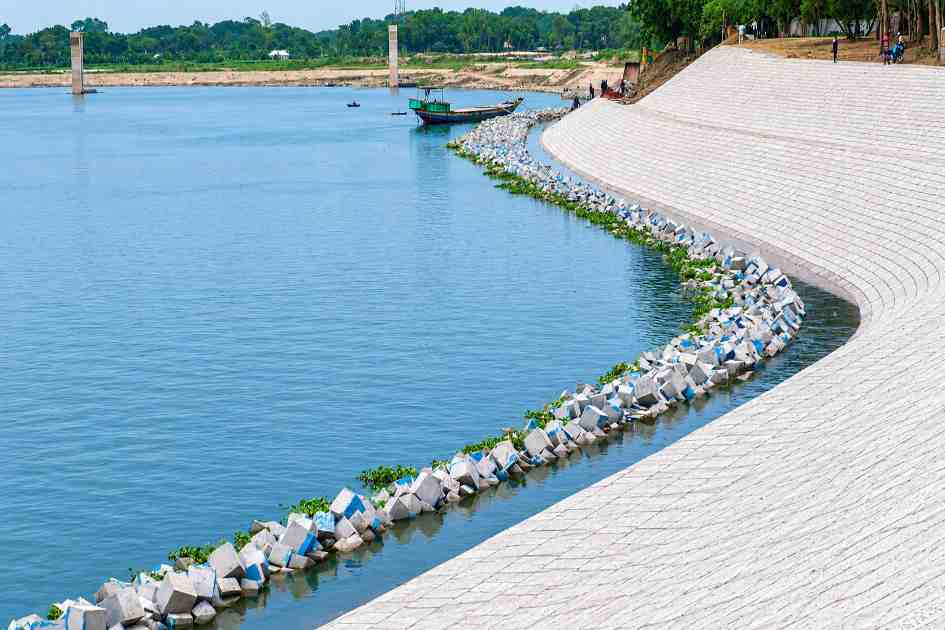



A permanent embankment along the Madhumati River is bringing long-awaited security to erosion-hit communities, protecting thousands of families, farmland and institutions while raising hopes for economic recovery and tourism.
Residents living along the banks of the Madhumati River in Bangladesh’s Faridpur district are celebrating a rare sense of security after a long-awaited permanent embankment project neared completion ahead of Eid, ending decades of fear over relentless river erosion.
For years, festive occasions were overshadowed by anxiety as powerful currents of the Madhumati swallowed villages, cropland and homes. Now, with around 90 percent of the embankment work completed, thousands of families in the erosion-prone areas of Madhukhali and Alfadanga upazilas say they can finally look toward the future without the constant threat of displacement.
The project, implemented by the Bangladesh Water Development Board (BWDB), has transformed what was once one of the region’s most persistent natural hazards. Residents say the permanent embankment has protected thousands of households, vast stretches of agricultural land and important institutions from further destruction.
Among the sites safeguarded by the project is the library and memorial museum dedicated to Bir Sreshtho Lance Nayek Munshi Abdur Rouf, which had been under threat from advancing river erosion.
For generations, the Madhumati River was synonymous with fear for communities living along its banks. Following the implementation of the government’s major infrastructure initiative, many residents now describe the river as a source of relief rather than anxiety.
Priya Akter, a riverbank resident, said she had been left destitute by repeated erosion.
“My home has been washed away five times by the river and I have lost all my farmland,” she said. “Now I am somehow living on the riverbank. With the construction of this embankment, we no longer have to worry. Whatever little we have left will be protected and we can live in peace.”
Another resident, Easmin Akter, said fear of losing everything had robbed her of sleep for years.
“I spent many nights awake, worried that the river could take everything at any moment,” she said. “Now we do not have to stay awake through the night. We are grateful to the government. Every Eid used to be marked by fear, but this year we celebrated peacefully and happily.”
Safayet Sheikh, a resident of Roufnagar village, said numerous settlements had disappeared from the map because of river erosion.
“Thousands of families have lost everything and become destitute,” he said. “Now whatever people still have can be protected. We are extremely happy. It is difficult to express our feelings in words. This embankment has given us hope to rebuild our lives.”
Kamar Khali Union Parishad Chairman Rakib Hossain Chowdhury Iran said the project had brought relief to communities living along the Madhumati.
“Thousands of families, agricultural lands and institutions were under threat from erosion,” he said. “We are all pleased with the construction of the embankment. Alongside the protection work, measures have also been taken to improve the area’s appearance.”
Authorities have installed permanent benches and shaded structures along the embankment and built modern stairways providing access to the river. The site is already attracting visitors from distant areas and is increasingly being viewed as a recreational destination rather than solely a flood protection structure.
BWDB Executive Engineer Md Rakib Hossain said approximately 90 percent of the work had already been completed.
The project began on July 1, 2023 and was originally scheduled for completion on June 30, 2027. However, officials expect the work to finish ahead of schedule.
The Tk 4.87 billion project involves the construction of 9.5 kilometres of permanent embankment at eight vulnerable points across Madhukhali and Alfadanga upazilas.
Hossain said landscaping and beautification efforts are also underway. Permanent benches and shaded seating areas have been installed and various tree saplings are being planted along the riverbank.
He added that authorities aim to develop the area into a full-fledged recreational destination in the future, allowing visitors from across the region to spend time along the protected riverfront while ensuring long-term protection for local communities.
Source: Somoynews.tv




