

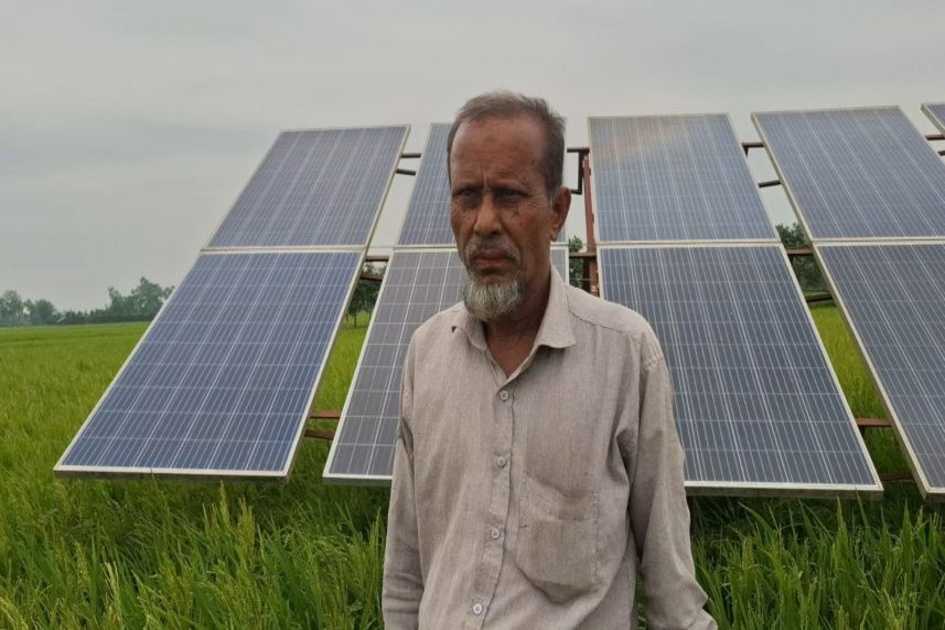



Self-taught innovator’s low-cost system helps rural communities cut diesel use and irrigation costs.
As diesel prices rise and power cuts continue to disrupt farming across Bangladesh, a self-taught mechanic in a remote northern village is driving a quiet shift toward solar-powered irrigation.
In Molani village under Thakurgaon Sadar upazila, Soleman Ali, widely known as “Solar-man Soleman”, has developed a portable solar irrigation system that is helping farmers reduce costs, ease dependence on fossil fuels and irrigate cropland using renewable energy.
In a country highly exposed to climate shocks and Energy insecurity, his grassroots innovation is being seen as a practical option for small and marginal farmers facing rising agricultural costs.
Bangladesh’s large-scale Boro rice cultivation depends heavily on irrigation during the dry season, with millions of pumps running on diesel and electricity. Frequent power outages and fuel price volatility have added pressure on rural livelihoods.
Bangladesh has more than 1.6 million irrigation pumps, many of them diesel-powered, underscoring the scale of the challenge.
Soleman’s solar-powered system offers an alternative.
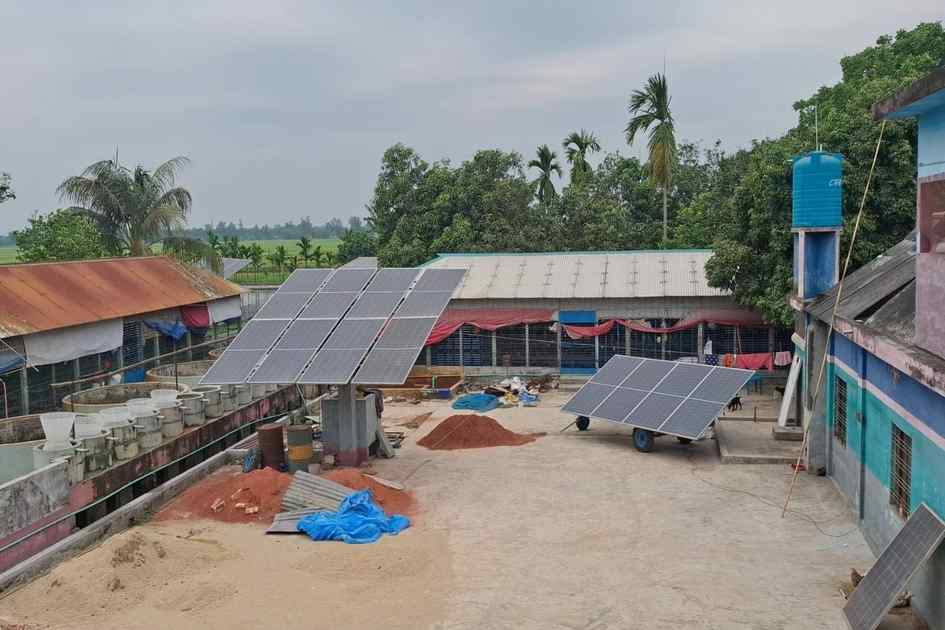
Mounted on wheels and powered entirely by solar panels, the device can be moved easily between fields while lifting groundwater for irrigation.
“I started with curiosity and necessity,” Soleman said while demonstrating the machine in the fields. “I wanted to find a cheaper and sustainable way for farmers to irrigate their land.”
Unable to study beyond first grade because of poverty, Soleman worked as a bicycle mechanic before teaching himself electrical and solar technologies through years of hands-on experimentation.
His journey into renewable energy innovation began in 2013 when he started assembling systems using discarded solar panels and locally available components. Without formal engineering training or institutional support, he spent years testing and refining his design.
Over time, he developed a fully mobile solar irrigation device with a gearbox that regulates water flow and an adjustable solar panel frame designed to track sunlight.
The machines range from 1,220 to 4,400 watts in capacity and cost between Tk 60,000 and Tk 210,000 ($500-$1,750).
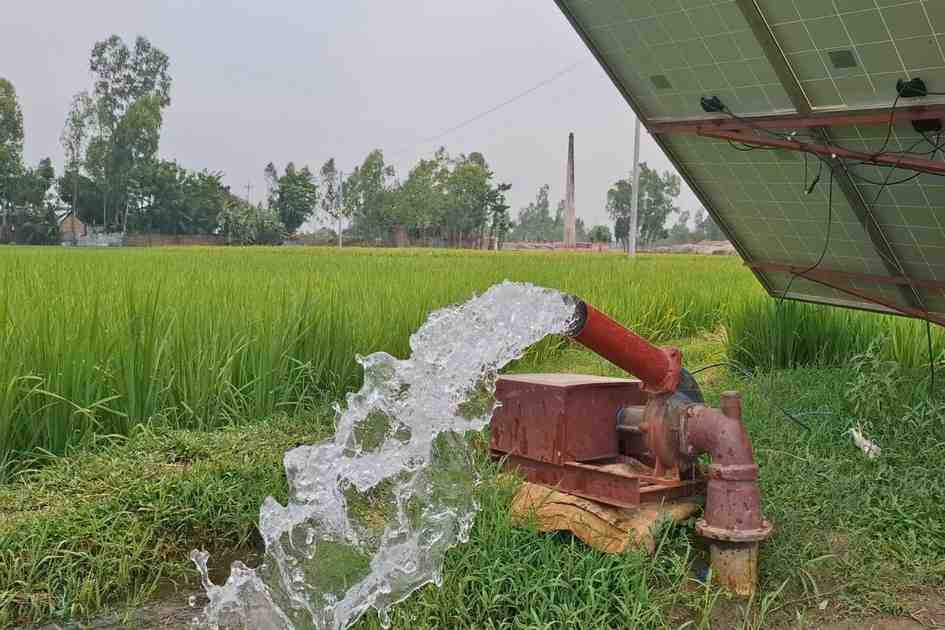
The most widely used version, a 2,440-watt system powered by four 610-watt solar panels, can pump about 700 litres of water per minute and irrigate up to 8-10 acres of Boro farmland per season.
Farmers say the technology is sharply reducing irrigation expenses.
Traditional irrigation using diesel pumps often costs Tk 7,000-8,000 per bigha. Soleman’s system cuts that to around Tk 2,500-3,000, reducing costs by more than half after installation.
Md Babar Ali, a farmer from Baliadangi in Thakurgaon, has used one of Soleman’s units for nearly four years.
“After the initial investment, I can irrigate my fields and even run my fish hatchery throughout the year without additional fuel costs,” he said.
Md Shaheen from Haripur purchased two units last year and now irrigates nearly 65 bighas of land at a significantly lower cost than conventional methods.
Demand for the systems is now spreading beyond Thakurgaon to districts including Panchagarh, Natore, Rangpur and Sunamganj.
So far, Soleman has built and sold more than 100 units, including 25 this year alone. He also earns income by renting out machines to local farmers.
But rising demand is becoming increasingly difficult to manage.
“I cannot keep up with all the orders,” he said.
His use of solar energy extends far beyond irrigation. He has adapted systems to run welding machines, livestock and poultry equipment, refrigerators, fans, lights and even air conditioners. His household now runs almost entirely on solar electricity.
Environmental advocates say Soleman’s work shows how frontline communities are already developing climate solutions without waiting for large-scale industrial or corporate intervention.
Sohanur Rahman, Executive Coordinator of YouthNet Global, said the example highlights the need for locally driven climate action and energy justice.
“A just transition cannot become corporate capture,” he said. “Local innovators like Soleman demonstrate that solutions already exist within frontline communities. Renewable energy must directly support farmers, reduce inequality and strengthen climate resilience.”
Agriculture officials also see potential for scaling the technology nationally.
Mazedul Islam, Deputy Director of the Department of Agricultural Extension, said wider adoption of solar irrigation could significantly reduce pressure on fossil fuels while ensuring affordable access for farmers.
The Eco Social Development Organization, a local NGO, has already distributed 18 units under agricultural projects, with 16 more scheduled for delivery.
As Bangladesh expands renewable energy and climate adaptation efforts, Soleman’s invention is emerging as more than a farming tool.
For many farmers facing rising fuel costs and worsening climate pressure, his machines are becoming an economic lifeline, offering a path toward cheaper, cleaner irrigation and greater resilience in an increasingly uncertain future.




