

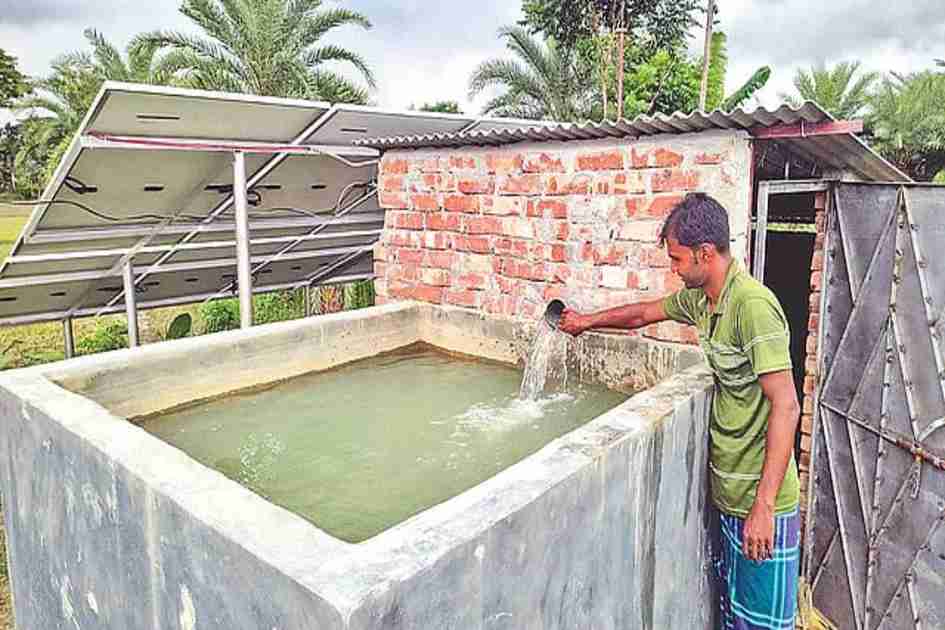



Backed by Nabolok Parishad and PKSF, a community-run system in Hayatpur is helping 42 farmers irrigate 50–60 bighas with lower costs and dependable water access.
As rising fuel prices and electricity shortages continue to increase farming costs across Bangladesh, a group of farmers in Jessore district is showing how renewable energy can offer a more affordable and climate-friendly future for agriculture.
Farmers are reducing irrigation expenses by almost half after adopting a community-managed solar irrigation system, replacing costly diesel-dependent water pumps with clean energy in Hayatpur village of Monirampur Upazila .
The initiative has not only lowered production costs but also reduced uncertainty over water availability during critical farming periods, offering a glimpse of how renewable energy can strengthen the resilience of rural communities facing economic and climate pressures.
During a visit to Hayatpur on July 30, a solar-powered irrigation pump was found operating at the centre of agricultural fields supplying water continuously to around 50–60 bighas of farmland. At least 42 farmers are currently benefiting from the system.
Farmers take ownership of clean energy solution
Unlike conventional irrigation systems often controlled by individual pump owners, the solar irrigation facility in Hayatpur is managed collectively by a 20-member farmers’ committee.
The installation cost of the system was Tk 800,000. Development organisation Nabolok Parishad, with financial support from the Palli Karma-Sahayak Foundation (PKSF), provided a 70 percent grant of Tk 560,000. The remaining Tk 250,000 was contributed by the farmers’ management committee.
Mahabur Rahman, treasurer of the committee, said the solar panels and motor came with a 24-year service warranty from the supplier, ensuring long-term reliability.
“Previously, farmers depended on diesel pumps, where rising fuel prices often increased irrigation costs. The solar system has made water supply more affordable and dependable,” he said.
Renewable energy supports climate-resilient farming
Bangladesh’s agricultural sector relies heavily on irrigation, making farmers vulnerable to fluctuations in diesel prices and electricity shortages. For many small holder farmers, energy costs have become a major challenge affecting farm profitability.
Climate advocates say expanding renewable energy-based irrigation could help reduce fossil fuel dependence, cut carbon emissions and support a just transition in agriculture by ensuring that vulnerable farming communities are not left behind.
Community ownership key to long-term success
Ibrahim Khalil, project manager of Nabolok Parishad, said the initiative was designed to create a sustainable, community-owned model.
“Farmers have contributed 30 percent of the cost so that they consider the pump their own asset and take responsibility for its maintenance. The system has been designed to operate for at least 20 years,” he said.
He added that 10 smaller solar irrigation pumps have also been installed in nearby fields, with each capable of providing irrigation support to 15–20 bighas of agricultural land.
Small village, wider energy transition lesson
The Hayatpur initiative reflects a broader shift taking place in climate-vulnerable countries like Bangladesh, where communities are exploring renewable energy solutions to address rising energy costs, food security challenges and climate impacts.
For farmers, the solar irrigation system is more than a technological upgrade. It represents a move towards cleaner energy, lower farming costs and greater control over their livelihoods.
As Bangladesh works to expand renewable energy and build climate resilience, community-led solutions like Hayatpur’s solar pump model could become an important pathway towards a fair and sustainable agricultural transition.




