

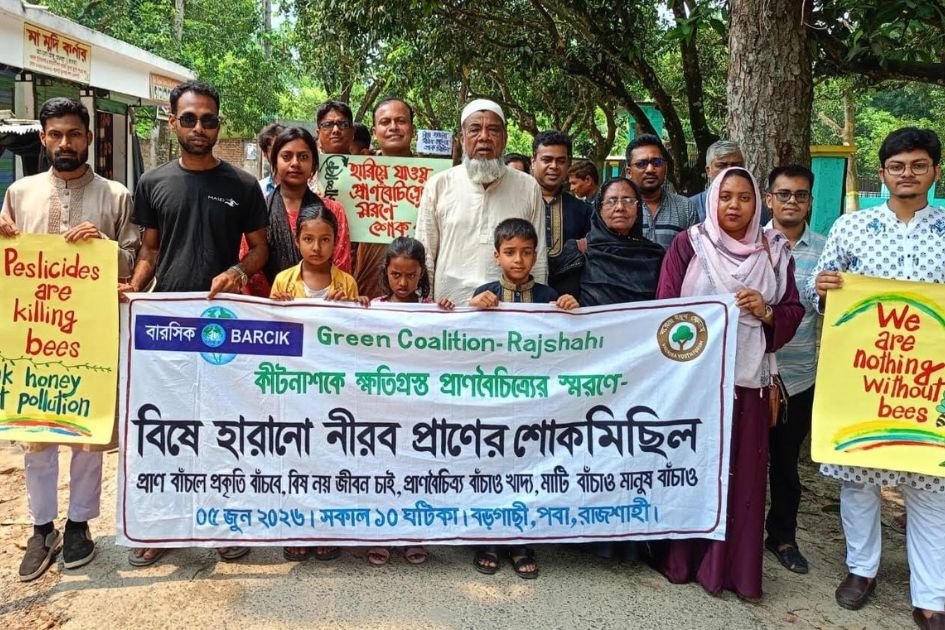



Farmers, activists and residents in Rajshahi held a silent march and memorial event on World Environment Day, highlighting biodiversity loss from pesticides and calling for agroecological farming and environmental justice.
Farmers, environmental activists, teachers, students and local residents gathered in Rajshahi, a metropolitan city in northwestern Bangladesh, on Friday (June 5) to mourn the loss of beneficial species increasingly threatened by pesticide use, joining a unique awareness campaign titled “Silent March and Memorial Meeting for the Silent Lives Lost to Poison.”
The event was held under the shade of a century-old mango tree in the Schoolpara area of Boro Gachhi village in Paba upazila to mark World Environment Day. It was jointly organized by development research organization BARCIK, Barendra Youth Forum and Green Coalition-Rajshahi.
Participants said the programme was dedicated to the memory of soil microorganisms, bees, butterflies, birds, frogs, fish, earthworms, plants and other beneficial species that are disappearing due to excessive pesticide use.
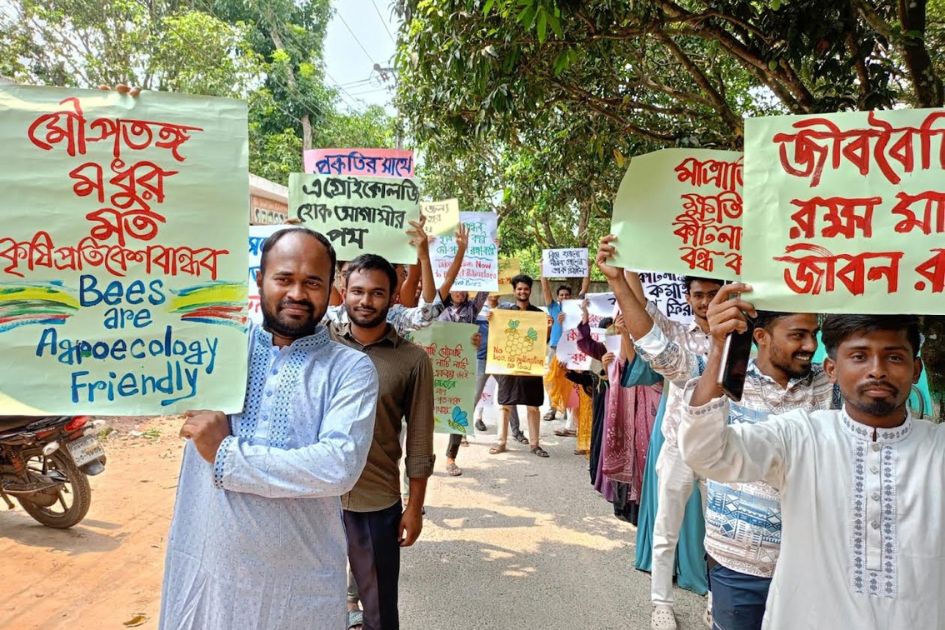
The event began with a silent march in which farmers, youths, teachers, poets, writers, environmental campaigners and local community members carried placards and chanted slogans including “Nature survives when life survives,” “We want life, not poison,” “Save biodiversity, save food” and “Save the soil, save people.”
A one-minute silence was observed in memory of biodiversity damaged or lost due to pesticide use. Participants later planted saplings of banyan and Pakur trees.
Following the tribute, organizers staged an eco-theatre performance featuring 24 participants portraying different elements of nature and biodiversity. The symbolic characters included pollinators, forests, fireflies, rivers, soil, farmland, indigenous seeds, earthworms, birds, butterflies, frogs, native fish, rainwater, wetlands, air, groundwater, soil microorganisms, farmers, the Barind region and future generations.
Through individual performances, the participants described how pesticides, pollution and environmental destruction are threatening their existence and affecting human life.
Tamim Tuli, portraying a river, said, “I am not just water; I carry history, civilization and life. When a river dies, people lose not only water but also fish, agriculture, culture and livelihoods. If rivers survive, people survive. If rivers die, civilization will eventually dry up as well.”
Playing the role of soil, Sohel Rana said excessive use of chemical fertilizers and pesticides was destroying countless microorganisms living beneath the surface.
“When the soil becomes sick, agriculture and the food system become sick as well,” he said.
Umme Fatema Tuz Johora, portraying a butterfly, said the disappearance of butterflies represented more than the loss of a beautiful species.
“It signals a major crisis in pollination and ecological balance,” she said.
Rabiul Hasan Mintu, acting as a frog, said frogs help farmers by consuming harmful insects that damage crops.
“Yet today my own existence is under threat because of toxic pesticides,” he said.
Representing future generations, Rashed Khan Milon said, “We will bear the consequences of today’s environmental destruction. A safe planet, clean water and a biodiversity-rich environment are our rights.”
At the conclusion of the performances, Md Atikur Rahman appeared as the “Lawyer of Nature” and delivered a closing argument on behalf of all characters.
“Every component of nature has the right to survive,” he said. “By destroying the environment, we are endangering our own future. Sustainable development is impossible without environmental justice. Every living being has the right to live in a healthy and dignified environment.”
BARCIK researcher and regional coordinator Shahidul Islam later read out a declaration calling for biodiversity conservation, environmentally friendly agriculture, protection of rivers and wetlands, reduced dependence on chemicals and the establishment of environmental justice.
The programme also featured speeches by Md Shahinul Islam, regional manager of UCEP Bangladesh; Md Mahmudul Haque, president of the Boro Gachhi Eidgah Field Committee and a retired teacher; and Jewel Kibria, associate professor of Bangla at Rajshahi College.
The speakers said every species and natural element plays an essential role in maintaining ecological balance. They warned that excessive and uncontrolled pesticide use in agriculture is harming bees, butterflies, birds, frogs, fish, earthworms and soil microorganisms.
They stressed that pesticide dependence must be reduced and agroecology and environmentally friendly farming practices promoted to ensure safe food production, protect farmers’ health and conserve the environment.
In the final segment of the programme, participants took part in a collective pledge titled “United Commitment to Protect the Earth,” led by Rahima Khatun, president of the Green Coalition Paba Upazila branch.
The pledge included commitments to protect rivers, agricultural land, forests, pollinators, ponds, wetlands and other ecosystems; discourage harmful pesticide and chemical use; promote environmentally friendly farming and environmental justice; and preserve a livable planet for future generations.
Participants declared: “The Earth does not belong to us; we are part of the Earth.”
Farmers, students, environmental activists and local residents attending the programme expressed strong support for biodiversity conservation, safe food production and the expansion of agroecological and chemical-free farming systems.
Organizers said the struggle to protect the environment and biodiversity is not only about saving nature but also about safeguarding human existence and the security of future generations.




