




Civic groups say Satkhira’s urban poor face insecure housing, poor services and eviction risks despite their essential role in the municipality’s daily economy.
One in four residents of Satkhira municipality in southwestern Bangladesh is a climate-displaced person or low-income slum dweller, citizens’ leaders said Thursday as they placed an eight-point demand for housing and protection from climate disasters.
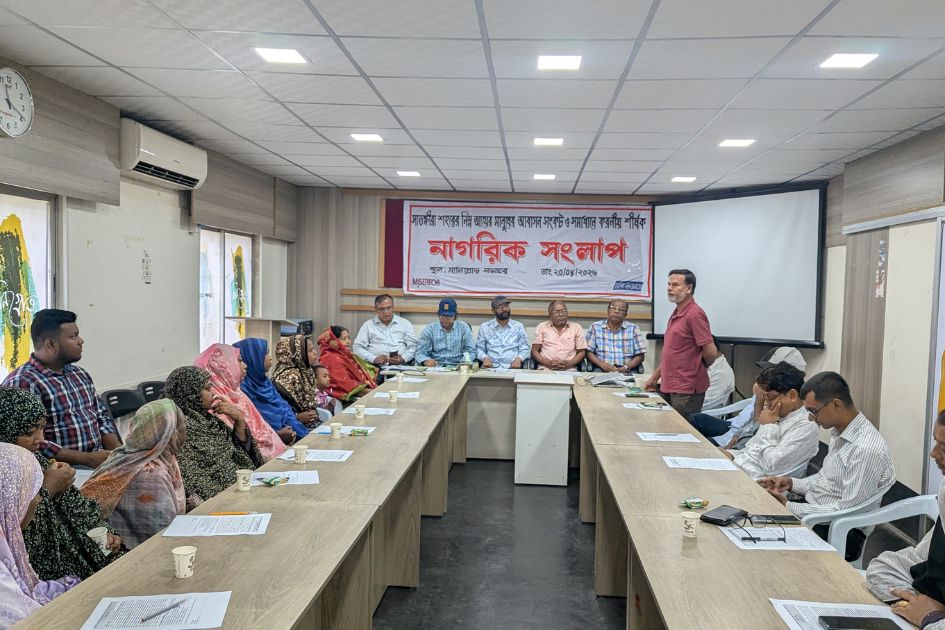
The demands were made at a civic dialogue titled “What should be done to solve the housing crisis of low-income landless slum dwellers in Satkhira,” organised by the Bangladesh Resource Center for Indigenous Knowledge or BARCIK, at the Mangrove auditorium in Satkhira town at 11:30am.
The dialogue was chaired by Abu Affan Rose Babu, president of Green Coalition Satkhira. BARCIK programme officer Gazi Mahida Mizan presented the concept paper.
The paper said the coastal district of Satkhira is highly vulnerable to climate change. Every year, people made destitute by natural disasters move to the town in search of livelihoods.
It said around 50,000 people among the town’s nearly 200,000 residents are low-income pavement dwellers, shack dwellers and slum dwellers. This means one in four people in the town is living in deep uncertainty as a climate-displaced person.
Although this large population keeps the town running by working in waste management, transport, domestic work and construction, they are routinely ignored in urban development planning, the paper said.
It also said that in 2024, 104 families from the Itagacha slum were evicted without rehabilitation on the pretext of widening the Satkhira-Shyamnagar road. The families have since been living in inhumane conditions under the open sky for a long time.
Citizens’ leaders told the dialogue that slum dwellers suffer from various complex diseases because they live in hostile environments and spend about 30 percent of their income on medical treatment.
They said planned development that includes the urban poor is essential to uphold constitutional rights and achieve the Sustainable Development Goals.
Speakers at the dialogue included citizens’ leaders Kalyan Banerjee, Pabitra Mohan Dash, Kishori Mohan Sarkar, Madhab Chandra Datta, M Kamruzzaman, Mostafizur Rahman Ujjal, Golam Sarwar, Ali Nur Khan Babul and Siddiqur Rahman.
Others who spoke included BARCIK regional coordinator Md Shahin Islam, cultural activist Dilruba Ruby, development worker Sakibur Rahman Babla, Green Coalition joint general secretary SM Biplob Hosen, executive members Md Hosen Ali and Hriday Mondal and Samakal district correspondent Kishor Kumar.
Kumaresh Sarkar from Rajar Bagan Rishipara, Jobeda Khatun and Mazeda Khatun from Itagacha slum also spoke on behalf of slum dwellers.
The dialogue demanded safe and disaster-resilient housing for poor slum dwellers, including the 104 evicted families, permanent measures to end urban waterlogging, and subsidised access to safe drinking water, electricity and sanitation services in slums.
It also called for the children of slum dwellers to be brought under technical education, an end to any eviction without alternative rehabilitation, free education and healthcare for poor children in slums, year-round access to subsidised food items and the building of a planned, pro-poor city in line with government commitments.




