

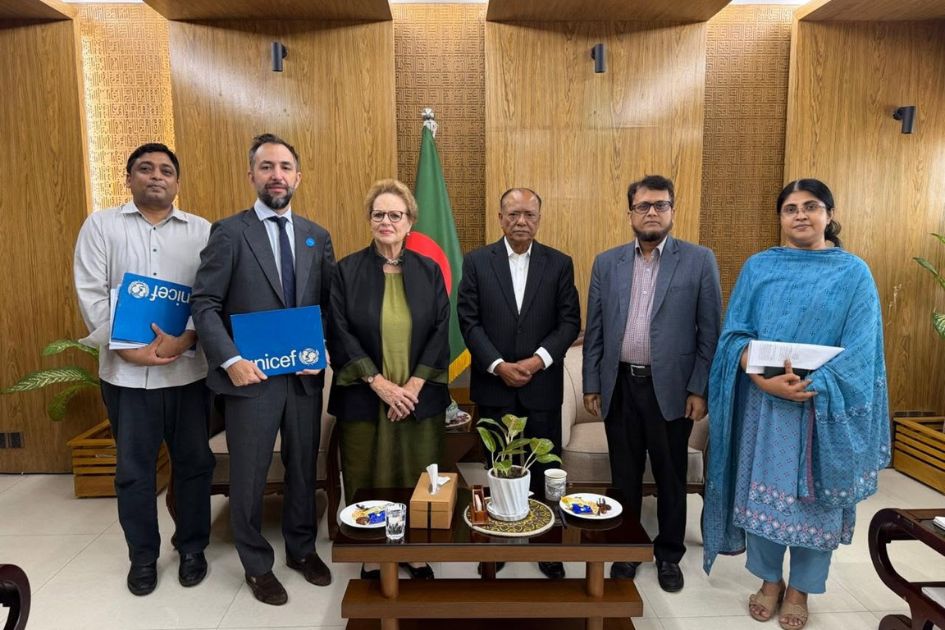



Bangladesh and UNICEF will jointly develop district-level climate risk tools while expanding efforts to make essential services, schools and health facilities more climate-resilient.
Bangladesh and UNICEF discussed measures to protect children and adolescents from the impacts of climate change and make essential social services, including education, health, nutrition, water, sanitation and hygiene, more climate-resilient, the environment ministry said Wednesday.
UNICEF Bangladesh Representative ad interim Gillian Mellsop met Environment, Forest and Climate Change Minister Abdul Awal Mintoo at his office in Bangladesh Secretariat in Dhaka, where they also discussed efforts to protect children from lead pollution and other forms of pollution.
Mintoo said children and young people were “the architects of a climate-resilient Bangladesh, both today and in the future” and should therefore be given priority in climate action plans.
He said the ministry was working to implement the plans in accordance with the special directives of the prime minister.
Mellsop thanked the minister following the Cabinet’s approval of the National Strategy and Multi-Year Action Plan for a Lead-Free Bangladesh (2026-2035) and assured him of UNICEF’s full cooperation in implementing the action plan.
Bangladesh has continued to play a leading role internationally in addressing climate-related risks, according to the ministry. Although children bear no responsibility for causing the climate crisis, they are among its greatest victims.
A recent UNICEF report found that approximately 58.8 million children in Bangladesh are exposed to at least one climate-related hazard, while nearly nine out of every 10 children face three or more hazards simultaneously.
Based on government-approved data, the ministry and UNICEF will jointly develop a district-level Children’s Climate Risk Index (CCRI) and Climate Landscape Analysis for Children (CLAC). The tools are intended to identify the most vulnerable districts and support targeted investment planning in climate adaptation and other climate-related sectors.
UNICEF is supporting the inclusion of children and adolescents in plans to implement Bangladesh’s Nationally Determined Contribution (NDC 3.0) to reduce carbon emissions. The support covers education, health and nutrition, water, sanitation and hygiene sectors in coordination with the Department of Environment and relevant ministries.
UNICEF will also continue supporting assessments of the potential for rooftop solar power installations at government schools and health facilities.
The Environment, Forest and Climate Change Ministry will continue supporting UNICEF and relevant ministries in developing models for environmentally friendly and disaster-resilient schools, the ministry said.
The meeting also covered the incorporation of climate and environmental education into the national curriculum, the organisation of the Youth Climate Negotiators Fellowship and Youth Climate Summit and increased participation of student and adolescent networks in the national tree-planting programme.
The participants reaffirmed their commitment to strengthening partnerships with development partners to ensure a safe and habitable Bangladesh for future generations.
Dr Md Saidur Rahman, additional secretary of the ministry’s Environment Pollution Control and Law Wing, along with relevant officials from UNICEF Bangladesh and the ministry, attended the meeting.




