

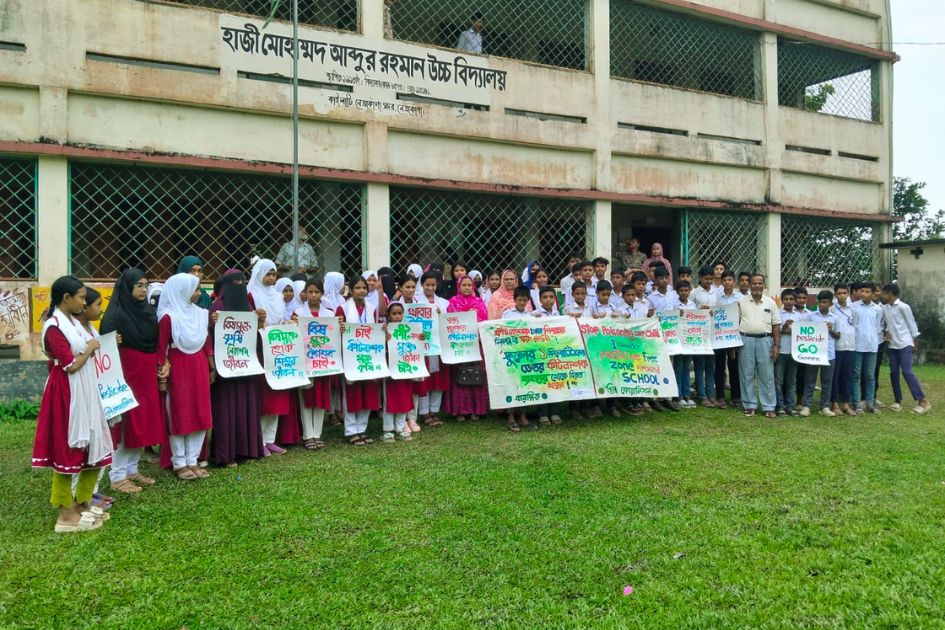



Backed by BARCIK and Green Coalition Committee, the school campaign urges farmers and residents to protect children, soil and water by avoiding harmful pesticide use near classrooms.
Students and teachers at a school in Bangladesh’s northern Netrokona district have called for a one-kilometre pesticide-free zone around educational institutions, warning that the uncontrolled use of hazardous pesticides and pest-control chemicals is damaging crops, soil, water and the wider environment.
The campaign, supported by the private research organisation BARCIK and organised by the Green Coalition Committee, aims to stop all harmful pesticide use within at least one kilometre of schools to protect children and ensure a safer, poison-free future for the next generation.
As part of the initiative, students of Kailati Haji Abdul Hamid High School in Netrokona organised an unusual and lively awareness programme, carrying handmade placards and banners to urge local farmers and people from all walks of life not to apply pesticides within a one-kilometre radius of the school.
The campaign called for children to be able to grow up in an environment free from the effects of chemical poisons. It also urged the creation of a school-based safety zone by declaring the one-kilometre area around educational institutions completely pesticide-free to protect the environment and public health.
Campaigners also called for wider use of environment-friendly and organic farming methods instead of harmful pest-control chemicals, saying such steps would help preserve soil and water quality and protect future generations from serious diseases such as cancer.
After the rally and awareness sit-in, the school’s head teacher, Khalilur Rahman Palash, said students wanted to grow up in a healthy and normal environment, not in fear of chemical poisons.
“We will request local guardians, teachers and residents not to use any pesticide within one kilometre around the educational institution,” he said.




