

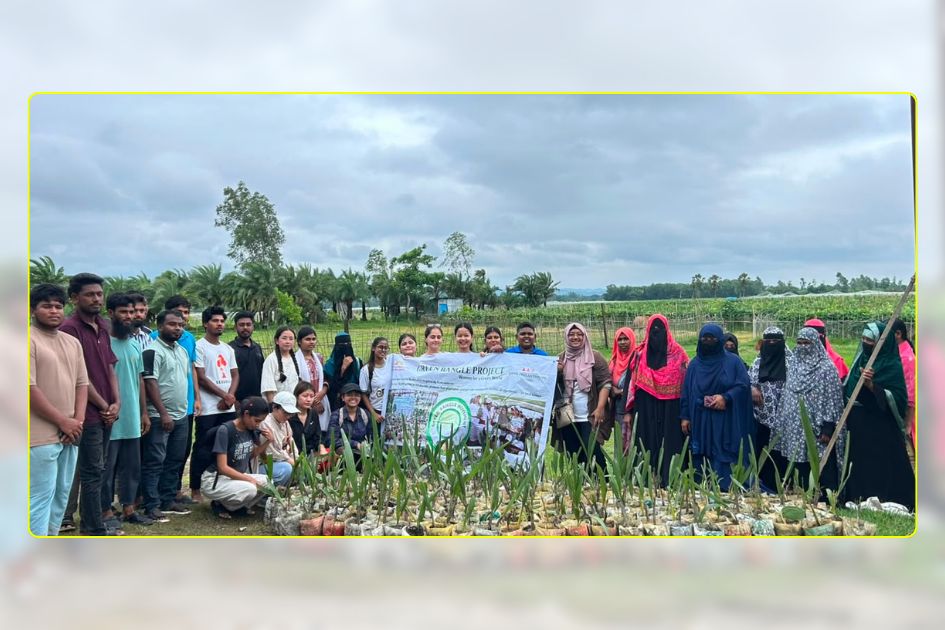



Women-run nurseries and student volunteers helped link shoreline protection with income opportunities, using salt-tolerant palms suited to Guliakhali’s sandy, wind-exposed coastal conditions and long-term restoration needs.
A community-led coastal restoration drive has planted 1,000 palm saplings at Guliakhali Beach in Sitakunda, Chattogram, bringing together local women, university students, staff and community members to strengthen the area’s coastal green belt.
The Green Bangle Project, an environmental initiative under the Asian University for Women, carried out the plantation on August 18, 2026, at the Guliakhali Embankment area in Sitakunda, a coastal upazila of Chattogram in south-eastern Bangladesh.
Organisers said 500 Palmyra palm saplings or Borassus flabellifer were planted from the project’s own nursery, along with 500 sugar date palm saplings, or Phoenix sylvestris and a large quantity of sugar date seeds contributed by the Sitakunda Local Women’s Home Nursery.
The plantation brought together 10 local women from Guliakhali, 24 AUW students and staff members and 10 local student participants, reflecting the project’s focus on community-based environmental restoration.
The Green Bangle Project said the involvement of local women, many of whom have received training through its ongoing capacity-building programmes, showed how ecological restoration could be linked with women’s empowerment and local livelihoods.
Participants worked across the plantation area, digging, planting and securing saplings under guidance from the project’s field team. Local women also shared traditional ecological knowledge connected to land stewardship in the Guliakhali region.
The participation of AUW students and staff alongside local schoolchildren created an intergenerational and cross-community exchange, with university volunteers learning planting techniques directly from experienced women in Guliakhali.
A key part of the plantation was the contribution from the Sitakunda Local Women’s Home Nursery, which supplied 500 sugar date saplings and a large quantity of sugar date seeds.
The nursery is run and maintained by local women, who cultivate and prepare saplings from their homes before they are transplanted to Green Bangle Project restoration sites.
Organisers said the home nursery model provides income for women, who grow sugar date saplings from seed in their homesteads and tend them over several months before selling or contributing them to plantation initiatives.
The same work also supports environmental restoration, as saplings raised from seed are later replanted along the coastline, contributing to reforestation, soil stabilisation and the ecological recovery of the Guliakhali shoreline.
The project said women involved in the nursery are helping regenerate the landscape they depend on while earning income through their labour.
Palmyra and sugar date palms were selected because of their resilience in the coastal conditions of Guliakhali, organisers said.
Both species can tolerate high salinity, withstand strong coastal winds and develop deep root systems that help stabilise sandy and erosion-prone soil.
The palms also have economic and cultural value for local communities, with sap collection, leaf-based handicrafts and fruit yields offering potential livelihood benefits to women and families who tend them.
Organisers said the plantation therefore serves both ecological and economic goals by helping protect the shoreline while creating long-term livelihood opportunities linked to the restored landscape.




