

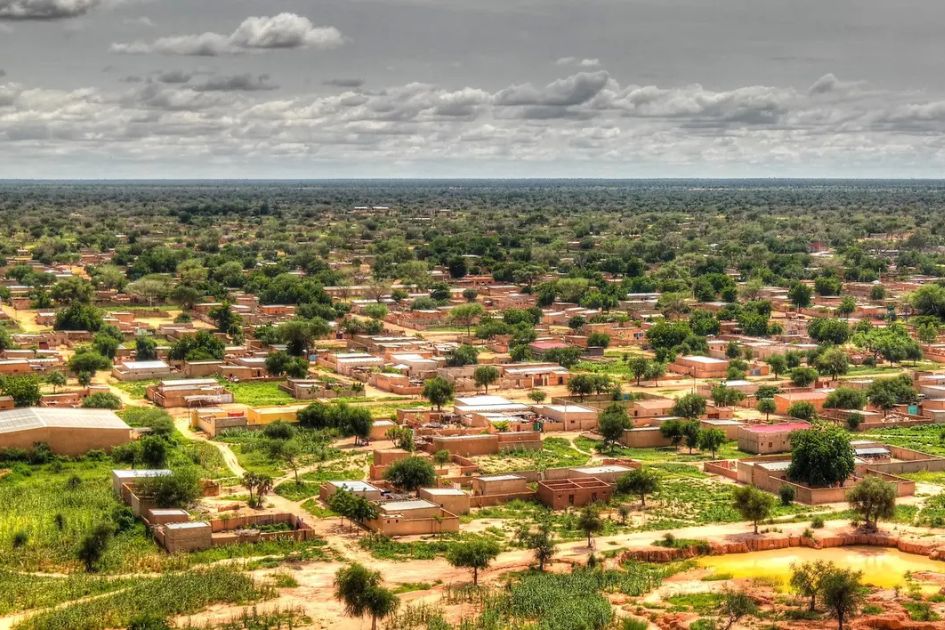



Scientists say rising groundwater, revived wadis and an expanding Lake Chad could reshape farming prospects, even as stronger storms bring worsening flood risks across the Sahel.
Water is returning across large parts of Africa’s Sahel after decades of drought with groundwater levels rising, Lake Chad expanding and previously dry landscapes holding more water as stronger and increasingly intense monsoon rains sweep the region.
Wells are refilling and water tables have risen by 13 feet or more in some places. Farmers are gaining access to irrigation water for the first time in decades, new trees are being nurtured on agricultural land and near-extinct wildlife, including the scimitar-horned oryx, is returning.
The revival is transforming a region long associated with drought and famine. But hydrologists say the increase in rainfall alone does not fully explain the recovery. Changes in land use, traditional rainwater harvesting, efforts such as the Great Green Wall and declining water withdrawals from some rivers may also be contributing.
The shift began in the 1990s and has accelerated during the past five years.
“Across the Sahel, from Ethiopia to Senegal, we have evidence of increased terrestrial water storage,” said Richard Taylor, a hydrogeologist at University College London who has led teams studying links between climate, land use and groundwater recharge in the region.
The Sahel’s late 20th century droughts left soils hardened by intense sun. Now, erratic but extreme rainfall is returning to the semi-arid belt, triggering deadly floods but also replenishing rivers, filling desert depressions, restoring water to dry riverbeds known as wadis and sending runoff from impermeable soils into underground aquifers.
Scientists are discussing whether the strengthening West African monsoon could place the Sahel on the threshold of a new humid era.
Researchers say the increase in rainfall since the severe droughts of the 1970s and 1980s explains only part of the transformation. Changes to the land surface may also be influencing the recovery, ranging from the internationally funded Great Green Wall and renewed use of traditional water-harvesting practices to disruption caused by jihadist militants that has led to the abandonment of irrigation schemes that once removed water from rivers.
Much remains uncertain in the remote region along the southern edge of the Sahara Desert. But climate scientists expect the broader trend towards greater and more extreme rainfall to continue during the 21st century. With underground water reserves recovering, some researchers see the possibility of an agricultural renaissance.
The Sahel is a semi-arid belt around 500 miles wide stretching across North Africa from Senegal in the west to Ethiopia in the east. More than 150 million people live in the region, which forms a transition between the Sahara Desert to the north and savanna grasslands and coastal forests to the south.
Water has always been central to survival there. Rainfall has remained sporadic and unpredictable since the end of a humid period around 5,000 years ago.
The amount of rain reaching the Sahel is largely determined by the West African monsoon, a moisture-laden wind moving northwards from the Gulf of Guinea between June and September. Hydrologists say whether the monsoon reaches the 15th parallel north of the equator or stalls at the 10th parallel can determine whether communities experience a successful year or a failed harvest.
During the late 20th century droughts, when the monsoon repeatedly failed to penetrate far enough north, as many as a million people died from hunger and disease.
Conditions are now changing.
Wildlife has begun to benefit in some areas. Wadi systems are reviving in Chad’s Ouadi Rimé-Ouadi Achim nature reserve, where conservationists have recorded rising populations of aardvarks, porcupines, badgers and foxes.
The reserve has also seen the successful reintroduction of the scimitar-horned oryx. Once declared extinct in the wild, the species now numbers more than 600 individuals.
Elsewhere, West African giraffes are feeding on increasingly green vegetation in areas from which they had previously disappeared.
Farmers are also responding to wetter conditions.
In southern Niger, agricultural communities have increased crop production while encouraging the natural regeneration of about 200 million trees on land that was previously treeless, according to former World Resources Institute geographer Chris Reij.
Farmers in Chad, Niger and Cameroon are also restoring small-scale irrigation by tapping groundwater around recovering oases, supported by new aid initiatives including the World Bank’s regional recovery programme PROLAC.
Achta, a farmer in Chad, said last year that the change in water availability had transformed agricultural prospects.
In the past, she said, there had not been sufficient water to irrigate crops and harvests had been poor. She now has enough water to cultivate four times as much land and has doubled her onion production.
The World Bank said her experience reflected a wider transformation across the Lake Chad basin.
Across much of the Sahel, rainfall is not only increasing but is increasingly concentrated in powerful downpours associated with clusters of thunderstorms known to meteorologists as Mesoscale Convective Systems.
These storm systems, which periodically develop during the monsoon season, produce most of the Sahel’s rainfall and are now considered among the most powerful storm clusters on Earth.
A recent analysis found that the frequency of extreme storms has tripled since the 1980s.
Scientists have linked the rainfall revival to changes in temperatures over the North Atlantic.
An assessment published in 2021 by the United Nations’ Intergovernmental Panel on Climate Change found “high confidence” among climate scientists that the change results from strong warming in the North Atlantic driven by a combination of global heating and declining sulphate aerosol pollution from coal burning in Europe and North America.
Those aerosols previously created a thin atmospheric haze that cooled the ocean. Researchers say the cooling helped prevent the West African monsoon from migrating north into the Sahel, contributing to drought.
As sulphate pollution declined, the North Atlantic warmed, drawing the monsoon back towards the Sahel and strengthening its capacity to produce intense rainfall.
The consequences are not entirely beneficial.
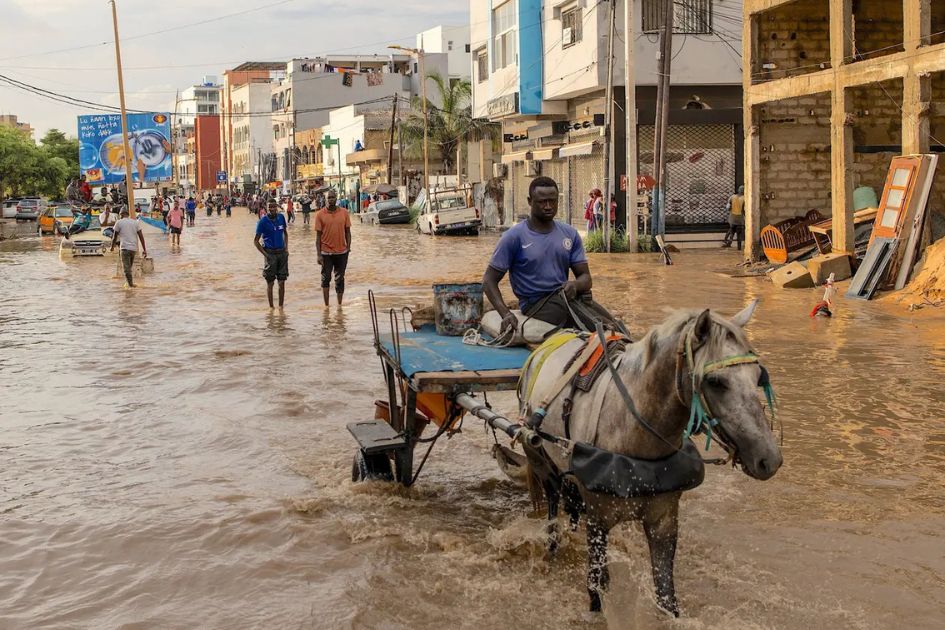
Dakar, Senegal, experienced flooding following heavy monsoon rains in August 2022, illustrating the increasing challenge posed by severe downpours.
Niger, among the world’s 10 poorest countries, lost tens of thousands of people to famine during the late 20th century droughts. It now records more deaths from floods than droughts.
During the 2024 monsoon, powerful storms inundated Niamey, Niger’s capital. In rural parts of the country, flooding destroyed more than 150,000 mud-brick homes.
Although intense rainfall can initially be destructive, hydrologists say it can significantly benefit underground water supplies.
When heavy rain falls on compacted land, much of it does not immediately soak into the soil. Instead, water rapidly runs towards rivers and dry wadis, where it can move into aquifers.
Hydrologists say this indirect form of infiltration becomes particularly important during the heaviest storms.
“In some locations, rainfall intensity is more important than the annual rainfall amount in determining the magnitude of groundwater recharge,” Taylor said.
He said the growing intensity of rainfall is a major factor behind rapidly rising water tables, particularly because much of the Sahel’s water does not drain towards the ocean but instead flows inland into lakes and depressions.
Researchers are observing the consequences across the landscape.
New ponds are appearing on previously arid land while ancient wadi networks are being restored. Taylor’s research network has also documented wells refilling across the region.
Average water tables across much of Niger have risen by about 13 feet, indicating an estimated 15 percent increase in aquifer reserves.
Satellite observations are supporting the findings from the ground.
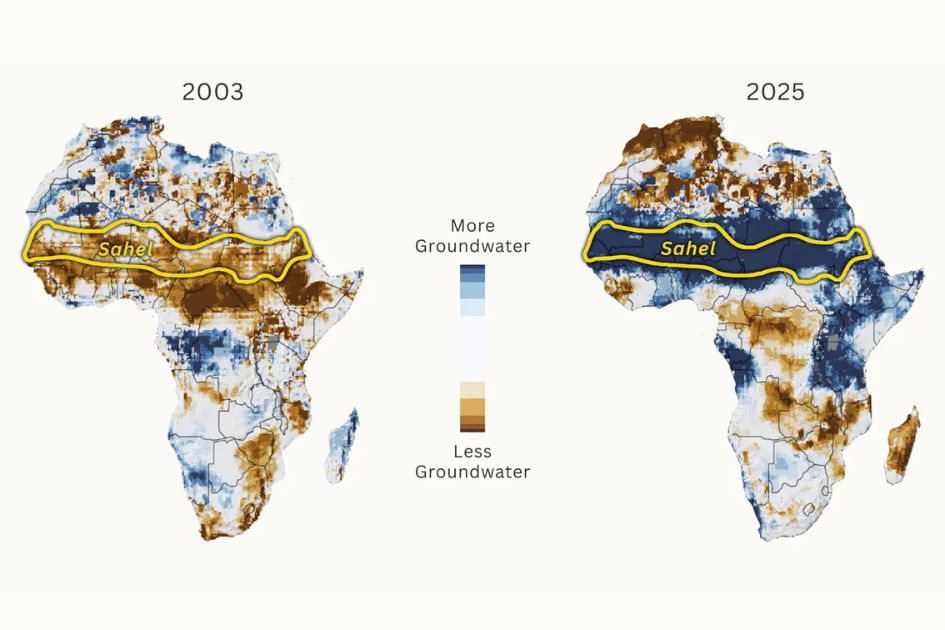
NASA’s Gravity Recovery and Climate Experiment mission measures changes in land mass by detecting small variations in gravitational force. Over the past two decades, it has recorded a sharp rise in gravitational force across the Sahel, which hydrologists attribute to increasing terrestrial water storage.
Measurements of shallow groundwater storage in February 2003 and February 2025, compared with the average between 1948 and 2012, illustrate the change.
Researchers nevertheless caution that rainfall volume and storm intensity provide only part of the explanation.
Changes in the landscape may also affect how much water is retained.
Environmentalists have long argued that expanding agriculture in the Sahel during the 20th century contributed to desertification by removing natural vegetation, degrading soils and allowing desert sands to advance.
From a hydrological perspective, however, some agricultural changes may have had the opposite effect because certain crops allow soils to retain more moisture.
All vegetation draws water from soil and releases it into the atmosphere through transpiration. But shallow-rooted African grains such as millet and sorghum transpire less water than the deeper-rooted grasses they replace, leaving more moisture in the ground.
Changes caused by prolonged drought may also have increased runoff.
Soil crusting driven by drought has increased runoff by around 50 percent in the central Sahel in recent decades, according to research by Christophe Peugeot, a hydrologist at the HydroSciences laboratory at the University of Montpellier in France.
Peugeot found that drought had permanently altered the region’s soils, helping fuel the floods occurring today.
Much of that runoff eventually reaches Lake Chad, which lies along the borders of Nigeria, Cameroon, Chad and Niger.
The lake drains an area almost six times the size of California and was once one of Africa’s largest bodies of water. Its dramatic contraction became one of the most recognisable symbols of the Sahel’s late 20th century hydrological decline.
The less widely recognised development is that Lake Chad is now recovering as water inflows increase.
Hydrogeologists at the University of N’Djamena in Chad reported that the lake expanded in 2024 to a peak of more than 9,000 square miles. That was almost as large as it had been during the 1960s and 10 times its size in the mid-1980s.
Researchers say the recovery is partly hidden in satellite imagery because extensive areas of the lake are covered by saturated vegetation.
As the lake expands, the aquifer beneath it is also being replenished.
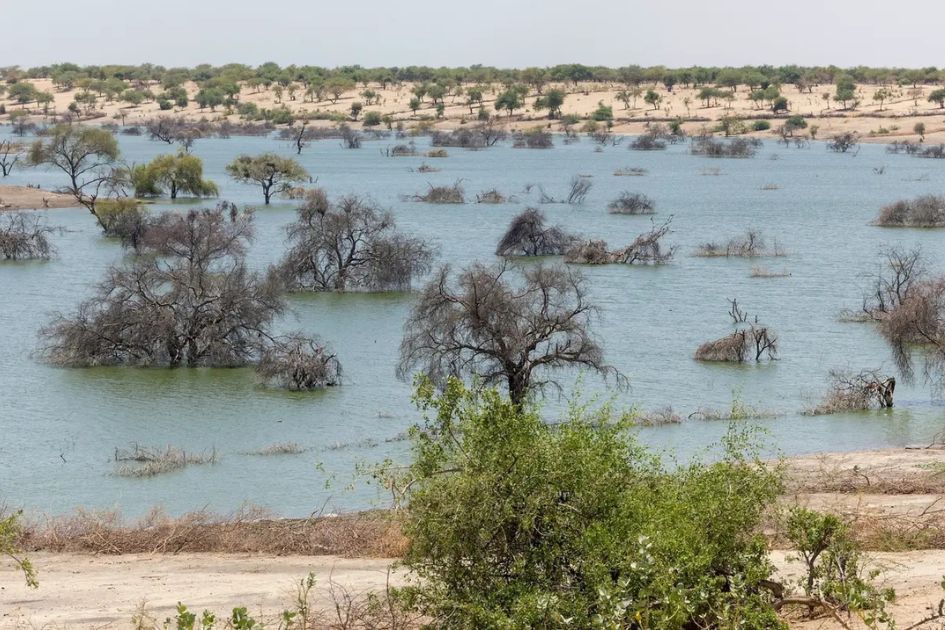
Recently flooded areas around Kiskawa, Chad, have left dead trees standing in an arm of Lake Chad, another visible sign of changing water levels.
Some scientists believe deliberate efforts to retain rainfall in soils may also be contributing to rising groundwater.
Among the initiatives is the Great Green Wall, which was originally conceived as a barrier of planted trees designed to stop the Sahara’s advance.
The programme has since evolved towards more grassroots approaches aimed at controlling soil erosion, retaining rainfall and improving soil moisture, measures that can also increase infiltration into underground reserves.
Many projects are reviving traditional methods of harvesting water.
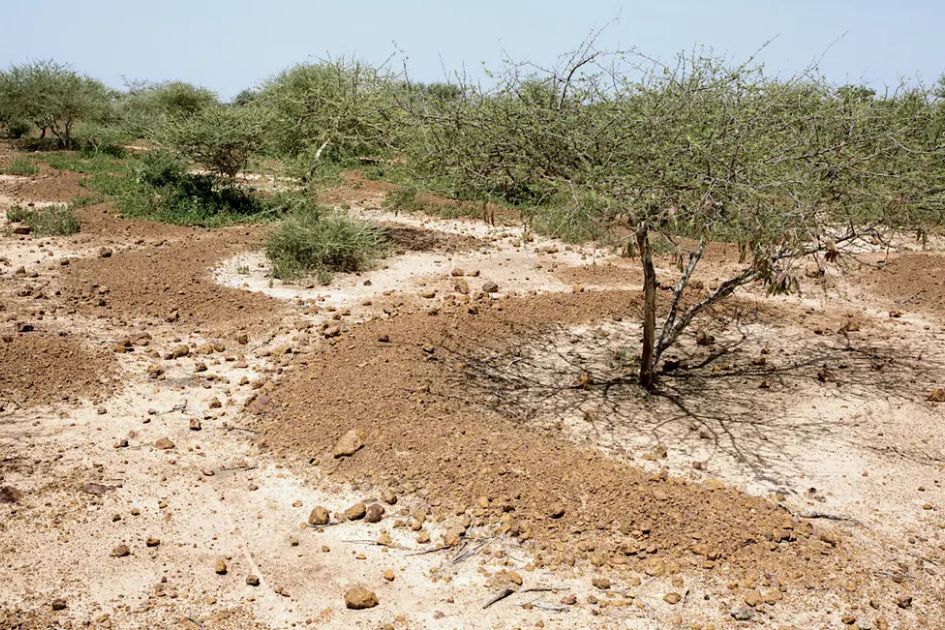
These include arranging stones along the contours of hillsides, digging small holes among crops known as “zai pits” and constructing crescent-shaped mounds around trees.
Such crescent-shaped structures have been used to capture rainwater around gum acacia trees in Ninefouno, Niger.
Alpha Lo of the Climate Water Project, who recently highlighted the recovery of Sahelian groundwater in an online analysis, argues that these techniques are “the primary reason” for the increase.
Most researchers, however, say that although such methods can be highly effective locally in supporting trees and crops, they are not yet being practised widely enough to explain a recovery occurring across the entire Sahel.
A further explanation is that people may be withdrawing less water from rivers, allowing more water to remain in the system and eventually infiltrate aquifers.
One factor is the decline of large irrigation projects developed during drought years to increase food production.
Cameroon, for example, once removed much of the flow of the River Logone, historically the largest single source of water entering Lake Chad, to irrigate rice.
The SEMRY irrigation project reportedly diverts substantially less water today because of poor management, ageing infrastructure and farmers leaving the area.
Conflict is also influencing water use.
Around Lake Chad, some farmers have abandoned irrigated land because of Boko Haram, a militant jihadist group that continues to terrorise communities.
Timmo Gaasbeek, food security policy officer at the Netherlands Ministry of Foreign Affairs, said the instability in northern Nigeria means river water is no longer being captured upstream to the same extent.
Instead, he said, the water continues into Lake Chad, contributing to higher lake levels and greater groundwater recharge.
Most climate models indicate that annual rainfall will rise further in the coming decades as global heating continues and the cooling influence of sulphate aerosols over the North Atlantic diminishes.
Taylor expects the Sahel to experience especially pronounced increases in extreme rainfall, which he said would further increase groundwater recharge.
The additional water could create new agricultural opportunities.
Peugeot said greater water availability in valley bottoms could encourage irrigation development and create new prospects in several parts of the Sahel.
Nigeria, encouraged by forecasts of improving water availability, is considering restoring the 165,000-acre South Chad Irrigation Project on the former shores of Lake Chad.
The massive irrigation scheme had long been abandoned because of a lack of water.
But scientists warn that the Sahel’s emerging water revival does not mean rainfall will become predictable.
Rain is expected to remain highly erratic across different timescales and the region will continue to face the competing risks of drought and destructive flooding.
Most immediately, climatologists are forecasting that this year’s strong El Niño event could bring drought to the eastern Sahel while delivering bumper rainfall and further flooding farther west.
This article is republished from the Yale Environment 360.




