




Civic groups say evictions without rehabilitation would deepen the housing crisis, urging authorities to protect the rights and dignity of Rajshahi’s urban poor.
Three civic organisations in Rajshahi have submitted a memorandum demanding that slum evictions in the city be halted unless residents are provided with alternative housing and rehabilitation.
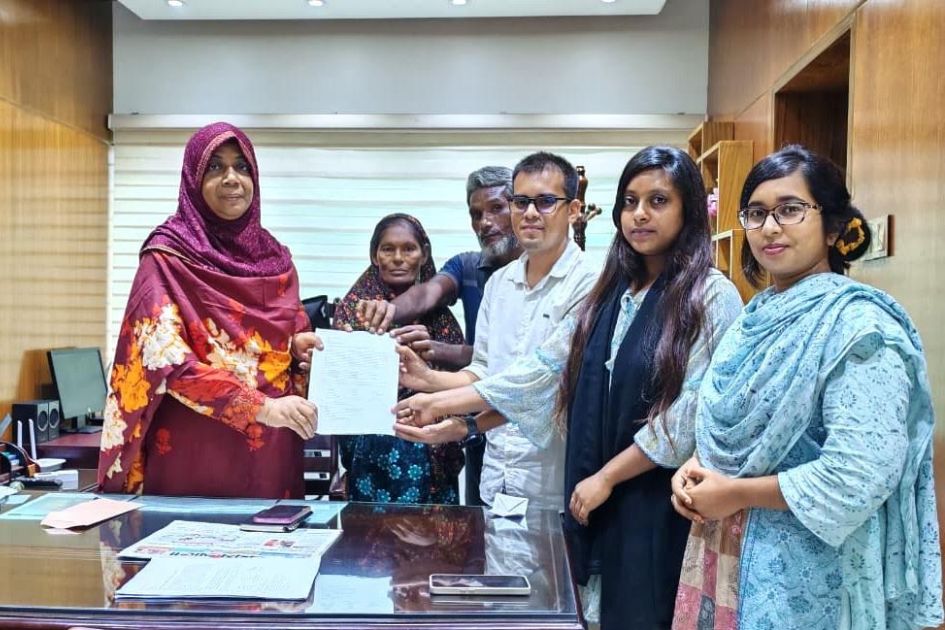
A delegation from the Namovodra Basthuhara Sarbik Unnayan Sangathan, Barendra Youth Forum and Green Coalition submitted the memorandum at noon on Monday, calling for an end to evictions of landless and low-income people living in slums, including the Namovodra Lakeside slum in Rajshahi city.
The memorandum said people cannot be made homeless in the name of development and urban management. It said every citizen has the right to dignified housing in light of the Constitution, human rights and the Sustainable Development Goals.
It said evicting slum residents without arrangements for rehabilitation could not be considered a humane, just or sustainable solution, and called on the relevant authorities to halt evictions until rehabilitation is ensured and to address the housing crisis facing slum residents.
The memorandum, jointly signed by Mahbub Siddiqui, president of the Rajshahi region chapter of Green Coalition and a river and environmental researcher; Md Bachchu Mia, president of the Namovodra Basthuhara Sarbik Unnayan Sangathan; and Md Atikur Rahman, president of the Barendra Youth Forum, was submitted to the Rajshahi divisional commissioner.
Shahana Akter Jahan, an additional divisional commissioner, received the memorandum on behalf of the divisional commissioner. A copy was also submitted to Kazi Shahidul Islam, the deputy commissioner of Rajshahi.
Separate copies of the memorandum were sent to Zakaria Taher, minister of the Ministry of Housing and Public Works; Md Mizanur Rahman Minu, minister of the Ministry of Land; the secretary of the Ministry of Housing and Public Works; the senior secretary of the Ministry of Land; the general manager of Bangladesh Railway’s western zone; Mahfuzur Rahman Riton, administrator of Rajshahi City Corporation; and Md Abul Kalam Azad Babbar, chairman of the Rajshahi Development Authority.
According to the Bangladesh Bureau of Statistics’ Slum Census and Floating Population Census 2014, more than 39,000 people lived in about 104 large and small slums in Rajshahi city. The memorandum said the number has now risen to around 100,000.
A large proportion of the residents moved to the city from rural areas because of river erosion, drought, floods, landlessness, a lack of employment opportunities and poverty, according to the memorandum.
But after moving to the city, they remain deprived of basic rights including safe housing, clean water, sanitation, education, healthcare, employment and social security, it said.
Most slum residents work as rickshaw pullers, construction workers, domestic workers, hawkers, small traders, transport workers and day labourers. The memorandum said they make an important contribution to the city’s economy and service sector while remaining deprived of the right to safe housing.
The memorandum put forward five demands, calling for the recognition of the rights of the urban poor and immediate steps to ensure their civic rights as part of efforts to build Rajshahi as a humane, inclusive, climate-resilient and sustainable city.
The demands are that no slum, including the Namovodra Lakeside slum, be evicted without ensuring rehabilitation; that plans be adopted to provide safe, dignified and environmentally friendly housing for all slum residents in Rajshahi; that water, sanitation, healthcare, education and social security services be ensured for slum residents; that affected communities be allowed to participate and give their views before any decision concerning eviction; and that the housing rights of the urban poor be given priority in local and national development plans.
The memorandum described the demands as a civic call for a just and humane urban life with dignity for all.




