

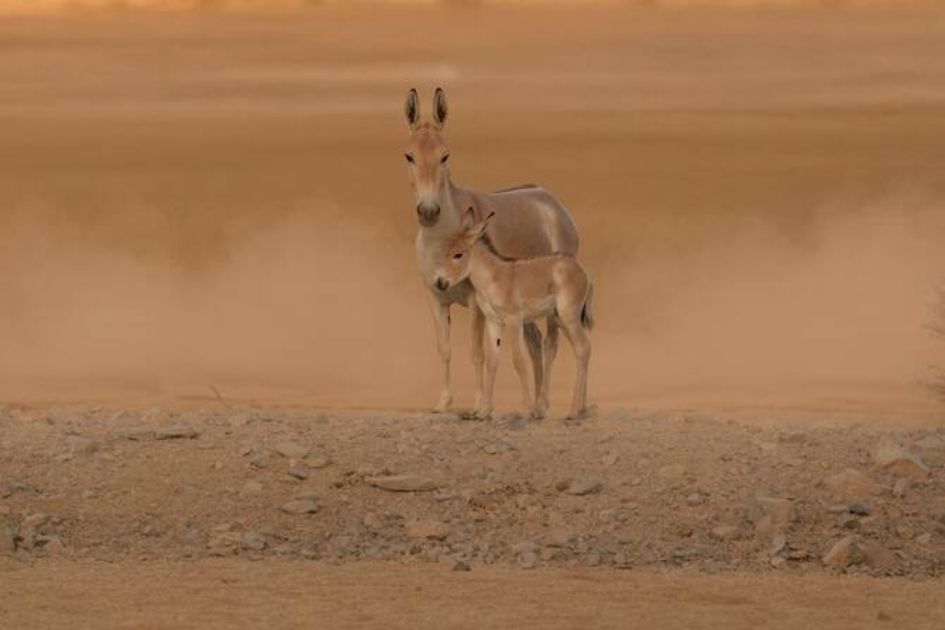



Saudi Arabia’s Prince Mohammed bin Salman Royal Reserve is rebuilding a lost desert ecosystem, with onager reproduction signaling progress in restoring native species and habitats.
A wild onager, or Asiatic wild ass, has been born in Saudi Arabia for the first time in more than a century, marking a major milestone in efforts to restore native species and revive the biodiversity that once shaped the Arabian Peninsula’s ecosystems.
Andrew Zalumis, chief executive of the Prince Mohammed bin Salman Royal Reserve, told Arab News: “An animal that poets praised more than 1,000 years ago has returned to our desert after nearly 100 years, and its return has begun with the birth of a foal. There is a deep beauty in that. It is a symbol of freedom, resilience in the face of adversity and that wild spirit.”
He said the birth of the first onager born and raised on Saudi territory in more than a century was about far more than the arrival of a single animal.
The achievement was made possible through the reserve’s “Rewild Arabia” programme, which aims to return 23 historically native species to their former habitats.
The male onager foal was born in June 2025. News of its birth was withheld until it had reached almost one year of age because the first year of life is the most vulnerable period for onager foals. During that period, only about half of the foals survive.
Reserve authorities said the animal had successfully passed the critical first 12 months of life. Two other female onagers are also currently pregnant and are expected to give birth next winter.
The Persian onager is under threat. Fewer than 600 Persian onagers are believed to remain in the wild. In 2025, the International Union for Conservation of Nature (IUCN) listed the subspecies as “Critically Endangered”.
The IUCN has forecast that its population could decline by 90 percent by 2050 if effective conservation measures are not taken.
The onager once held an important place in Arabia’s natural and literary heritage. More than 80 surviving poems from the pre-Islamic and early Islamic periods mention the animal, praising its speed, vigilance and independent nature.
Unlike domestic horses and donkeys, the onager did not submit to human domination. It therefore became a symbol of freedom and the wild, untamed character of the desert.
Ancient rock art depicting wildlife can be found throughout the Prince Mohammed bin Salman Royal Reserve. The carvings provide evidence of which species and types of ecosystems once existed in the region and are helping guide restoration efforts aimed at returning native species.
Of the 23 species targeted for restoration under the “Rewild Arabia” programme, 14 have already been restored. Six species, including the Persian onager, have also successfully reproduced.
The reserve’s long-term goal is to restore habitats capable of supporting native predators, including the Arabian leopard, cheetah and lion.
Zalumis said: “Saudi Arabia has vast scale, visionary leadership and clear strategic direction. The country is rapidly building a record of experience and success that is making it a regional centre for onager conservation.”
In April 2024, several onagers were brought to Saudi Arabia from Jordan through a partnership with the Royal Society for the Conservation of Nature, which works to protect nature.
Seven onagers travelled 935 kilometres by road from Jordan’s Shaumari Wildlife Reserve to the Saudi reserve. The group comprised five females and two males.
Shortly after the animals arrived, a female onager that had conceived in Jordan gave birth to a foal. Two other pregnancies later failed. In one of those cases, a female onager died.
After a gestation period of about 11 months, an onager foal must stand within 15 to 20 minutes of birth and begin nursing from its mother. This is essential for obtaining colostrum, or the first milk, which is necessary for immunity and survival.
The herd currently consists of five females and three males, including adults. It is now the only onager herd in Saudi Arabia.
The Persian onager is a subspecies of Equus hemionus and is one of the oldest members of the horse family. It originated about four million years ago.
There are five subspecies of the species. One of them, the Syrian onager, once roamed the Arabian Peninsula in herds of up to 100 animals. It became extinct because of hunting and habitat destruction.
The last known Syrian onager was shot and killed in Iraq in the early 1920s. The last animal kept in captivity died at Vienna Zoo in 1927. The Persian onager is the closest living relative of the Syrian onager.
“One species alone cannot restore an ecosystem,” Zalumis said. “But the return of a charismatic and symbolic species plays an important role, both environmentally and culturally.”
Protecting onagers also requires safeguarding native vegetation, open landscapes and wildlife movement routes.
Zalumis said the successful reproduction of the onagers is therefore being viewed as an indicator of progress in broader landscape restoration. It means the ecosystem is being restored across the reserve.
The project is part of Saudi Arabia’s broader conservation efforts. The country is working to protect 30 percent of its land and marine areas by 2030.
Saudi Arabia, a signatory to the Convention on the Conservation of Migratory Species of Wild Animals, increased the proportion of protected land from about 4.5 percent at the beginning of 2018 to 18 percent. Over the same period, the proportion of marine areas under protection also rose from about 2.5 percent to 16 percent.
Several national programmes are working to restore species that have disappeared from the wild or face severe threats.
Through its partnership with Jordan’s Royal Society for the Conservation of Nature, the Prince Mohammed bin Salman Royal Reserve has received another female onager. The new animal will help plans to establish two separate breeding herds. This will increase genetic diversity and strengthen the population’s long-term ability to survive.
Reserve authorities want to establish a founding onager herd that can eventually support the restoration of the species in Saudi Arabia and across the wider region.
Zalumis said conservation success should not be measured simply by how many animals have been released into the wild. What ultimately matters is whether the animals can survive naturally without human intervention.
The onager serves as an indicator in this regard because it requires extensive open landscapes, healthy native vegetation and interconnected migration routes to survive. Environments where onagers can thrive can also support other species that share the same habitat.
“Our goal is to reach a situation 10 years from now where no signboard is needed to indicate a protected natural area; nature itself will provide the evidence,” Zalumis said.
Over the next 25 years, the reserve authorities aim to build self-sustaining populations of Arabia’s iconic wildlife. Herds of these animals will roam restored grazing lands while predators return to their territories.
The long-term plan also includes creating ecological corridors or connecting routes between protected areas across the region. This will prevent wildlife populations from becoming isolated and create an interconnected landscape.




