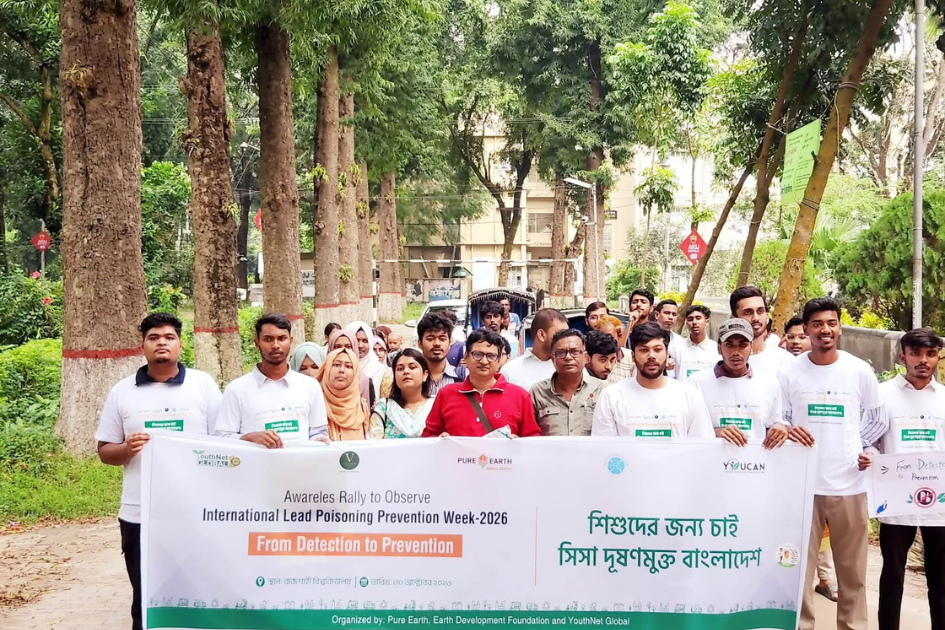



Speakers stressed the need for stronger law enforcement, safer battery recycling and producer accountability, while urging young people to help identify contamination sources and prevent lead exposure.
Students, teachers and young people gathered at the University of Rajshahi on Friday, calling for stronger action to tackle lead pollution and protect public health and the environment.
The programme was organised by YouthNet Global and Pure Earth Bangladesh to mark International Lead Poisoning Prevention Week 2026, under the theme “Together, We Stand Against Lead Pollution.”
The event is part of a week-long awareness campaign across all eight administrative divisions of Bangladesh. YouthNet Global is implementing the initiative with support from Pure Earth Bangladesh, while Volunteer for Bangladesh, YOUCAN and the Earth Development Foundation are co-organisers.
YouthNet Global Rajshahi Divisional Coordinator Hridika Ahsan Shreya highlighted the harmful effects of lead exposure on maternal and child health. She said young people and local communities could play an important role in tackling the problem through collective action, identifying sources of contamination and promoting preventive measures.
University of Rajshahi Professor Aminul Islam Kanak said preventing lead pollution requires effective enforcement of existing laws and practical action under relevant policies.
Safer products and responsible recycling
Pure Earth Bangladesh Country Director Mitali Das said protecting children from lead poisoning requires coordinated action, including identifying sources of exposure, controlling pollution, ensuring safer consumer products and promoting environmentally sound recycling of used batteries.
She said Pure Earth was working with the Ministry of Environment, Forest and Climate Change, the Department of Environment and other stakeholders on guidelines for Extended Producer Responsibility (EPR).
EPR is a policy approach that requires producers to take responsibility for managing their products after use, including their collection, recycling and safe disposal.
According to Das, the proposed guidelines would help strengthen the collection, tracking and environmentally sound recycling of lead-acid batteries.
Unsafe battery recycling puts communities at risk
YouthNet Global Executive Coordinator Sohanur Rahman warned that unsafe and unregulated recycling of lead-acid batteries poses risks far beyond recycling facilities, threatening the health of workers, families and entire surrounding communities.
He called for stronger public awareness, collective action to address harmful industrial practices and greater momentum for policy reforms to prevent lead pollution.
Awareness campaign reaches communities nationwide
The nationwide campaign aims to raise awareness among children, young people, teachers, representatives of public and private institutions and local communities about the sources and harmful effects of lead exposure.
It also seeks to encourage communities to identify contamination sources, adopt preventive measures and involve young people in local initiatives to tackle pollution.
Alongside university-based programmes, activities include rallies, community meetings, awareness drives in educational institutions and public discussions across the country’s eight administrative divisions.
Through these initiatives, YouthNet Global and its partners aim to strengthen community understanding of lead pollution and encourage young people to take an active role in safeguarding public health and the environment.