

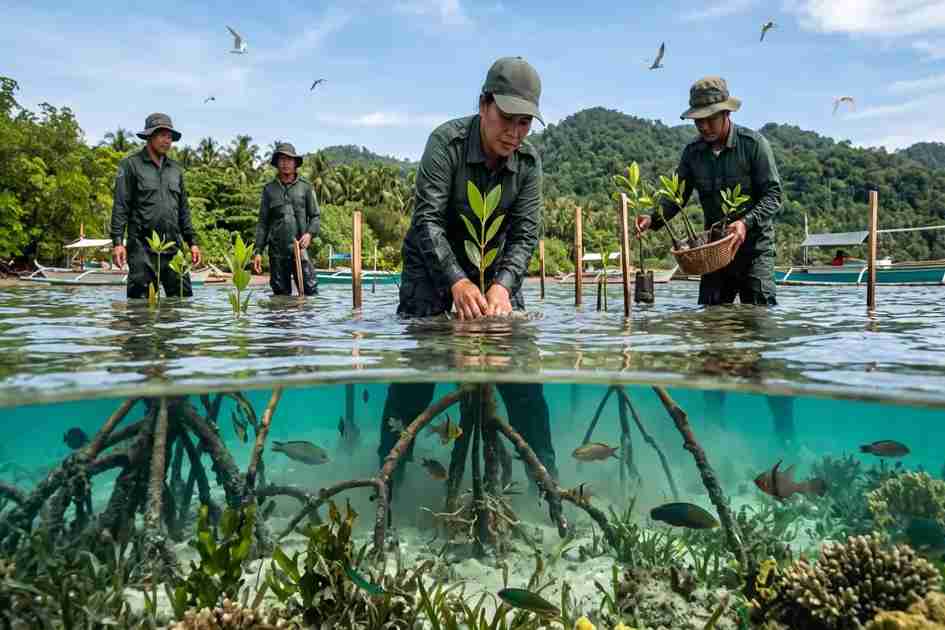



Community-led forest, beekeeping and seagrass projects show how long-practiced local conservation efforts are being formally linked to climate adaptation, biodiversity protection and sustainable livelihoods.
The Philippines has launched its first national-level policy on nature-based solutions, requiring the integration of approaches that protect ecosystems, address climate change and support livelihoods into the national agenda.
The Department of Environment and Natural Resources launched the policy on June 30 during “Usbong: Transdisciplinary Forum on Nature-based Solutions,” alongside a new Nature-based Solutions, or NbS, Catalogue and a memorandum of understanding signed by founding members of the NbS Support Network.
In a keynote video speech, Environment Secretary Juan Miguel Cuna said the policy, which is based on the International Union for Conservation of Nature Global Standard, “gives us a national standard for recognizing, supporting and scaling nature-based approaches across our climate, biodiversity and disaster risk reduction programs.”
Nature-based solutions, which aim to protect the environment, restore ecosystems and respond to societal challenges, are not new to the Philippines. Many communities have practiced them for years, if not decades.
Forest Foundation Philippines Deputy Executive Director Alaya de Leon said the policy helps ensure that long-standing community practices, now described as NbS, remain “people-centered, integrate gender equality, disability and social inclusion; and respond to capacity-building needs at the local level.”
“For generations, Filipino communities and Indigenous peoples have managed forests, restored coastlines and stewarded the land before it was called NbS,” she said.
Dixon Gevaña, director of the University of the Philippines Los Baños Forestry Development Center, said the challenge was “not simply adopting NbS, but strengthening, connecting and integrating local and Indigenous practices that already exist across policy, governance, financing and implementation systems.”
The forum also highlighted community-led projects using NbS approaches.
In Victorias, Negros Occidental, the Gawahon Eco-Park, home to the endemic Southern Indigo-banded kingfisher, has become a destination for birders from around the world. The bird lives along the park’s clear forest streams and waterfalls, which run through one of the area’s remaining forest patches.
But the kingfisher and other species dependent on forests and freshwater ecosystems face growing threats from habitat loss and climate change.
To help protect Gawahon’s forests, community members, particularly women, are restoring ecosystems while building sustainable livelihoods. The Gawahon Livelihood on Apiculture Development Association, or BeeGLAD, has developed a sustainable honey enterprise that produces bottled honey and honey-based products including beeswax, honey balm and soap.
Sustainable honey production, using regenerative apiculture and ethical harvesting techniques, can help address climate change and biodiversity loss.
BeeGLAD Chairman Lourdes Pedoy said wild honey collectors in Gawahon now use sustainable harvesting methods and no longer rely on destructive practices such as burning hives.
Women members of BeeGLAD, who previously only processed honey, have expanded their roles to stingless beekeeping, biodiversity monitoring and organizational management.
Pedoy said sustainable honey has not yet become the primary income source for women in Gawahon but expressed confidence that it could bring greater financial benefits to the community.
She said the project had strengthened women’s empowerment, adding, “Malaking bahagi na po ang mga kababaihan sa beekeeping and harvesting po, specifically sa stingless beekeeping.”
In the coastal barangay of Mambayaan in Balingasag, Misamis Oriental, community members have also adopted an NbS approach by restoring seagrass meadows while pursuing sustainable sea cucumber farming.
Jose Romeo Ebron, chief executive officer of the Philippine Family Farmers’ Agriculture Fishery Forestry Cooperatives Federation, or AgriCOOPh Federation, said the C-Grass project, formally Creating Gender-Inclusive Resilience Actions for Seagrass Sustainability, recognizes the role of fisherfolk, especially women’s organizations, in coastal protection and marine biodiversity.
The project, run by the AgriCOOPH Federation, is promoting women’s participation in all aspects of implementation. It has recorded gains including the establishment of a floating nursery, capacity-building activities and the approval of a marine reserve and protection zone, though it continues to face challenges from frequent typhoons and limited infrastructure support.
“By engaging in sea cucumber farming, the women are helping nurture seagrass meadows which help in coastal protection and serve as nurseries for fish,” C-Grass Project Lead Lourdes Diocson said.
“Seagrass meadows, which are very important for the sustainability of our small-scale fisher folks, are one of the most important habitats of fish and marine life, enriching our fishing grounds,” she added. “As rooted submerged marine flora, they buffer the shore from strong storm effects and help in preventing erosion. Sea cucumbers help in providing nutrients to the sea sediments.”
The Gawahon and Mambayaan initiatives are among community-led NbS projects supported through grants from the Forest Foundation Philippines in partnership with the Philippines-Canada Partnership on Nature-based Solutions for Climate Adaptation.
The Canadian government funds the projects.
Source : The Manila Times




