

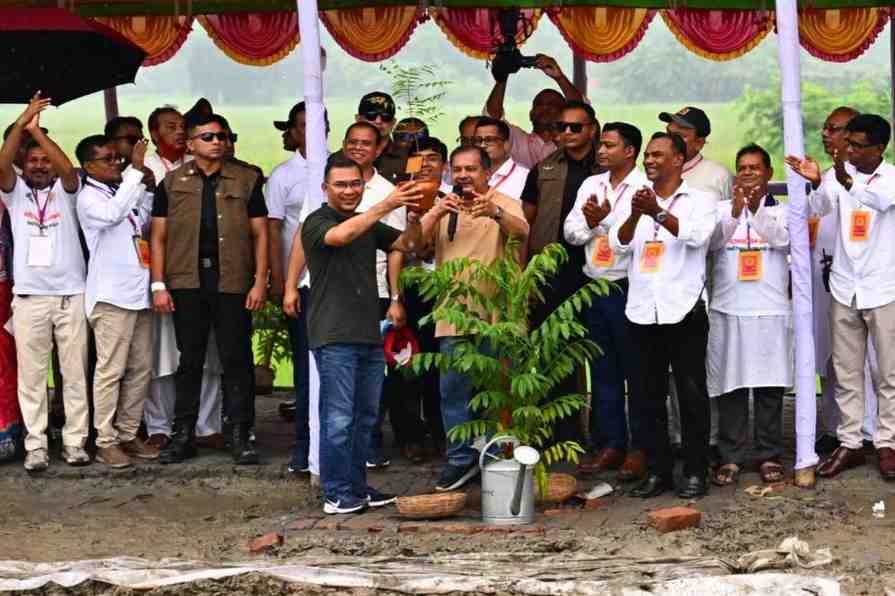

Bangladesh Prime Minister Tarique Rahman joined a tree-planting drive in Barishal on Monday, advancing his government’s 250-million-tree pledge before meeting women benefiting from the flagship Family Card social welfare programme.
Bangladesh Prime Minister Tarique Rahman on Monday joined a tree-planting drive in the southern district of Barishal as part of his government’s pledge to plant 250 million trees within five years.
Rahman, who is also chairman of the ruling Bangladesh Nationalist Party (BNP), planted coconut and neem saplings along the banks of the newly re-excavated Sarikal-Batajor Canal in Batajor Union of Gournadi upazila.
Around 2,500 saplings were due to be planted in the area under the programme, according to officials. State Minister for Environment, Forest and Climate Change Shaikh Faridul Islam was also present at the programme.
“Planting the saplings is not the end of the job. Everyone must take care of the trees,” Rahman told residents attending the event.
“You look after your children every day after they are born. In the same way, you must care for these young saplings every day,” he added.
The initiative forms part of the government’s five-year plan to plant 250 million trees across Bangladesh, one of the BNP’s election promises aimed at increasing forest cover, protecting biodiversity and strengthening resilience to climate change.
Rahman formally launched the nationwide campaign in the southeastern Cox’s Bazar district in June. The government has said priority will be given to native and environmentally suitable species, while ensuring the maintenance and survival of planted trees.
Bangladesh, a densely populated delta nation, is highly vulnerable to floods, cyclones, rising seas, extreme rainfall and other impacts of climate change.
Following the plantation programme, Rahman met women benefiting from the government’s “Family Card” social protection scheme, another major pledge from the BNP’s election manifesto.
The programme recognises women as heads of beneficiary households and aims to improve their decision-making power, financial independence and the overall living standards of their families.
Under the pilot scheme launched in March, each selected household receives a monthly allowance of 2,500 taka through direct digital payments to the female beneficiary’s bank account or mobile wallet.
The government initially selected 37,567 households after surveying and verifying the economic conditions of women-headed families in selected areas. Each card can cover up to five members of a household.
The BNP returned to power after winning a two-thirds majority in the February 2026 general election. Its election platform included the Family Card programme for low-income households alongside employment, healthcare and economic reform pledges.
Rahman was also scheduled to join another tree-planting programme beside the Sagardi Canal in Barishal city later Monday.




