

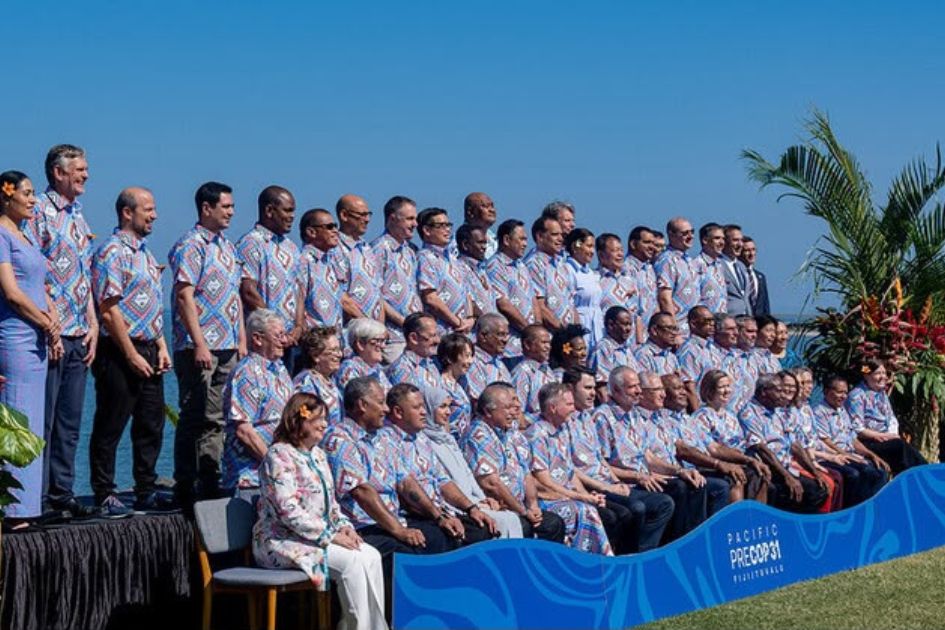



Pacific leaders used the Tuvalu meetings to press for faster emissions cuts, easier climate finance and stronger adaptation support despite criticism over the absence of major foreign leaders.
Only two leaders from outside the Pacific attend Tuvalu gathering, but climate finance pledges and regional declaration offer fresh momentum ahead of COP31 in Türkiye.
Australia’s ambitious attempt to bring world leaders face-to-face with the Pacific climate crisis has come under scrutiny after only two leaders from outside the region attended a high-profile gathering in Tuvalu, raising questions over Canberra’s diplomatic expectations ahead of COP31 in Türkiye.
Despite the disappointing leadership turnout, Pacific nations have defended the initiative, pointing to fresh climate finance commitments and a regional declaration aimed at strengthening international action on emissions, adaptation and ocean protection.
The Pacific pre-COP meetings, held in Fiji and Tuvalu from October 5 to 8, attracted around 4,000 participants from more than 100 countries across the official conference and associated events, according to Australian organisers.
However, the limited participation of foreign heads of state and government has prompted criticism of Australia’s diplomatic strategy and questions about the effectiveness of its high-profile climate gathering.
An October 8 analysis by ABC News foreign affairs reporter Stephen Dziedzic highlighted the gap between the Australian government’s early ambitions and the eventual leadership turnout, while acknowledging the significance of placing Pacific climate concerns at the centre of international discussions.
World leaders stay away
Australian Prime Minister Anthony Albanese joined Pacific leaders in Tuvalu, but only two national leaders from outside the region attended: Timor-Leste President José Ramos-Horta and Mauritius President Dharambeer Gokhool.
A month before the gathering, Fiji had indicated that five leaders from outside the Pacific were expected to participate. That number subsequently fell to two, although ministers and senior representatives from other countries attended.
The shortfall drew criticism from Australia’s political opposition, which questioned the value of spending approximately A$20 million on the event.
Critics described the gathering as a diplomatic disappointment, arguing that Canberra had failed to attract the influential international leaders initially envisaged for the talks.
Australian Climate Change and Energy Minister Chris Bowen rejected suggestions that the government had failed to deliver on its commitments.
He maintained that the objective was to bring international attention to the Pacific and the particular challenges confronting small island developing states.
Bowen defended Australia’s efforts to bring international representatives to Tuvalu and elevate the concerns of communities facing some of the most severe consequences of climate change.
The controversy has nevertheless raised questions about the gap between diplomatic expectations and the participation secured for the special leaders’ event.
Pacific leaders defend Australia
Despite the criticism, Pacific representatives have largely resisted blaming Canberra for the disappointing turnout.
Vanuatu’s Climate Change Minister Ralph Regenvanu, who has previously criticised Australia’s fossil fuel policies, told Reuters that Pacific nations had hoped to attract more international leaders.
He argued that their absence reflected the limited attention and priority given to a crisis that Pacific countries consider an existential threat.
Other Pacific representatives welcomed the opportunity to place their concerns before international decision-makers, even as they acknowledged the shortcomings of the gathering.
For low-lying island nations, the stakes extend far beyond diplomatic attendance.
Rising seas, coastal erosion, saltwater intrusion and increasingly destructive storms threaten homes, freshwater supplies, livelihoods and cultural heritage across the region.
Tuvalu, where land sits an average of just two metres above sea level, provided visiting representatives with a direct illustration of these challenges.
Delegations from around 30 countries and institutions visited Funafuti, where a major coastal adaptation initiative is reclaiming land to protect communities against rising seas.
The project demonstrates the extraordinary measures being undertaken to preserve habitable land in one of the world’s most climate-vulnerable countries.
Pacific leaders have repeatedly warned that such adaptation efforts require sustained international investment, particularly from major greenhouse gas emitters.
Pacific declaration sends message to major polluters
Although the gathering fell short of its leadership ambitions, it produced political commitments intended to shape negotiations at COP31.
One significant outcome was the adoption of the Taku Pakasoa Declaration on October 6.
The Pacific-led declaration calls for deep, rapid and sustained greenhouse gas emissions reductions, stronger international cooperation, enhanced climate resilience and improved access to finance.
It also emphasises protecting oceans, keeping the Paris Agreement’s 1.5°C temperature goal within reach and recognising the knowledge and leadership of Indigenous peoples and local communities.
The declaration is a political commitment rather than a formally negotiated decision under the UN Framework Convention on Climate Change.
Nevertheless, it provides a platform for advancing Pacific priorities in Antalya, particularly on emissions reductions, adaptation finance and the transition away from fossil fuels.
Pacific representatives have stressed that the climate crisis requires urgent action from major emitters rather than further delays in implementation.
Climate finance pledges fall short of needs
The meetings also generated fresh commitments to the Pacific Resilience Facility, a regionally owned financing mechanism designed to support community-led adaptation and disaster preparedness.
Fiji announced a US$10 million contribution, while Denmark pledged approximately US$2.3 million and Solomon Islands committed US$1.1 million.
The United Kingdom announced a £10 million contribution towards the facility’s next phase, while the Netherlands pledged €1 million. Ireland also indicated plans to increase its previous commitment.
Despite the announcements, the facility remains significantly below its financing ambitions.
Reuters reported on October 7 that total pledges stood at just under US$200 million, compared with an initial capitalisation target of US$500 million and a longer-term goal of US$1.5 billion.
The fund seeks to address longstanding barriers that prevent vulnerable communities from accessing conventional international climate finance.
However, the financing challenge extends beyond securing new pledges.
According to figures presented during the pre-COP meetings, more than US$16 billion in climate finance has been committed to Pacific countries since the Paris Agreement, but over US$5 billion remains undisbursed.
The gap highlights persistent difficulties in translating international commitments into resources available to countries already confronting severe climate impacts.
Australia also announced additional support for regional renewable energy and climate-resilient infrastructure, alongside an action plan aimed at simplifying access to climate finance.
Pacific representatives have emphasised that funding must be predictable, accessible and responsive to local needs rather than remain tied up in complex procedures.
Australia’s coal policies face renewed scrutiny
The diplomatic controversy has also revived questions about Australia’s credibility as a climate leader.
While Canberra has expanded support for Pacific adaptation and renewable energy, its continuing role as a major exporter of coal and natural gas has attracted criticism from environmental organisations and climate-vulnerable countries.
On September 30, the New South Wales Independent Planning Commission approved an extension of Hunter Valley Operations, allowing coal mining at its northern and southern sites into the 2040s.
Days later, on October 7, Australia’s High Court upheld a ruling against the approval process for the expansion of the Mount Pleasant coal mine, citing deficiencies in the assessment of downstream greenhouse gas emissions.
The ruling does not permanently prohibit the expansion, which may be reconsidered under the applicable planning framework. Existing operations retain separate approval.
The developments have intensified debate over Australia’s international climate diplomacy and domestic fossil fuel policies.
Climate advocates argue that continued fossil fuel expansion undermines efforts to limit global warming, while supporters of coal production emphasise employment, export earnings and energy security.
The tension is particularly significant for Pacific nations seeking both stronger emissions reductions and greater financial assistance from Australia.
COP31 presents crucial test
The Pacific meetings also highlighted the unusual arrangement between Australia and Türkiye for the upcoming UN climate summit.
Under their partnership, Türkiye will host COP31 and hold its presidency, while Australia, represented by Chris Bowen, will serve as President of Negotiations.
The arrangement gives Canberra a leading role in facilitating formal negotiations while working with Türkiye to advance international cooperation.
COP31 will take place in Antalya from November 9 to 20.
The summit will provide an opportunity to assess whether the political momentum generated in the Pacific can translate into stronger international commitments on emissions reductions, adaptation, climate finance and other priorities affecting vulnerable countries.
At the conclusion of the pre-COP meetings, UN Climate Change Executive Secretary Simon Stiell urged governments to accelerate implementation and expand access to affordable climate finance.
Fiji’s Climate Change Minister Lynda Tabuya also stressed that pre-COP does not adopt formal decisions and that its real value would be determined by its influence on negotiations in Antalya.
For Pacific countries, the central concern remains whether international promises will produce tangible improvements in the lives of communities already facing rising seas and worsening climate impacts.
The limited turnout of international leaders has exposed weaknesses in Australia’s diplomatic ambitions, but the declaration, financial commitments and renewed attention to Pacific priorities demonstrate that the gathering produced outcomes beyond its controversial guest list.
With COP31 approaching, Australia and Türkiye now face the challenge of converting political declarations into meaningful international action.
For Pacific island nations confronting rising seas, the ultimate measure of the gathering will be less about who attended Tuvalu than what governments deliver in Antalya.




