




Research in Kurigram highlights how repeated floods, erosion and extreme weather undermine essential services and wellbeing, strengthening calls to recognise non-economic losses in climate policy and finance.
Climate-related disasters are disrupting education, healthcare, communication and access to safe drinking water in northern Bangladesh, leaving behind losses that often go unrecognised in conventional assessments of economic damage, according to new research involving 277 households.
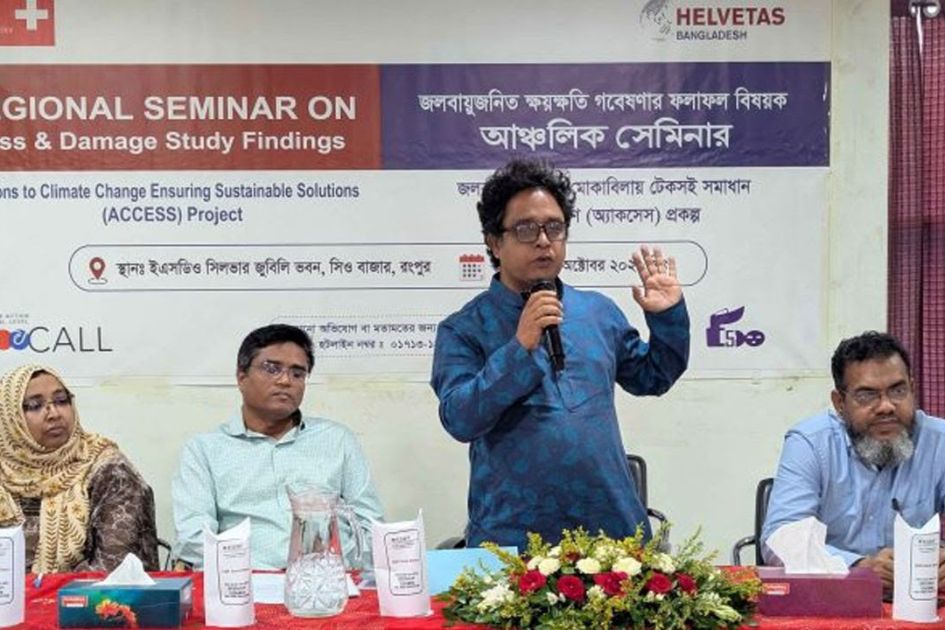
The findings, presented at a seminar in Rangpur on Thursday, highlight the growing burden of non-economic loss and damage on climate-vulnerable communities and the need for government policies to address consequences that cannot easily be measured in monetary terms.
The seminar, held at the ESDO Silver Jubilee Building, presented research on economic and non-economic losses caused by climate-related hazards in northwestern Bangladesh.
Prof Dr Atikul Islam of the Environmental Science Discipline at Khulna University, who led the research, said the study surveyed 277 households across six unions in Kurigram district.
The surveyed communities included Holokhana and Bhogdanga in Kurigram Sadar, Nun Khawa and Berubari in Nageshwari, and Dharanibari and Dhamshreni in Ulipur.
The research was conducted under the ACCESS project, implemented by the Eco-Social Development Organization (ESDO) and Helvetas Bangladesh. The initiative focuses on strengthening climate resilience and developing sustainable responses to climate-related challenges.
According to the findings, the surveyed communities experienced extensive damage to homes, agricultural land, crops, livestock and infrastructure over the past decade as a result of recurring floods, droughts, riverbank erosion, cold waves, heatwaves, excessive rainfall, lightning and hailstorms.
However, the research found that the consequences extended well beyond damaged property and lost livelihoods.
Among surveyed respondents, 72% reported impacts on communication systems, while 61% identified losses or disruptions affecting education. Another 58% reported impacts on healthcare services, 49% on access to safe drinking water and sanitation, and 47% on physical and mental health.
The findings illustrate how recurring climate-related hazards can affect essential services and everyday wellbeing, creating challenges that conventional financial assessments may fail to capture.
Damage to infrastructure can be assigned a monetary value, but the consequences of interrupted education, reduced access to healthcare and deteriorating mental health are considerably harder to quantify.
For vulnerable households, disruptions to transport and communication networks can also make it harder to reach schools, hospitals and other essential services. Limited access to safe water and sanitation may further increase health risks, particularly during and after disasters.
Although the study focused on selected communities in Kurigram, its findings raise broader questions about how Bangladesh assesses climate-related losses and incorporates them into disaster management, adaptation planning and development policies.
Experts attending the seminar stressed that addressing economic damage alone would be insufficient to protect communities repeatedly exposed to climate-related disasters.
Prof Dr Tuhin Wadud, director of Riverine People, was among those discussing the effects of climate change in Rangpur division and the need for improved disaster responses.
Ahsan Habib, superintending engineer of the Bangladesh Water Development Board, and Nur Alam, director of the Department of Environment, also participated in discussions on climate impacts and possible responses.
Representatives from the Department of Social Services, Department of Agricultural Extension and Kurigram Zila Parishad attended the seminar, which examined measures to strengthen resilience and address climate-related losses.
The research comes amid growing international attention to non-economic loss and damage, a dimension of climate change that encompasses consequences beyond destroyed infrastructure and lost income.
Unlike economic losses, which can often be estimated through the cost of damaged assets or declining productivity, non-economic losses may involve human health, cultural heritage, community relationships, identity and other aspects of wellbeing that are difficult to express in financial terms.
For countries such as Bangladesh, where vulnerable communities face recurring extreme weather events and long-term environmental pressures, recognising these losses is increasingly important for developing comprehensive climate responses.
The issue also has implications for international climate finance, particularly as developing countries seek greater support for addressing losses and damages that cannot be prevented through mitigation and adaptation alone.
The findings have particular relevance ahead of the 31st United Nations Climate Change Conference, COP31, scheduled to take place in Antalya, Türkiye, from November 9 to 20, 2026.
Loss and damage, including the operation of the Fund for Responding to Loss and Damage, forms part of international climate policy discussions under the United Nations Framework Convention on Climate Change.
For climate-vulnerable countries, an important challenge is ensuring that international financing and national response mechanisms adequately consider the wider human consequences of climate-related disasters rather than focusing exclusively on measurable economic losses.
The Kurigram findings underline the importance of incorporating disrupted education, healthcare, safe water access and community wellbeing into climate risk assessments and development planning.
They also highlight the need for locally informed policies that recognise the cumulative effects of repeated disasters on vulnerable households.
As Bangladesh prepares for COP31, the research offers further evidence of why discussions on climate justice and loss-and-damage finance must extend beyond destroyed homes, damaged crops and lost income.
For communities living with recurring floods, erosion and extreme weather, the consequences of climate change are not confined to what they lose financially. They are also reflected in interrupted education, declining health, reduced access to essential services and the increasing difficulty of maintaining a secure and dignified life.




