

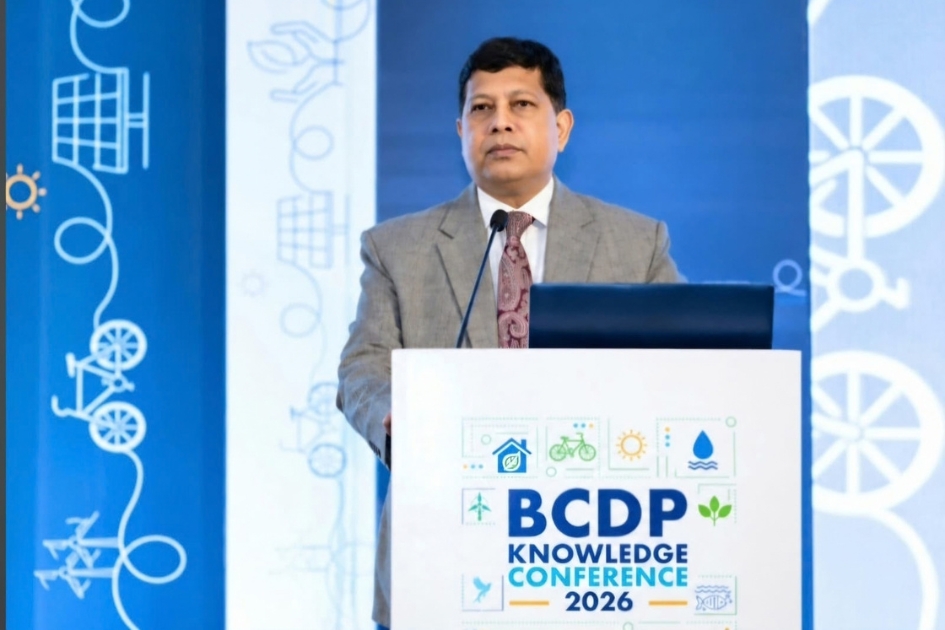



The BCDP Knowledge Conference highlighted project preparation, tailored financing and stronger institutional coordination as priorities for delivering climate action and improving livelihoods across Bangladesh.
In the face of escalating climate challenges, Bangladesh has made remarkable strides in establishing a strong policy foundation for climate action. Underpinned by the National Adaptation Plan (NAP) 2023–2050, NDC 3.0 and Bangladesh Delta Plan 2100, the country has set a strategic direction for strengthening resilience and pursuing low-carbon development. The defining challenge now is to translate these national commitments into well-prepared projects and measurable development outcomes. Achieving this will require effective institutional arrangements, appropriate technical support and clear accountability for results.
The Bangladesh Climate Development Partnership (BCDP) provides a unique platform for advancing this agenda. As a country-led, multi-tier platform, it brings together government institutions, development partners, financial institutions, the private sector, academia and civil society to align national climate priorities with investment opportunities and technical expertise. By linking policy objectives with investment planning, BCDP can help establish a coherent pipeline of climate projects and direct resources towards the country’s most pressing needs.
Against this backdrop, the BCDP Knowledge Conference, held in Dhaka on 7–8 October 2026, was a timely and laudable initiative to advance Bangladesh’s climate priorities. Organised by the Ministry of Environment, Forest and Climate Change with support from the Asian Development Bank (ADB), the conference brought together more than 500 policymakers, government officials, development partners, financial institutions, private-sector representatives, researchers and civil society members.
Discussions revolved around translating the NAP 2023–2050, NDC 3.0 and Bangladesh Delta Plan 2100 into concrete programmes and projects.
The conference set out a clear agenda for advancing Bangladesh’s climate priorities, including building a pipeline of bankable projects, strengthening inter-ministerial collaboration, identifying appropriate financing pathways and establishing robust systems for monitoring and accountability. Discussions focused on NAP costing and delivery, climate resilience and low-carbon development, and mechanisms to mobilise public and private capital. Priority sectors included energy, transport, water resources, agriculture and food systems, industry and social protection.
A key tangible outcome was the launch of the BCDP web portal, providing a digital platform for climate project tracking, investment pipeline management and information-sharing among government agencies and development partners. The discussions also reinforced an important principle: financing arrangements must reflect the distinct economics of climate investments. While commercially viable projects may attract private capital, adaptation initiatives that generate substantial public benefits but limited direct financial returns will continue to require public funding and concessional support.
Turning climate priorities into viable investments requires rigorous project preparation. Proposed projects must be supported by sound feasibility assessments, robust technical designs, clear institutional arrangements and credible assessments of costs and benefits. Public resources and concessional finance will remain essential for initiatives with significant social and environmental benefits but limited commercial returns.
Where viable revenue streams exist, private investment can play a complementary role. Blended finance, risk-sharing instruments and targeted technical assistance can help bridge the gap between national climate priorities and investor requirements.
Climate investments must also reflect the diverse vulnerabilities and development needs of communities across Bangladesh. Adaptation initiatives should prioritise reliable infrastructure, secure livelihoods, access to essential services and locally appropriate solutions. Integrating these considerations into project design will help ensure that investments deliver lasting benefits for vulnerable populations rather than focusing solely on infrastructure or expenditure targets.
The next step is to translate the conference recommendations into a structured follow-up agenda through BCDP working groups. This should identify priority projects, assign institutional responsibilities, establish timelines and specify technical support requirements. Progress should be assessed against agreed milestones and measurable development outcomes, rather than solely by the volume of commitments made or resources mobilised.
The BCDP web portal can support this process by tracking progress and strengthening transparency among participating institutions.
The conference has laid the groundwork for more focused climate investment planning. Its lasting contribution will depend on whether the recommendations lead to stronger project pipelines and demonstrable improvements in climate resilience and livelihoods.
Well-defined responsibilities, realistic timelines and results-based monitoring will be essential to sustaining momentum. By converting its climate ambitions into tangible outcomes, Bangladesh can strengthen community resilience, protect livelihoods and support a more sustainable and climate-resilient economy.
About the author
Mohammad Navid Safiullah is an Additional Secretary (Climate Change) at Bangladesh’s Ministry of Environment, Forest and Climate Change, where he works on climate policy and related national initiatives.




