




Nepal’s prime minister urges Himalayan nations to deepen climate cooperation and calls for stronger finance, resilience measures and global responsibility.
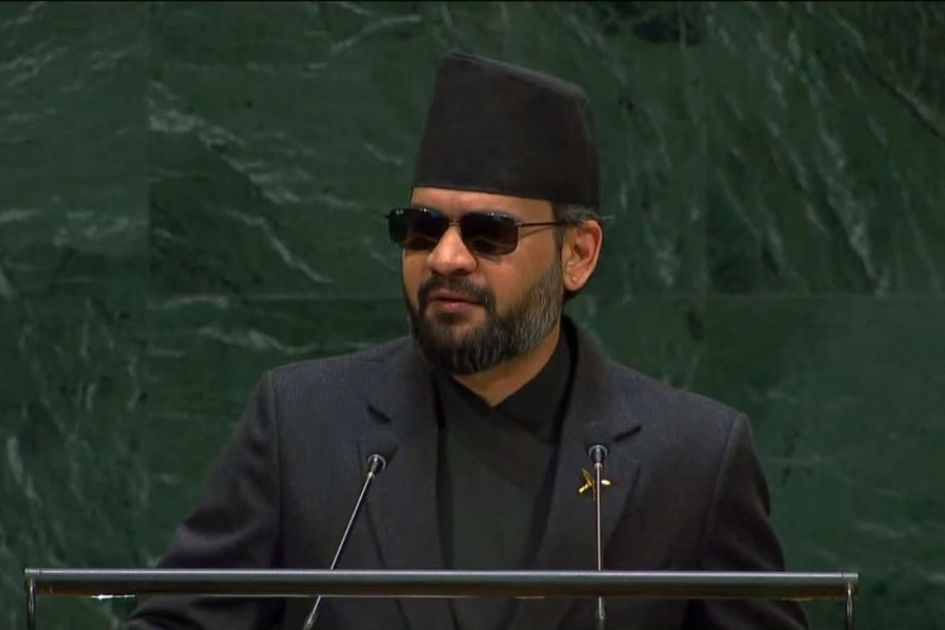
Nepal Prime Minister Balendra Shah has called for stronger international support for countries facing climate change impacts, saying Nepal is paying a “colossal price” for a crisis it contributed little to create.
Addressing the 81st session of the United Nations General Assembly in New York on Thursday, Shah highlighted Nepal’s recent Bhotekoshi-Trishuli floods as a warning of the growing risks facing the Himalayan region.
“Climate change does not recognize borders,” Shah said, referring to the impacts of melting glaciers, unstable mountain slopes, floods and landslides across Nepal, China and India.
He said the disaster had killed at least 1,400 people and left more than 6,000 missing, while preliminary assessments estimated Nepal’s physical recovery needs at around 10 percent of its gross domestic product.
The floods swept away bridges, roads, schools, homes and livelihoods and disrupted Nepal’s progress towards the Sustainable Development Goals, Shah said.
“I come before you from Nepal, a distant country in the Himalayas, carrying a close warning for humanity,” he said.
Shah recalled United Nations Secretary-General António Guterres’ visit to Nepal nearly three years ago, when Guterres warned from the foot of Mount Everest about the dangers posed by the climate crisis.
The prime minister said the warning had not been translated into action quickly enough.
“We, the political leaders of the world, have been negligent to translate those warnings into action at the speed and scale that vulnerable people require,” Shah said.
Himalayan climate cooperation
Shah said rising temperatures were destabilising the Himalayan ecosystem, with melting permafrost contributing to unstable mountain slopes and increasing the risks of ice-rock avalanches, floods and landslides.
He proposed the creation of a Himalayan Climate Resilience Mechanism led by Nepal, India and China.
The mechanism, he said, should enable the three countries to share satellite data and technical expertise, monitor dangerous glacial lakes, strengthen early-warning systems and coordinate assistance during disasters.
“Let the Himalayas become a laboratory of international cooperation, rather than a frontier of fragmented information,” Shah said.
He said the Hindu Kush Himalaya region was home to nearly two billion people and provided water, ecosystems, agriculture and livelihoods to populations far beyond Nepal.
“The Himalayas are not peripheral to the planet. They are part of the planet’s life-support system,” he said.
Calls for climate finance
Shah said Nepal contributes less than 0.1 percent of global greenhouse gas emissions but is facing retreating glaciers, increasingly unstable mountain slopes and unpredictable rivers.
“For Nepal, climate catastrophe is not just a humanitarian event, but a development emergency,” he said.
The prime minister said major disasters destroy infrastructure and livelihoods while forcing poorer countries to borrow money to rebuild damage they did not cause.
He called for greater grant-based international assistance, saying existing climate financing mechanisms remained inadequate.
“The Loss and Damage Fund, the Global Environment Facility and other relevant financing mechanisms remain grossly inadequate,” Shah said.
He also criticised the complexity of accessing international climate finance.
“Climate finance must not become a bureaucratic maze through which vulnerable countries spend years proving that they need help,” he said. “When the house is burning, we do not ask the family to complete fifty forms. We act.”
Shah said the principle of “common but differentiated responsibilities and respective capabilities”, recognised under the UN climate framework, should guide the international response.
“Those who have historically contributed more to the problem, and those with greater capacity to respond, must do more,” he said.
‘Flawless logistics for war and broken logistics for food’
Shah also criticised what he described as an unequal international system in which military goods move more efficiently across borders than essential supplies for ordinary people.
He pointed to shortages of fertiliser, bitumen and cooking fuel in Nepal, contrasting them with the movement of weapons and military equipment across international borders.
“Inter-continental missiles arrive on time. Rifles and ammunition cross borders, clear every bottleneck, meet every deadline,” Shah said.
“But a peasant in Nepal cannot procure her fertilizer or fuel at market price at a time of need.”
“We have built a world with flawless logistics for war and broken logistics for food,” he said.
Shah said Nepal was not alone in facing such pressures, referring to Bangladesh, Bhutan, India, the Maldives, Pakistan and Sri Lanka.
He said countries across the region were dealing with climate impacts while also being affected by wars and geopolitical crises they did not start.
“This tells us there is a lot more broken than meets the eye in the present order of global cooperation,” he said.
Six words for climate action
Shah framed Nepal’s immediate climate demands around six words.
“Relief. Rehabilitation. Reconstruction,” he said. “And also: Responsibility. Reparation. Resilience.”
He said the first three were needed after disasters, while the latter three were necessary to prevent climate disasters from becoming a permanent condition for vulnerable countries.
Shah said Nepal had already taken steps to strengthen resilience, including restoring forests, expanding hydropower, promoting electric mobility and strengthening climate adaptation at the local level.
But he said Nepal could not build resilience alone.
“Remarkable for a least developed country, Nepal is already playing a global role exceeding its ecological share,” he said.
Climate justice and global inequality
Shah expanded his remarks to the wider international system, saying the United Nations was founded on principles of sovereignty, international law and human dignity.
“Today, that international system is under strain,” Shah said.
“Too often, military and economic power determines whose voice is heard.”
He called for a fairer global economic order and said climate justice was not simply about financial assistance.
“It is about distributive justice, who bears the costs,” he said.
“It is about procedural justice, who has a voice.”
Shah said the international system should consider whether the interests of mountain communities, small island states, landlocked and least-developed countries and future generations were being given equal weight.
Nepal’s political transition
Shah also presented Nepal’s recent political changes as part of a broader generational shift.
He said young people had demanded politics based on integrity and accountability and described the change as part of a wider reaction against conflict, inequality and a lack of opportunities.
“Our youth have demanded a politics of integrity and accountability,” he said.
Shah said his government’s priorities were to build a state capable of delivering decent jobs, social protection and opportunities for Nepalis to build their futures at home.
He said Nepal needed to move away from ad hoc responses to climate disasters and develop a culture of preparedness.
“Let us finance resilience, and invest in insurance and innovation,” he said.
“Let us build stronger infrastructure and institutions. Let us reduce fossil-fuel dependence. Let us build systems that warn, alert and save lives.”
Shah ended his address with a reference to the Himalayas as the “rooftop of the world”.
“And when the next warning comes from the rooftop of the world,” he said, “let us be ready to hear it, and ready to act.”
He concluded by wishing for the welfare of the world and calling for the world to follow the path shown by the Buddha.




