




A national dialogue brought together policymakers, experts and development partners to outline priorities for river restoration, investment and stronger institutional coordination.
Speakers at Kollolini: A River Dialogue 2026 called for stronger enforcement of river protections, sustained investment and regular monitoring to help restore Bangladesh’s rivers.
The Kollolini Recommendations urged government agencies to clarify their responsibilities, implement existing plans more effectively and secure long-term funding for river maintenance. They also proposed an ongoing platform to track commitments and progress, according to a press release.
The dialogue was convened by the Team Europe Initiative on Climate and Energy in Bangladesh and organised by the European Union, AFD, the Netherlands Embassy, GIZ and the Swiss Embassy, with coordination by Red Orange Limited and Deltares.
Held at Aloki Convention Centre in Dhaka on Thursday under the theme “Knowing Our Rivers, Deciding Together”, the dialogue brought together government officials, diplomats, development partners, experts, civil society representatives and young people ahead of World Rivers Day.
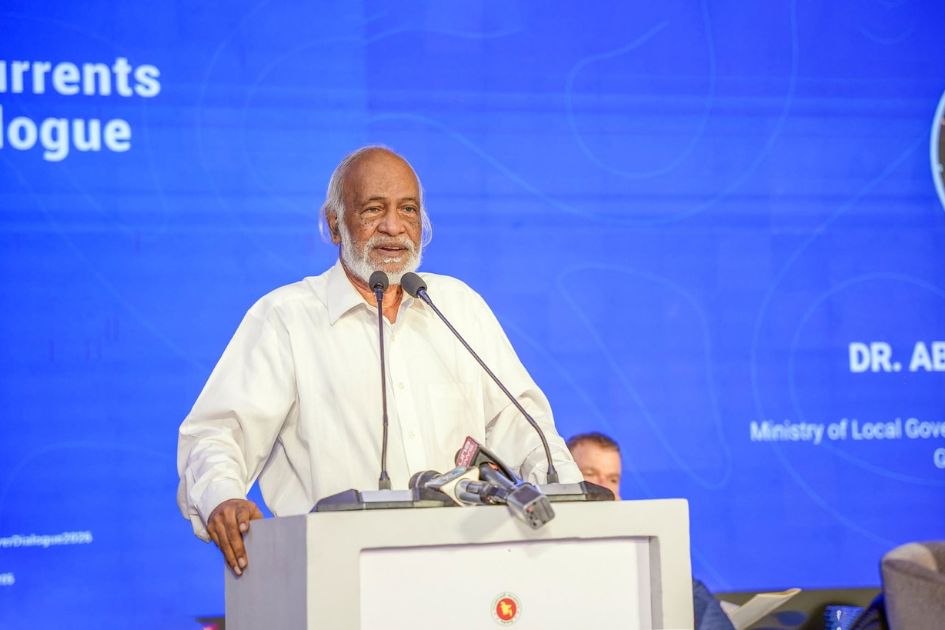
At the closing session, Local Government, Rural Development and Cooperatives Minister Dr Abdul Moyeen Khan called for sustained cooperation and practical action.
“Every river that runs through our land carries the stories of our ancestors and the hopes of our children. When a river dies, a part of our collective memory fades with it. We cannot allow that silence to settle over Bangladesh,” he said.
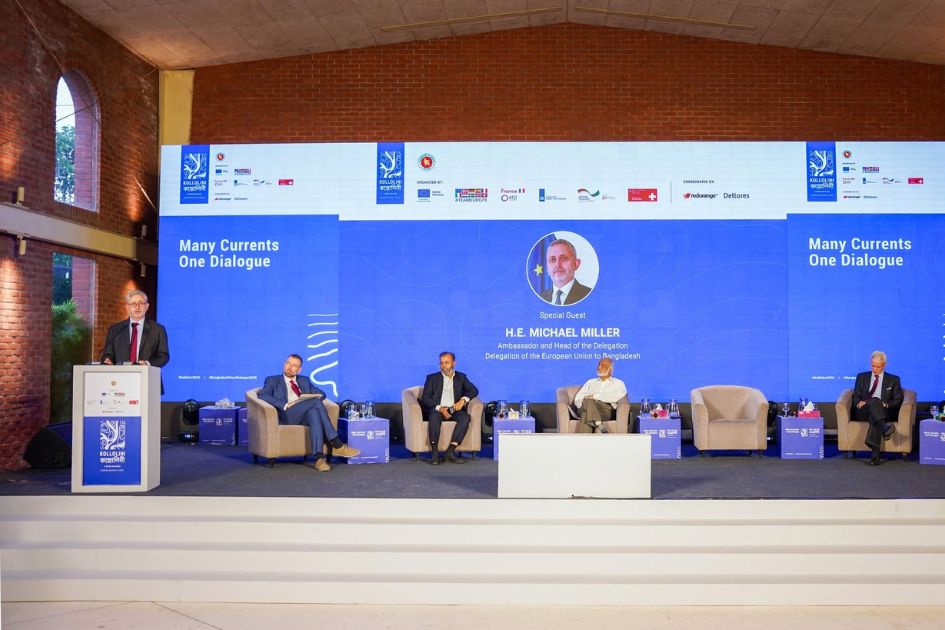
State Minister for Environment, Forest and Climate Change Shaikh Faridul Islam attended as guest of honour. European Union Ambassador Michael Miller, Swiss Ambassador Reto Renggli and German Embassy Deputy Head of Mission Daniel Blum attended as special guests.
A shared responsibility
Opening the dialogue, AFD Bangladesh Country Director Cynthia Mela called for decisive, collective action to repair the relationship between people and rivers. Dr Michal Krejza, minister counsellor and head of development cooperation at the Delegation of the European Union to Bangladesh, said climate strategies would remain incomplete without healthy rivers.
French Ambassador Jean-Marc Séré-Charlet described rivers as links between history, culture and everyday survival. Dutch Ambassador Joris van Bommel emphasised continued cooperation and shared responsibility.
Following a trailer screening of BURIGANGA: Forgotten River Mother, water resources and climate expert Malik Fida A Khan, senior adviser at Red Orange, outlined the scale of pollution, encroachment and lost river connectivity.
A high-level panel moderated by Red Orange Founder and Managing Director Arnob Chakrabarty featured Asian Development Bank Country Director Qingfeng Zhang, Drik Picture Library film director Tapash Paul and Riverine People Joint Secretary-General Mahabuba Rahman.
Water Resources Minister Md Shahiduddin Chowdhury Anee, who attended as chief guest, said “collective willpower is required” to protect rivers. He called for structural measures alongside policy action, community engagement and sustained coordination.
From investment to impact
A session on river investment examined how projects could deliver measurable improvements that last beyond individual funding cycles. Participants discussed long-term planning, ecological valuation, private-sector involvement and the need for clear responsibility for operations and maintenance.
Dr SM Zobaidul Kabir, joint secretary and Delta Wing chief at the General Economics Division of the Bangladesh Planning Commission, chaired the session. Nishchal Sardjoe of Deltares moderated it. Speakers included World Bank Senior Environmental Specialist Dr Md Istiak Sobhan; Green Climate Fund Water Resources Management Senior Specialist Dr Bapon Fakhruddin; BGMEA Director and Cute Dress Industry Ltd Managing Director Sheikh Hossain Muhammad Mustafiz; Martina Liebermann of GIZ; Ivan K Landers of the Asian Development Bank; and IUCN Country Representative Bipasha Hossain.
A second session addressed gaps between river plans and their implementation, including local ownership, education, institutional coordination and maintenance. State Minister for Water Resources Forhad Hossain Azad chaired it, while IWMI’s Shreya Chakraborty moderated. Representatives of the Netherlands Embassy, Swiss Embassy, École Pratique des Hautes Études, Footsteps and Parlement de la Loire joined the discussion.
“The government is trying its utmost to explore the causes of why our rivers are dying and drying up,” the state minister said, referring to the Bangladesh Delta Plan 2100.
Putting river rights into practice
An afternoon session examined how the legal recognition of rivers could lead to effective protection. Participants said that would require stronger institutions, enforcement and political commitment.
The session opened with a video message from Yuvelis Morales Blanco, a judge at the International Rights of Nature Tribunal and a 2026 Goldman Environmental Prize recipient. Moderated by Farah Anzum, the panel featured BELA Chief Executive Taslima Islam; BUET’s Dr Sara Nowreen; Emmanuel Schlichter of Rechte der Nature; AFD expert Farid Lamara; and National River Conservation Commission Secretary Md Moniruzzaman Talukder.
The programme also featured findings from a student River Innovation Hackathon, poster presentations, artwork by Drik Gallery and Shunno Art Space, photography by Abir Abdullah, a drama by Friendship and a Nodi Rox music segment featuring Chirkutt, Bangla Five and F-Minor.




