

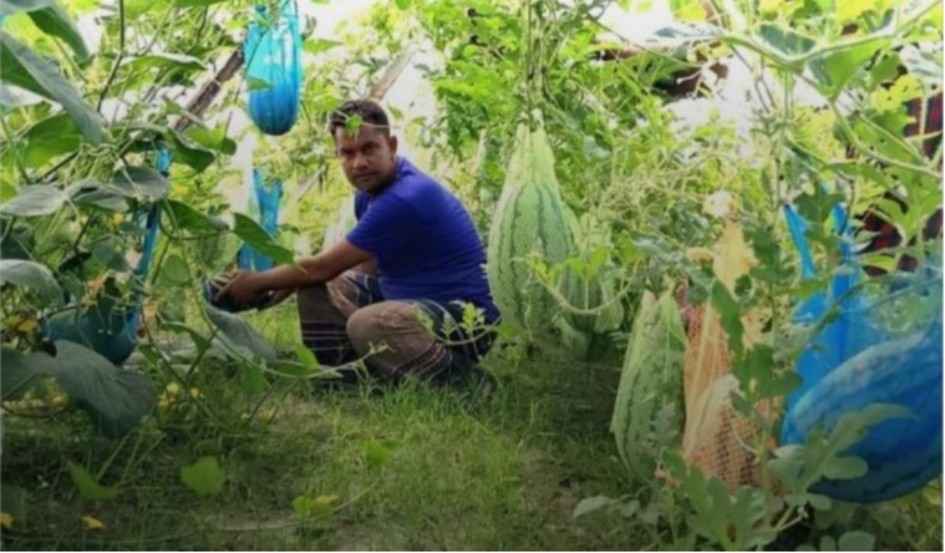



In Bangladesh’s coastal belt, rising salinity and climate shocks once crippled agriculture. Today, farmers in Paikgacha are leading a quiet revolution using multilayer and saline-tolerant farming to restore soil, diversify crops, and turn vulnerability into resilience across Khulna’s changing coastal landscape.
Khulna’s Paikgacha upazila, a southern-coast of Bangladesh is witnessing a quiet agricultural revolution. Through the adoption of modern technology and multilayer farming systems, farmers are now cultivating multiple crops on the same land transforming the once-saline, fallow coastal fields into vibrant hubs of food production and economic resilience.
A changing coastal economy
Once dependent almost entirely on brackish water shrimp farming, Paikgacha’s farmers are now diversifying their production. With government rehabilitation programs, incentives, and technical monitoring, they are producing more food grains and vegetables than the local demand requires a remarkable turnaround for one of Bangladesh’s most climate-vulnerable coastal areas.
Government initiatives aimed at promoting multi-crop agriculture in saline-prone regions have begun to bear fruit. Across 10 unions of Paikgacha, the embankments and canals once dominated by shrimp ponds are now lined with flourishing crops: bottle gourd, okra, bitter gourd, pumpkin, watermelon, beans, papaya, cucumber, red amaranth, and spinach. Farmers are receiving training, free seeds, and fertilizers under seasonal agricultural projects led by the Department of Agricultural Extension (DAE).
From salinity to Self-Sufficiency
In areas once devastated by shrimp cultivation, farmers are regaining their soil health and livelihood. Production of winter crops such as wheat, potatoes, sweet potatoes, mustard, maize, chili, onions, garlic, lentils and pulses has nearly doubled compared to last year.
“Paikgacha’s farmers are now producing their own nutrition and food security,” said a local agriculture officer. “This is no longer a story of survival it’s a story of innovation.”
Farmers like Bidhan Mondal of Deluti union have turned abandoned lands into modern agricultural plots, growing both local and exotic fruits and vegetables on canal banks. Similarly, Rabiul Sardar from Puraikati Beel in Gadaipur union has transformed his single-crop land into a multi-crop system, cultivating summer watermelon, gourd and bitter gourd. “Now I am self-reliant,” he said proudly.
Record yields despite climate shocks
According to Paikgacha’s Agriculture Office, vegetables are now cultivated on 234 hectares of pond and embankment land. Watermelon yields in Lata and Deluti unions have been particularly impressive. Over the past five years, the upazila has achieved record production of food grains even after enduring repeated natural disasters such as cyclones Sidr, Aila, Bulbul, Amphan, and Yaas.
“Twenty years ago, farmers could grow one or two crops a year,” said Md. Ekramul Hossain, Upazila Agriculture Officer. “Today, through multilayer and diversified cropping, many fields produce three or four crops annually. That’s a complete transformation.”
Science, technology and resilience
Paikgacha’s progress is rooted in innovation. Scientists are developing new high-yield and salt-tolerant crop varieties suited to the coastal environment. “We are rapidly popularizing these technologies through extension programs,” said Hossain. “Once the suitability is confirmed, we bring more fallow land under cultivation.”
He added that crop intensification and diversification have brought resilience to the coastal agricultural economy. “If we can continue expanding vegetable, fruit, lentil, potato, wheat, and maize cultivation, farmers’ incomes in the saline-prone south will continue to rise.”
Coastal agriculture in Bangladesh
Bangladesh’s coastal belt stretching across Khulna, Satkhira, and Bagerhat is home to over 40 million people whose livelihoods depend on agriculture and fisheries. Yet rising sea levels, soil salinity, tidal flooding, and repeated cyclones like Sidr, Aila, Amphan, and Yaas have severely degraded farmland and displaced communities. Once dominated by shrimp aquaculture and seasonal fallow lands, these regions faced declining yields and food insecurity for decades. In response, the government and development partners have promoted adaptive farming practices such as saline-tolerant crops, rainwater harvesting, and multilayer cultivation. Farmers in areas like Paikgacha are now experimenting with crop diversification, integrating vegetables, pulses, and fruits into former shrimp ponds.
These local innovations are reshaping the coastal agricultural economy reducing dependence on single-crop farming, restoring soil health, and building resilience against climate shocks that threaten Bangladesh’s food security and rural livelihoods.




