

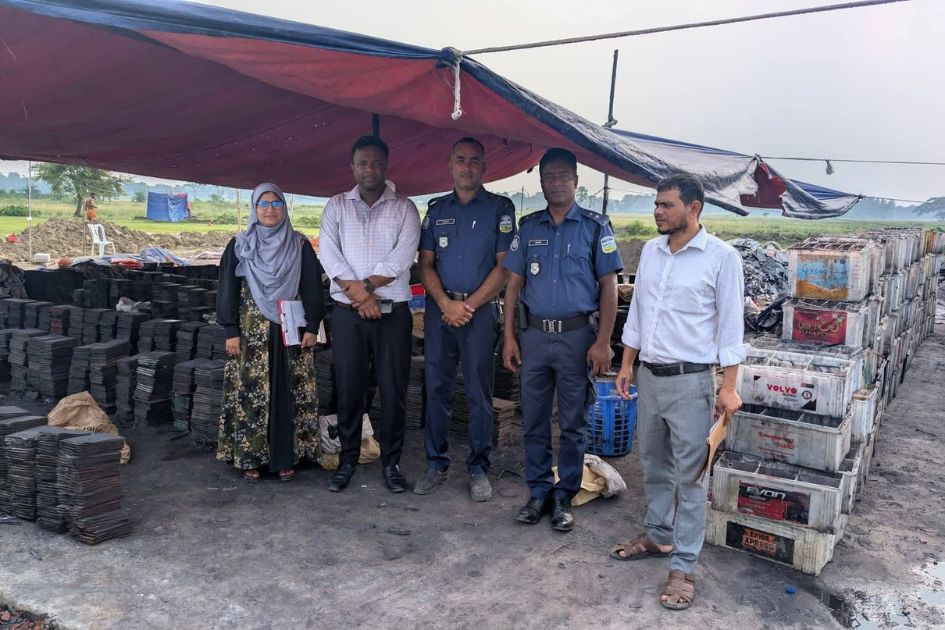



Authorities seized lead-processing equipment but made no arrests, prompting fresh questions over regulatory oversight, environmental risks and the use of agricultural land for unauthorised industrial activity.
A mobile court on Monday raided a suspected unauthorised used lead-acid battery smelting unit operating on agricultural land in Trishal upazila of Mymensingh, three days after a media report exposed the burning of old batteries in the area and raised concerns over pollution and damage to surrounding farmland.
The raid was conducted at a unit in Harba Bil in the Rayerground-Nighorkanda area under Harirampur Union. Around 50 workers reportedly fled the site before the operation, leaving authorities unable to make any arrests or impose fines.
The operation followed a report published on September 4 detailing how discarded batteries were allegedly being burned to extract lead in Nighorkanda of Harirampur Union and Namapara of Bailor Union. Both units were reportedly operating on agricultural land.
Residents had complained of black smoke, a strong chemical odour and suspected damage to paddy and fruit crops in nearby fields.
Equipment seized during raid
The mobile court was led by Assistant Commissioner (Land) and Executive Magistrate Mahbubur Rahman.
Officials said they recovered and seized equipment allegedly used in the lead-extraction process, including a blower, a ladle used to stir molten lead, a spatula and discarded battery casings.
Rahman said the equipment found at the site indicated that old batteries were being processed to extract lead.
He said the Assistant Director of the Department of Environment had been instructed to file a case against those responsible under the Bangladesh Environment Conservation Act.
Officials of the Department of Environment in Mymensingh and personnel from Trishal police station assisted in the operation.
No arrests were made as the workers had left the premises before the raid.
Questions over regulatory monitoring
The raid has raised questions about how the unit was able to operate if, as residents and local officials alleged, the activity had continued for months.
Residents said the Nighorkanda and Namapara units had been burning discarded batteries for an extended period, releasing smoke and a sharp chemical smell into surrounding areas.
They also alleged that the facilities lacked the required environmental clearance and trade licences.
The key question now is why routine inspections failed to detect the operations earlier.
If the units had been functioning for months on agricultural land, residents and local representatives say, regulatory agencies should explain why action came only after the media report brought the matter to public attention.
Land leased to factory, UP member confirms
Questions have also emerged over who owns and operates the facilities and whether local influence helped them continue.
Saiful Islam, a Union Parishad member of Harirampur, alleged that Anwarul Haque, the UP member representing Nighorkanda ward, had leased land owned by himself and his family to the lead-smelting unit.
Saiful Islam said repeated warnings had failed to stop the operation.
When contacted, Anwarul Haque confirmed that the land belonged to him and his family and had been rented out to the factory.
Asked whether the unit had a trade licence, he said it did not and acknowledged that the factory lacked the required government approval to operate.
How the factories operated
During visits to the two facilities, local sources estimated that nearly 50 workers were involved in the operations.
Workers reportedly dismantled old batteries during the day, separating lead from plastic casings. At night, the extracted lead was reportedly melted in pits dug into the ground and cast into blocks.
Local sources said the blocks were later sold to battery manufacturers.
Residents described the fumes released during the burning and melting process as highly harmful and said the smell spread across nearby farmland and settlements.
Nahid, a resident of Nighorkanda, said chemicals released during the burning of batteries and acid had damaged paddy and fruit crops in nearby fields.
UP member Saiful Islam Faraji alleged that the operation had continued on agricultural land for several months despite repeated objections from residents.
The allegations about environmental damage have not yet been independently quantified. Soil, water, crop and air-quality testing would be required to establish the extent of any contamination.
Managers admit lack of approvals
Abul Kalam, manager of the Harirampur unit, acknowledged that the factory did not have the required government approvals.
He said efforts were under way to obtain approval but declined to disclose the owner’s name, address or contact details, saying the business was being run by “managing everyone concerned.”
Bilal, identified by local sources as the owner of the Bailor Union unit, also acknowledged that his factory lacked government approval to operate on agricultural land.
He requested that no report be published about the facility.
Both managers’ admissions raise further questions about how the facilities were allowed to operate without the required approvals.
Second unit operating in Bailor
Local sources said another suspected unauthorised lead-smelting unit had been operating on the western side of the Dhaka-Mymensingh highway in Ward 6 of Bailor Union.
They identified Bilal as the person associated with that facility and alleged that another influential local resident, identified as Azad, had established the Nighorkanda unit after leasing farmland adjoining a brick kiln.
The allegations concerning the individuals require further verification through land records, lease documents, regulatory records and the formal ownership details of the businesses.
Agriculture officer warns of soil damage
Hammim Jahan, upazila agriculture officer, said lead and acid contamination could cause permanent damage to soil fertility.
He said crops grown on contaminated land could become unsafe for human consumption.
The potential impact therefore extends beyond smoke and odour. If lead or other hazardous substances have entered agricultural soil, the consequences could continue even after the factories stop operating.
Independent testing of soil and crops would be necessary to establish whether contamination has occurred and how extensive it is.
UP says it did not issue trade licence
Shamsuzzaman Masum, administrator of Harirampur Union Parishad, said the UP had not previously been aware of the factory and had not issued any trade licence for it.
He said local farmers were extremely angry over the operation.
His statement raises another question: how a commercial facility could operate on agricultural land without a local trade licence being issued or detected.
Residents fear operations may resume
Residents said they feared the factories could reopen at another location once the immediate scrutiny following the raid subsided.
They called on authorities to go beyond seizing equipment and identify the actual owners and financiers behind the operations, pursue legal action and investigate any environmental damage caused by the facilities.
They also demanded regular inspections of similar operations in the area to prevent unauthorised battery processing and lead-smelting from continuing undetected.
Attempts to obtain a response from the Department of Environment regarding the alleged monitoring lapse and the regulatory status of the two facilities should also be part of the continuing investigation.
Monday’s raid was an immediate enforcement action, but the larger test will be whether authorities can identify those responsible, determine whether agricultural land and crops have been contaminated and ensure that the operations do not simply resume elsewhere.
For the local administration and the Department of Environment, the issue now goes beyond one mobile court raid. It is whether regulatory enforcement can prevent hazardous lead processing from being carried out again on agricultural land in Mymensingh.




