

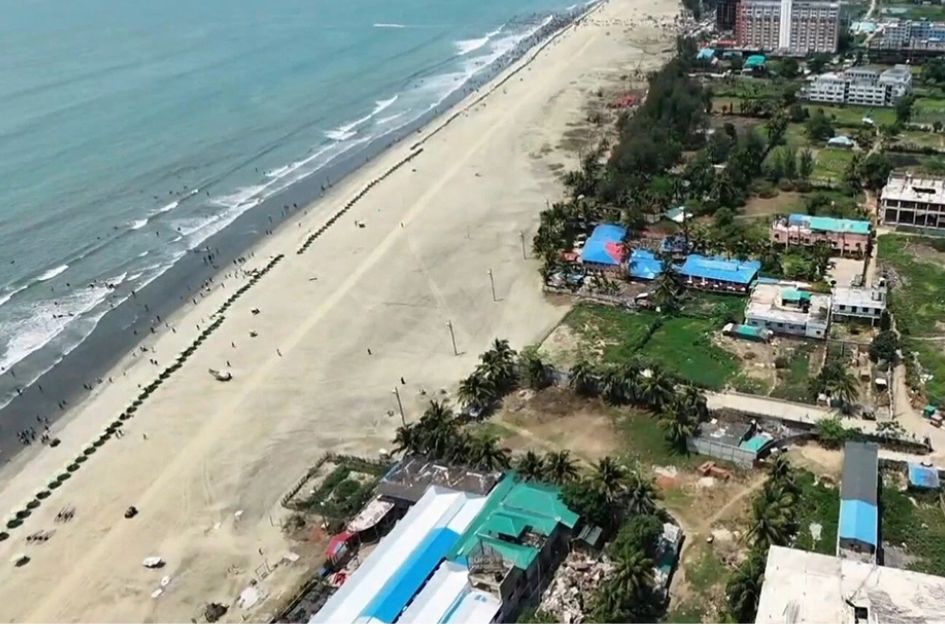



Court action, a UN expert’s intervention and local protests have placed the Sugandha-Kalatoli road plan under scrutiny, with advocates calling for independent review of its coastal risks.
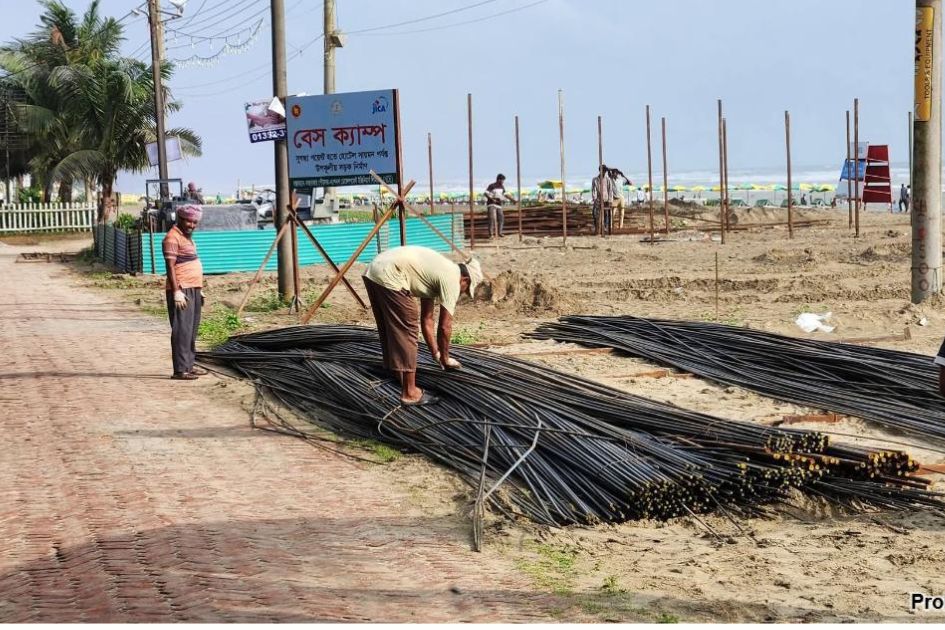
The aggressive push to construct a 1.2-kilometer, four-lane connection road and concrete protection embankment directly over the active sand dunes from Sugandha Beach to Kalatoli in Cox’s Bazar has escalated from a local environmental crisis into a critical question of national economic security and geographical sovereignty. Jointly executed by the Bangladesh government’s Local Government Engineering Department (LGED) and the Cox’s Bazar Municipality, and funded by the Japan International Cooperation Agency (JICA), the project’s engineering blueprint was formulated by the Japanese consulting firm Nippon Koei. Under the guise of urban modernization, this high-density concrete corridor represents a classic manifestation of “infrastructure diplomacy”, a mechanism leveraging foreign debt traps that compromises the country’s core natural assets and long-term economic autonomy.
Prime Minister Tarique Rahman firmly articulated the foundational principle of environmental stewardship, stating that environmental preservation is not a luxury, but an imperative for survival and national stability. Pushing concrete infrastructure onto ecologically fragile dunes directly violates the designated Ecologically Critical Area and Ecologically Sensitive Area and undermines these established sustainable development directives. This raises a fundamental policy contradiction: why should the short-sighted decisions of local authorities, tailored to serve the commercial interests of foreign consultants, be permitted to compromise the strategic integrity of national policy?
Debt trap dynamics and debt-driven governance:
A macroeconomic analysis of Bangladesh’s foreign debt portfolio underscores the strategic influence wielded by bilateral creditors. Official records indicate that Bangladesh’s total external debt portfolio stands at US$93.46 billion. Within this landscape, Japan/JICA commands an 18% share, amounting to US$13.91 billion, anchored by major consolidated commitments such as the Matarbari Power and Port development, valued at approximately US$5.73 billion. Annual disbursement metrics further illustrate JICA’s significant lending footprint alongside institutions like the World Bank and the Asian Development Bank (ADB).
When multilateral and bilateral lenders convert public debt into rigid, capital-intensive engineering contracts, economic empowerment gives way to foreign dependency. Projects like the BDT 63.50 crore Sugandha road loan leverage broader credit reliance to bypass local ecological resistance, exposing how debt-driven infrastructure financing can infringe upon fiscal sovereignty and national development priorities.
Ecological blindness and geomorphological risks:
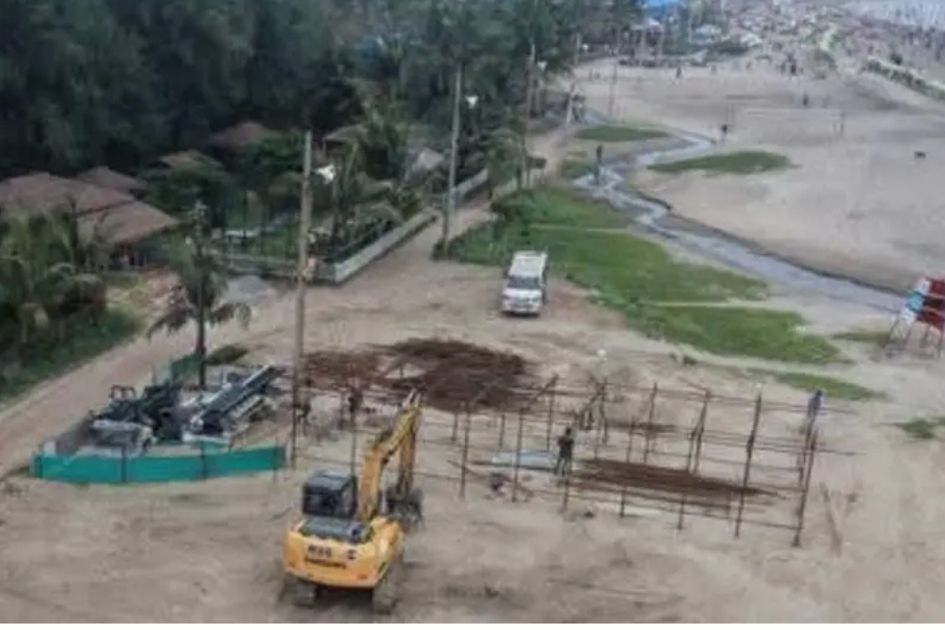
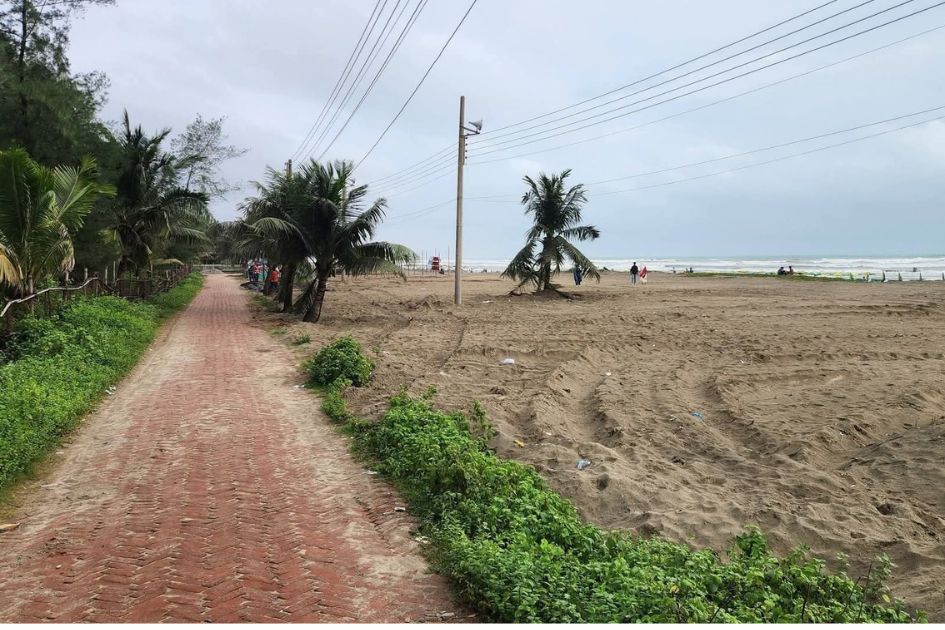
Proceeding without a comprehensive Environmental Impact Assessment (EIA), this four-lane highway represents catastrophic planning from a coastal geomorphology perspective. The active sand dunes of Sugandha and Kalatoli are not merely static piles of sand; they serve as a dynamic Natural Wave Attenuation System. Erecting hard engineering structures and concrete seawalls upon active dunes induces severe wave reflection. Consequently, the reflected wave energy scours the base of the beach, a process known as “beach scouring”, thereby accelerating coastal erosion exponentially.
In an era where sea-level rise and severe cyclonic storm surges in the Bay of Bengal are compounded by climate change, destroying natural buffer zones guarantees that marine surges will directly strike urban settlements. Multilateral agencies exploiting fragile socioeconomic conditions to impose capital-intensive engineering solutions ultimately exacerbate vulnerability rather than build resilience.
Legal injunctions, UN expert interventions and grassroots frontline movement:
Legal and institutional resistance against the Sugandha project continues to mount. Following a public interest writ petition filed by the Bangladesh Environmental Lawyers Association (BELA) and a contempt petition by Human Rights and Peace for Bangladesh (HRPB), the High Court bench of Justice JBM Hasan and Justice Aziz Ahmed Bhuiyan issued a rule staying all construction activities on the controversial stretch from Sugandha Point towards Sayeman Beach Resort for eight weeks. Concurrently, the Department of Environment issued a show-cause notice regarding flagrant violations of environmental statutes and prior judicial directives.
Welcoming the judicial stay, Astrid Puentes Riaño, the United Nations Special Rapporteur on the human right to a clean, healthy and sustainable environment, commended the High Court’s intervention as a timely step to protect one of the country’s most fragile coastal ecosystems. Emphasizing the international legal standing of the area, Puentes Riaño highlighted that Cox’s Bazar, the world’s longest unbroken natural sea beach, is a legally designated Ecologically Critical Area (ECA), a status that demands the highest level of state protection. She asserted that large-scale infrastructure projects in ecologically sensitive zones must be preceded by thorough, independent and participatory environmental, social and human rights impact assessments, along with rigorous climate risk evaluations. Such safeguards, she stressed, are fundamental state duties rather than discretionary formalities. Furthermore, the UN Special Rapporteur commended civil society and rights organizations for bringing the matter to court, noting that access to justice remains essential to protect vulnerable ecosystems and communities that lack a voice in decision-making processes.
Reacting to the UN Special Rapporteur’s intervention, urban planner Khondker Neaz Rahman strongly reinforced her observations while pointing the finger directly at systemic administrative negligence. He asserted that the international critique validates years of warnings from technical experts and civil society regarding corrupt bureaucratic practices within executing agencies. Neaz Rahman argued that certain government officers, driven by vested administrative interests and opaque procurement agendas, routinely collateralize public funds and ecological safety for donor-driven contracts. He stressed that when local authorities collude with foreign consultants to push unscientific designs through Ecologically Sensitive Areas and Ecologically Critical Areas, it represents not merely a technical error, but an institutionalized culture of accountability evasion. In light of the UN expert’s intervention, Neaz Rahman called on the state to actively resist corrupt bureaucratic overreach, audit project officials responsible for side-stepping EIA requirements and permanently dismantle ill-conceived infrastructure projects that compromise Cox’s Bazar’s coastal security.
Leading the charge on the ground, the Eco-Democratic Movement, Cox’s Bazar team has anchored the frontline grassroots resistance against this ill-conceived commercial expansion. Uniting local environmental organizations, youth groups and climate activists, the movement spearheaded a massive human chain and protest rally right in the courtyard of the Cox’s Bazar Municipality premises. Expressing the movement’s stance to Prothom Alo, spokesperson Md Jabed Nur Shantaw stated, “We also want the development of Cox’s Bazar. But not by filling or encroaching upon the active sand dunes of an ecologically critical beach. Just 20 minutes of rain submerges the entire town in waterlogging because the municipal drainage channels are not properly cleared. Yet, there is no project to solve this severe waterlogging.”
Translating grassroots outrage into decisive policy action, the Eco-Democratic Movement team submitted a formal memorandum addressed directly to the Project Director of LGED, with copies dispatched across six key administrative offices. Demanding an immediate suspension of all construction activities at Sugandha Beach and a mandatory redesign of the project, their grassroots mobilization successfully elevated local community voices into a vital national counterweight against bureaucratic inertia.
On August 30, 2026, both Transparency International Bangladesh (TIB) and the Bangladesh Institute of Planners (BIP) issued stern formal statements. TIB condemned the flattening of dunes for commercial corridors based on foreign consultancy without rigorous environmental appraisals, while BIP warned that constructing roads by destroying natural coastal defense systems directly contradicts sustainable development goals. Environmental advocates maintain that no excavation should occur without an independent review conducted by experts from BUET alongside local stakeholders and grassroots representatives.
The project also blatantly bypasses institutional planning guidelines outlined in the Cox’s Bazar District Master Plan (1st Amendment). Section 13.7 of the Draft Strategic Plan provides for a Social Assessment, Baseline Socio-Economic Survey and a Community Grievance Redress Committee (GRC) for relevant spatial or land-acquisition interventions. Whether these requirements were complied with should be independently verified. By side-stepping these mandatory social and environmental safeguards, LGED and JICA have ignored localized administrative accountability.
This bureaucratic overreach reflects deep historical roots. Chapter 13 of the Master Plan traces land acquisition frameworks back to the 1824 Bengal Regulation-I, enacted by the British East India Company to monopolize salt trade under the broad pretext of “Public Purposes.” Centuries later, top-down land acquisition continues to prioritize unilateral infrastructure goals over community consent and ecological protection.
In a statement published on August 29, 2026, prominent economist and activist Professor Anu Muhammad highlighted the project’s critical flaws. On the same day, citing severe engineering flaws, urban planner Khondker Neaz Rahman warned, “Attempting to obstruct the natural dynamics of active sand dunes with concrete embankments or four-lane highways reflects utter planning blindness. Marine hydrodynamic forces cannot be contained by rigid structures; such unscientific design will lead to a waste of public funds while permanently dismantling Cox’s Bazar’s natural defense against natural disasters.”
The imbalance between geomorphological imperatives and unscientific project design:
Past infrastructure failures along the Marine Drive near Teknaf Zero Point, where sections breached and collapsed into the sea, underscore the futility of rigid coastal engineering. The temporary measure of dumping geo-bags proved counterproductive, polluting the shoreline with synthetic debris. Similarly, the historical introduction of non-native Australian pine (Casuarina equisetifolia) proved counter-effective; its shallow fibrous root system fails to bind loose sand efficiently and uproots during cyclones, creating massive structural cavities along the dunes.
Conversely, the indigenous Nona Jhau serves as the genuine biological protector of the coastline. Its deep taproot system stabilizes sand layers, absorbs wave energy and facilitates natural dune accretion over time. Transitioning from JICA’s concrete-centric model to Nature-based Solutions (NbS) incorporating native vegetation remains the only scientifically sound trajectory.
Core vision for Cox’s Bazar: Economic security and tourism resilience:
The economic backbone of Cox’s Bazar relies entirely on its uninterrupted, natural sea beach. Tourists do not travel to Cox’s Bazar to view four-lane concrete highways; they come to experience the pristine expanse of the coastline. Degrading this foundational natural asset threatens the entire tourism ecosystem, jeopardizing hotels, local vendors, transport sectors and thousands of dependent livelihoods.
Addressing this core concern during policy discussions with the Cox’s Bazar Development Authority on August 7, 2026, Home Minister Salahuddin Ahmed explicitly laid out the strategic framework for the region. “The development architecture of Cox’s Bazar must strictly center on community-led economic empowerment, local participation, and environmental ecology. Sacrificing natural marine defenses for mega-structures driven by foreign lenders directly damages the local economy and undermines sustainable growth. True development lies in preserving the environment while uplifting local livelihoods.”
Strategic imperative and executive intervention:
Extricating the nation from debt-driven infrastructure schemes that compromise environmental security and sovereign governance is a strategic necessity. Preserving national assets requires unwavering execution and rigorous oversight.
Framed as an urgent demand to Prime Minister Tarique Rahman, civil society, the Eco-Democratic Movement, Cox’s Bazar team and frontline environmental advocates urge immediate executive intervention in JICA’s infrastructure framework. The establishment of an independent, scientific review panel to revise or revoke the flawed contract is demanded as a mandatory step to safeguard Cox’s Bazar from irreversible ecological and economic ruin.




