

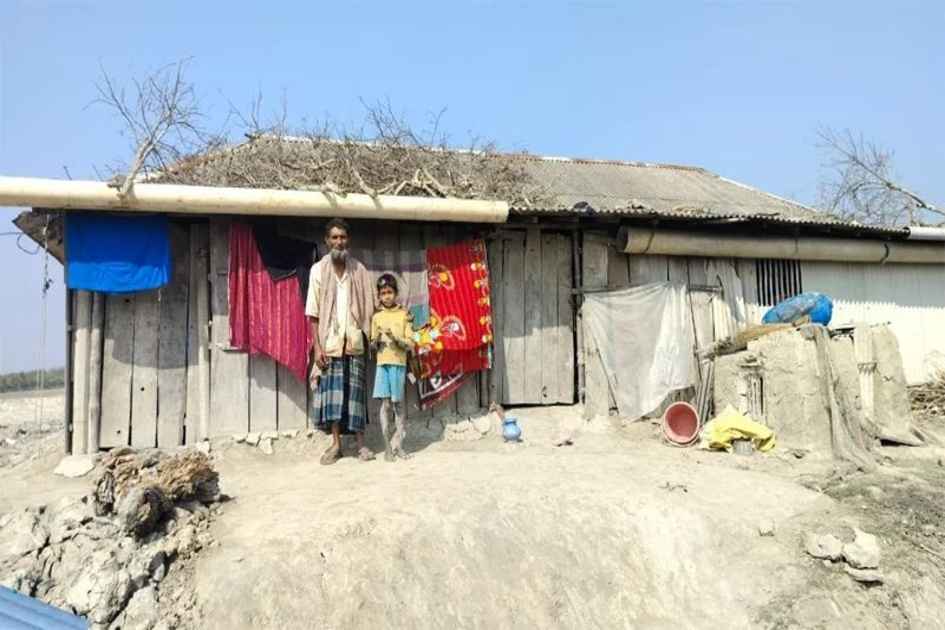



Dozens of landless families in coastal Satkhira fear eviction from a climate-vulnerable river char as a private fisheries lease sparks rights livelihood and environmental concerns amid growing climate justice debates.
Dozens of landless families who have lived for decades on a river char along the Chuna River in Shyamnagar upazila of Satkhira district are facing imminent eviction allegedly linked to a private fisheries project on leased government land in one of Bangladesh’s most climate-vulnerable coastal zones near the Sundarbans.
Shyamnagar Upazila Nirbahi Officer Shamsuzzaman Kanak said the administration would take necessary legal steps prioritising public interest.
The char communities are located in an area repeatedly affected by cyclones tidal surges river erosion and rising salinity impacts widely linked to climate change. For many landless families displaced by disasters elsewhere these fragile sandbars have become their last refuge.
Seventy-year-old day labourer Ahmad Ali a resident of the char broke down while describing his situation. “We have no land of our own. We live on the char with our children and grandchildren and survive somehow. Fishing and catching crabs no longer sustain us because the river has changed. If we are evicted now where will we go?” he said.
Ahmad Ali said his household of ten includes a person with disabilities and depends entirely on the river and a makeshift homestead. “If our houses are demolished we will have to live on the road. We beg the authorities to protect us,” he added.
Similar fears were expressed by 55-year-old Nilkanta Bairagi who said landless families have lived on the government-owned char land for nearly 40 years. “Many people previously leased parts of this char for shrimp enclosures but we were never asked to leave. After the land was leased to R-Rad Fisheries and Agro Park two years ago attempts to evict us began,” he alleged.
Residents said they were summoned to the Water Development Board office on Tuesday January 27 and instructed to remove their houses within 24 hours. They alleged the company’s manager threatened to demolish homes using excavators if they failed to comply.
Families living near Kolbari Bridge along the Chuna River including Marufa Begum Aminur Rahman Ratan Mondol and Shibapada Rishi said they are now living in constant fear. They accused R-Rad Fisheries and Agro Park of trying to force them off the land after leasing the char for a fisheries project.
According to residents the land was leased for three years of which around one and a half years have already passed. Despite the limited remaining lease period they alleged the company has begun digging ponds for shrimp farming destroying at least 100 bain and keora trees. These native species play an important role in stabilising riverbanks and limiting salinity intrusion which has intensified in coastal Satkhira in recent years.
They further alleged that excavators have been digging dangerously close to their homes creating embankments and ponds to pressure families into leaving. Residents also claimed they have been threatened with legal cases and forcible demolition.
The families said a cremation ground used by the local Hindu community has been buried under excavated soil raising concerns over religious and cultural rights. Two fishing boats used for catching fish and crabs in the Sundarbans have also reportedly been threatened with removal further undermining livelihoods already weakened by environmental degradation and declining fish stocks linked to rising salinity.
Describing their vulnerability residents said many families survive on daily labour and subsistence fishing and cannot afford basic social needs. They urged the authorities to cancel the lease on humanitarian and land rights grounds.
Coastal Bangladesh frequently faces disputes over char lands which are legally classified as government property but often serve as the only shelter for landless and climate-displaced populations. Rights groups argue that evictions without consultation rehabilitation or alternative housing deepen poverty and displacement in disaster-prone regions.
Responding to the allegations Abdur Rahman manager of Ar-Rad Fisheries and Agro Park said legal notices had been served but no responses were received. He said the company offered Tk 50,000 in compensation per family which residents declined. Asked why eviction efforts were initiated after more than half of the lease period had passed he said it was a management decision before disconnecting the call.
Commenting on the situation climate justice advocate Sohanur Rahman said forced evictions in such areas raise serious concerns. “These families are living on the frontline of climate change. Repeated disasters salinity and river erosion have already stripped them of land and livelihoods. Evicting them without rehabilitation or secure alternatives is not development it is a failure to recognise land rights and climate justice,” he said.




