




Khulna University plans a coastal Living Lab near the Sundarbans to advance climate research, strengthen international collaboration, and support field-based adaptation learning in Bangladesh’s vulnerable southwest.
In a significant step toward strengthening global climate research collaboration, Khulna University has announced plans to establish a coastal “Living Lab” research facility in Bangladesh’s southwestern region, adjacent to the world-renowned Sundarbans mangrove forest.
The proposed facility is envisioned not as a symbolic offshore campus, but as a fully operational field-based research station where scientists, students, and international partners can directly study coastal ecosystems, climate vulnerability, biodiversity loss, and community-led adaptation in real time. It is expected to function as a hub for long-term data collection, field experimentation, and applied climate solutions grounded in one of the world’s most climate-exposed landscapes.
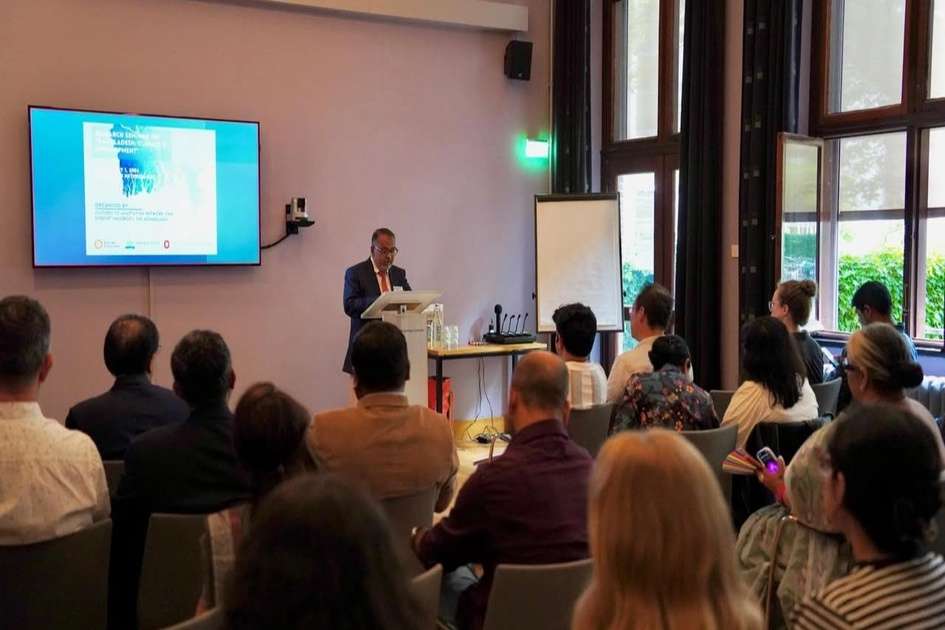
The announcement was made by Khulna University Vice-Chancellor Professor Dr. Md. Rezaul Karim during the opening session of a two-day international seminar titled Bangladesh: Climate and Development hosted at Utrecht University.
Sundarbans as a global climate sentinel landsca
Positioned beside the Sundarbans mangrove ecosystem, the Living Lab is expected to draw global scientific attention to a landscape widely regarded as a frontline indicator of climate change impacts. Rising sea levels, salinity intrusion, cyclonic storms, and accelerated erosion are already reshaping both the ecosystem and the livelihoods of millions living in the coastal belt.
Professor Karim emphasized that these changes are not future projections but present realities shaping Bangladesh’s development trajectory. He noted that climate change is deeply interconnected with food systems, water security, health outcomes, education, and economic resilience.
Defining the Living Lab approach
According to the university, the Living Lab model will integrate field-based research, community participation, and international academic collaboration in a shared physical space. The initiative is expected to bring together researchers and students to work alongside local communities, enabling knowledge exchange between scientific institutions and lived experience in climate-affected areas.
The proposed site is expected to support joint research activities, student field training, and applied innovation focused on adaptation strategies relevant to coastal Bangladesh.
Strengthening Bangladesh–Netherlands academic cooperation
The seminar highlighted expanding collaboration between Khulna University and leading Dutch institutions, including Wageningen University & Research, alongside Utrecht University.
Under the Cultures of Adaptation Network (CAN), researchers have been jointly studying climate adaptation, migration patterns, governance challenges, and social resilience in Bangladesh’s coastal regions. The initiative has been strengthened through academic linkages facilitated by Dr. Bishawjit Mallick, a former Khulna University student and currently an associate professor at Utrecht University.
Research exchange and future academic programs
The two-day seminar featured 32 research presentations covering water management, displacement and migration, climate justice, urban planning, and community-based disaster risk reduction. Discussions also emphasized the importance of bridging policy, academia, and field realities in climate-vulnerable regions.
The Bangladeshi delegation also held discussions with Dutch counterparts on expanding institutional cooperation, including the possibility of launching a joint degree program between Khulna University and Utrecht University.
Following the seminar, both institutions are scheduled to jointly organize an international Summer School from July 6 to 10, focusing on coastal ecosystem management and climate adaptation, combining classroom learning with field-based exposure.
Looking ahead
By linking the Sundarbans mangrove forest and surrounding coastal ecosystems with international academic networks, Khulna University aims to position the region as a globally significant living classroom for climate science and adaptation research.
The initiative reflects a growing recognition that some of the most important insights into climate resilience will emerge not only from laboratories and policy centers, but from frontline landscapes where climate impacts are already reshaping everyday life.




