

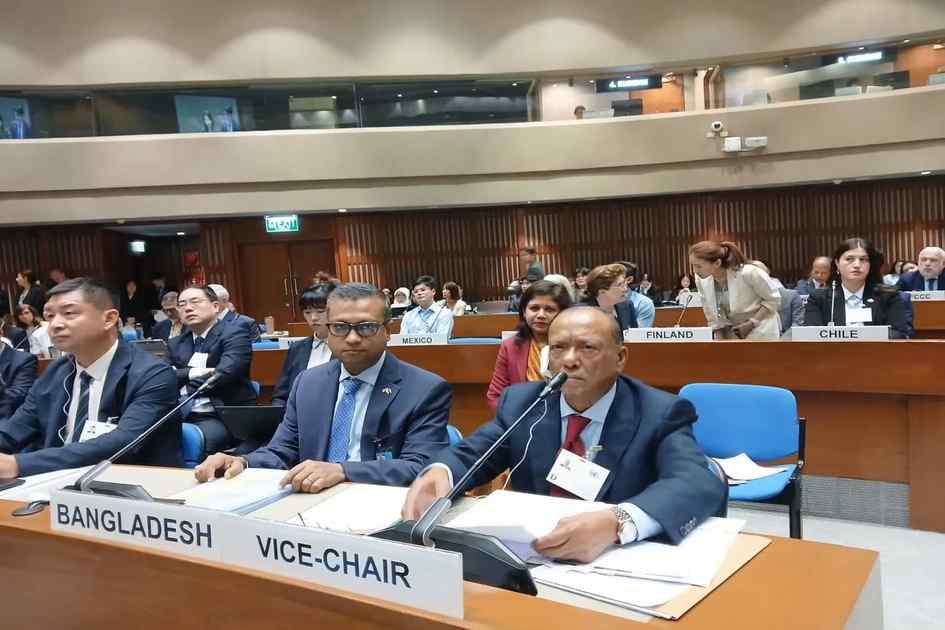

Bangladesh urged Asia-Pacific nations to deepen climate cooperation, promote a fair green economy, expand bio-based innovation and protect vulnerable communities through regional solidarity, climate finance and nature-based solutions.
Bangladesh has urged Asia-Pacific countries to strengthen regional cooperation to accelerate a just and climate-resilient green economy and bioeconomic transition, warning that fragmented national efforts will not be enough to respond to escalating climate impacts. Under Prime Minister Tarique Rahman, Bangladesh’s climate and environmental strategy prioritizes massive afforestation, renewable energy targets and robust global advocacy for climate funding.
The remarks were made on Wednesday in Bangkok during the Ministerial Roundtable Intervention at the ninth session of the Committee on Environment and Development hosted by the United Nations Economic and Social Commission for Asia and the Pacific. Bangladesh’s Minister of Environment, Forest and Climate Change, Abdul Awal Mintoo, delivered the statement and later responded to a question from UNESCAP Deputy Executive Secretary Ms. Lin Yang, outlining Bangladesh’s lived climate experience alongside national and regional policy directions.
He highlighted the rapid expansion of the global bioeconomy, projected to grow from $4 trillion today to $7.7 trillion by 2030, and stressed that countries must act collectively to ensure the transition is both equitable and resilient.
“Green growth must work for everyone,” Bangladesh tells Asia-Pacific
Emphasizing fairness at the center of climate action, the minister said, “Economic growth must be environmentally friendly and inclusive.” He added, “Farmers, fishers, women and marginalized communities must be the primary beneficiaries of this transition.”
He noted that Bangladesh, as a low-lying deltaic nation, remains highly exposed to climate shocks including floods, cyclones, salinity intrusion and extreme heatwaves. Citing World Bank data, he said severe heatwaves in 2024 alone caused losses of around $1.78 billion and resulted in approximately 25 million lost workdays.
“We are turning challenges into opportunities,” says minister on circular shift
At a parallel session co-hosted by the United Nations, FAO and UNEP, he highlighted Bangladesh’s growing shift toward a circular economy and bio-based innovation.
“We are turning our challenges into opportunities,” he said, pointing to the transformation of jute, Bangladesh’s golden fiber, into biodegradable and higher-value products as a sustainable alternative to plastic.
He added, “Clean energy access is expanding fast,” referring to more than 4.13 million solar home systems that now provide electricity to around 18 million people in rural and coastal areas. He also underscored the expansion of biogas and improved cookstove initiatives, saying these efforts are helping “reduce emissions while improving lives at the household level.”
On ecosystem-based adaptation, he stressed the importance of mangrove conservation, stating, “The Sundarbans is not just a forest. It is our frontline defense against climate disaster.”
“A circular future is not optional,” Bangladesh outlines long-term vision
Outlining the future policy direction, the minister said Bangladesh is advancing toward a circular future grounded in the principles of reduce, reuse and recycle, alongside expanded waste-to-energy systems and green job creation.
He announced a nationwide afforestation campaign under the leadership of Prime Minister Tarique Rahman targeting 250 million trees over the next five years, saying, “We must act at scale and act together if we want real resilience.”
He also emphasized that the Asia-Pacific region stands at a critical turning point, adding, “No country can face climate change alone. Regional solidarity is no longer a choice. It is a necessity.”
Bangladesh’s climate and environment agenda is being implemented under the Government of Bangladesh within its current constitutional framework, with an emphasis on resilience, inclusive growth and nature-based solutions.




