

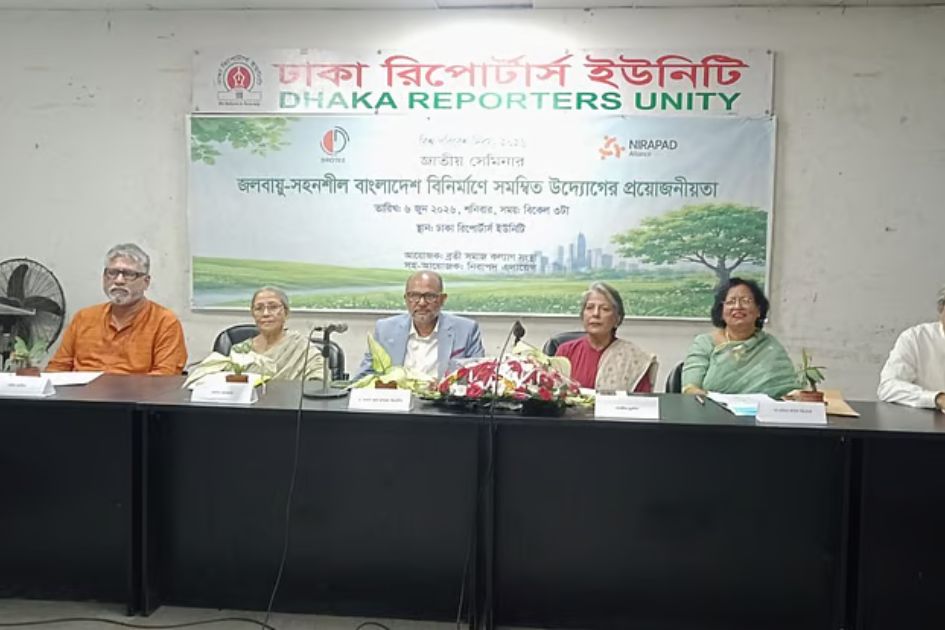

Economic adviser Rashed Al Mahmud Titumir says future investments should prioritize employment generation and environmental sustainability alongside financial returns to build a climate-resilient, inclusive and sustainable Bangladesh.
Bangladesh should evaluate future investments not only on economic returns but also on their ability to create jobs and protect the environment, Prime Minister’s Economic and Planning Adviser Rashed Al Mahmud Titumir said on Saturday.
Speaking at a seminar in Dhaka, Titumir said employment generation and environmental sustainability must be treated as equally important considerations alongside financial gains when approving new projects and investments.
The seminar, titled “The Need for Integrated Initiatives to Build a Climate-Resilient Bangladesh”, was jointly organized by Brati Social Welfare Organization and Nirapad Alliance at the Nasrul Hamid Auditorium of the Dhaka Reporters Unity (DRU). The event aimed to promote awareness, identify priorities and encourage coordinated action to address the climate crisis.
Titumir said four key conditions should be met before approving any future loan or development project: value for money, return on investment, employment generation and environmental compatibility.
“No development project should be undertaken unless these conditions are fulfilled,” he said.
Highlighting the challenges facing young people, he said uncertainty over employment, housing and quality of life remains a pressing concern. To address those realities, the government is prioritizing two objectives: establishing rights and building a discrimination-free Bangladesh.
Titumir said the government is working toward creating a democratic, humane and welfare-oriented state guided by the principle that Bangladesh comes first and people come above all else.
He also outlined plans for a major transformation in the country’s power and energy sectors. The government, he said, is pursuing an economic model that encourages investment and boosts production, leading to increased employment opportunities. Such growth would allow domestic revenue to rise without increasing tax rates, enabling greater spending on sectors such as health and education.
According to Titumir, Bangladesh intends to promote environmentally friendly technologies and electric transportation systems in place of fossil fuel-dependent alternatives. The production of electric buses, electric railway locomotives and other electric vehicles within the country would support industrialization while helping reduce air pollution.
Addressing climate adaptation, he said Bangladesh’s water, agriculture, industry and river management systems must be brought under an integrated planning framework. Reducing excessive dependence on groundwater, protecting rivers and water bodies, re-excavating waterways and promoting environmentally friendly agriculture should be national priorities, he said.
Titumir added that work is progressing on a five-year integrated development plan for the haor and baor regions as well as the Teesta Master Plan. Efforts are also underway to establish sustainable agricultural systems in the Barind region.
In her welcome remarks, Brati Social Welfare Organization founder and chief executive and former adviser to the interim government Sharmin S. Murshid said Bangladesh must go beyond strengthening adaptation capacity and ensure coordinated efforts among the state, civil society and international partners to confront climate change.
She said climate change is not a future threat for Bangladesh but a daily reality affecting millions of people. River erosion, displacement, limited access to education and healthcare and the feminization of poverty are among its many consequences.
Murshid stressed that the climate crisis cannot be resolved without global justice and meaningful accountability from developed countries. She also called for strengthening grassroots research, local innovation and citizen leadership to build an effective domestic response system.
Former interim government Fisheries and Livestock Adviser Farida Akhter said climate change is not merely an environmental issue but is also driven by consumerism, deforestation, excessive use of chemical fertilizers and pesticides and unplanned development.
While technology and artificial intelligence can support solutions, she said practical responses must prioritize the experiences and knowledge of farmers and local communities.
Brati Social Welfare Organization Chairperson Fawzia Karim Firoz said climate-resilient initiatives should be implemented through social responsibility and local partnerships so communities can advance based on their own capacities.
M.S. Siddiqui, co-convener of Dharitri Rokkhay Amra (DHARA), said Bangladesh should not rely solely on foreign financing to build climate resilience. Instead, sustainable solutions can emerge from within the domestic economy through waste recycling, resource recovery and the development of green entrepreneurs.
Sharif Jamil, member secretary of the same organization, said addressing climate change requires coordinated action and policy reforms at local, national, regional and international levels.
Among others who spoke at the seminar were Fariha Ami, chairperson of Brighters Foundation; Tahmidur Rahman, vice president of Nirapad Alliance; Zubayer Islam, operations lead at Climate Frontier; Judhisthir Chandra Biswas, executive director of Young Climate Action Network; Saidur Rahman Siam, director of Brighters Foundation; Nur Jahan Mukta, member of Gorjon Social Welfare Organization; and Syeda Anannya Faria, director of Deep Ecology and Snake Conservation Foundation.




