

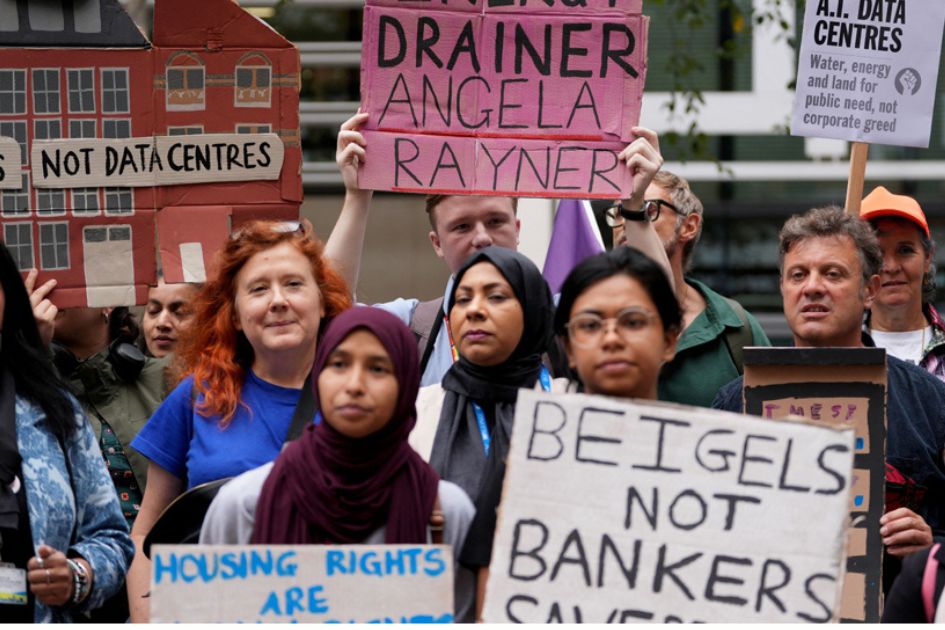



The planned East End data centre has become a flashpoint over heritage, housing and resource use as London weighs digital infrastructure against local community concerns.
Residents of Brick Lane, the historic centre of London’s Bangladeshi community, are opposing plans to build a data centre in a disused brewery, arguing that the development threatens the area’s heritage and overlooks an urgent need for social housing.
“This has really been the focal point of the British Bangladeshi community,” local councillor Faysal Ahmed said, recalling when his parents operated a restaurant beneath the home where he grew up on Brick Lane.
Many of the street’s curry houses remain, but Brick Lane and the surrounding neighbourhood are changing, partly as London expands the infrastructure needed to support its growing digital economy.
The proposed East End financial data centre forms part of a multi-million pound redevelopment of the sprawling former Truman brewery site. It would be an unusual presence on the graffiti-lined street, where tourists move between vintage shops and queue for bagels served throughout the night.
The 10-acre site is also set to include new offices and retail space, primarily serving the neighbouring financial district dominated by skyscrapers.
The UK government has approved the development as demand for water- and energy-intensive data centres grows worldwide, particularly for facilities supporting artificial intelligence, prompting opposition from communities in several countries.
Ahmed said the site could instead be used to help address housing demand in Tower Hamlets, where roughly 31,000 residents are on the waiting list for social housing.
The redevelopment includes only 44 flats, with just six designated for social housing, a provision that recently prompted residents to protest outside the housing ministry.
“My personal concern is about the need for affordable social housing for young people and preserving the heritage, the special character, of the area,” said Susanna Kow, a member of the Save Brick Lane campaign.
Planning documents show that the Labour government gave “significant weight” to the benefits of increasing data centre capacity, pointing to the need to “meet the escalating demand driving emerging technologies such as AI and increased digital services”.
The government’s housing department declined to comment on its August decision to approve the development. The Truman Brewery has not responded to an AFP request for its reaction.
“We’ve been campaigning on planning issues and the incursion of the city on the East End for quite a number of years,” said Jonathan Moberly, who is leading local opposition to the project.
Moberly said the development was part of a “growing national issue about the amount of power taken from the grid that can stop other developments happening, like housing”.
The International Energy Agency reported in April that global electricity demand from data centres had grown by 17 per cent last year.
The agency projects that electricity consumption by data centres will double over the five years to 2030.
“The UK already faces a projected daily water deficit of nearly five billion litres by 2050,” according to a report on the UK government website.
“National water resource plans do not adequately account for the burgeoning demand from infrastructure such as AI data centres. This oversight risks intensifying water stress in already vulnerable regions.”
Industry consultant Mark Acton, however, said data centre infrastructure was becoming increasingly essential, particularly in London, where proximity can deliver the ultra-fast response times required for financial trading.
“Everything we currently do digitally comes from a data centre,” Acton said, arguing that the facilities had become an easy target because of what he described as a lack of understanding about their actual water and energy consumption.
If Britain is serious about maintaining sovereignty over its AI infrastructure, “you’ve got to have somewhere to put it”, Acton said.
Campaigners at environmental charity Global Action Plan argue that UK planning rules have failed to keep pace with the sector’s expansion and do not adequately account for its environmental costs.
“It’s been a kind of Trojan horse for bad development,” said Owen Espley, the organisation’s community campaigns manager.
“We need local knowledge and input to go into shaping developments to improve them and make sure that we get better data centres at the end of it,” he said.
Further along Brick Lane, Carol Burns, who was born and raised in the area, says she has no plans to leave.
Sitting inside the shop her family has operated since the 1800s, surrounded by walls covered with family photographs, Burns said she was proud to remain part of London’s East End community.
“People are always trying to buy this place, but no. They’ll have to drag me out of here feet-first,” she said in her thick Cockney accent.




