

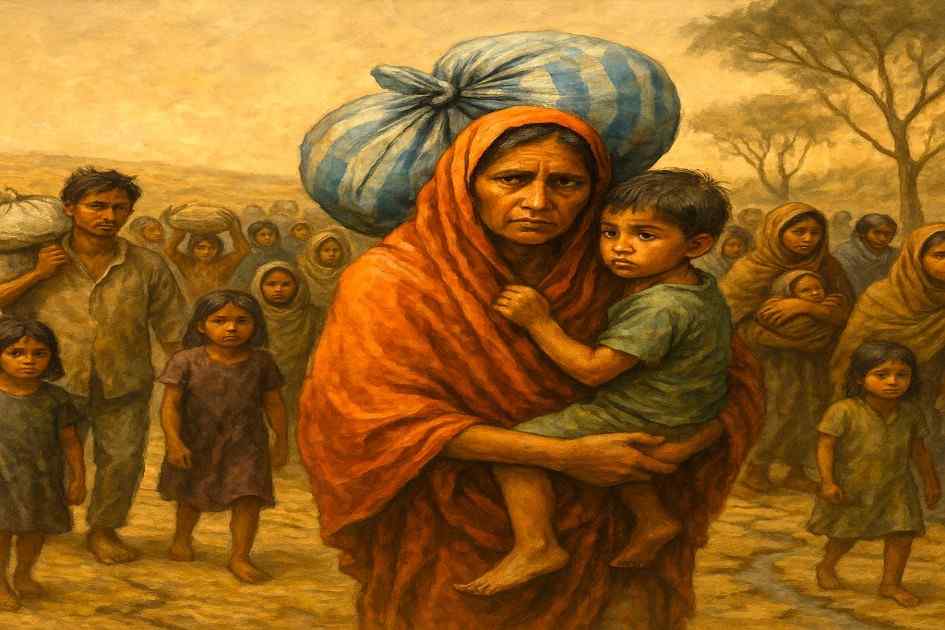

Millions in Bangladesh face internal displacement due to climate-induced disasters like floods, salinity, and river erosion. Lacking legal recognition and support, they struggle in urban slums or transient shelters. Urgent policy, land rights, and global climate finance are essential for justice.
In the saline-laced fields of the southwest, the eroding banks of mighty rivers, and the ever-expanding slums of Dhaka, a silent humanitarian crisis is unfolding. Climate change in Bangladesh is no longer a distant threat—it is a daily reality forcing millions from their homes. These people, internally displaced by floods, cyclones, river erosion, salinization, and droughts, are the human face of global warming. Often excluded from international refugee frameworks, they remain invisible—yet their numbers continue to rise.
Climate risks and geography
Bangladesh’s low-lying geography—70% of its land lies less than a meter above sea level—makes it one of the most climate-vulnerable countries on earth. Bordered by the Ganges, Brahmaputra, and Meghna rivers, the country faces recurring natural disasters that trigger mass internal migration.
In 2023 alone, over 800,000 people were displaced by sudden-onset disasters, according to the Internal Displacement Monitoring Centre. But this number excludes those uprooted by slow-onset events like salinity intrusion, land degradation, and water scarcity. The World Bank estimates that by 2050, over 13 million Bangladeshis could be internally displaced due to climate change—more than any other country in South Asia.
Stories of abandonment and struggle
In Gabura, a union in Satkhira, Cyclone Aila in 2009 permanently altered life. Seawater breached embankments, salinizing fields and drinking water. Once a hub for rice farming and shrimp cultivation, Gabura is now largely abandoned. Those who remain struggle with toxic water and dead farmland. Others have migrated to Khulna or settled in informal settlements in Dhaka.
The consequences are especially severe for women and children. With no land titles, displaced families receive no compensation. In urban slums like Mirpur and Mohammadpur, many young girls face early marriage or trafficking as families lose income and security. Without official recognition, these internally displaced persons (IDPs) are locked out of rehabilitation programs.
Urban pressures and marginalization
Dhaka’s population has soared past 21 million, fueled in part by climate-driven migration. Thousands arrive each week, seeking safety from disappearing lands. Most end up in overcrowded, underserved settlements like Korail, where clean water, legal protection, and public services are scarce.
Residents often come from river-eroded districts along the Jamuna or Padma. Many work in low-paying informal jobs—rickshaw pullers, domestic workers, or construction laborers—with no legal address, voting rights, or access to welfare programs.
In Gaibandha, shifting riverbanks annually destroy homes and farmland. Abul Kalam, a farmer, has been displaced four times since 2015. Now living in a bamboo shack on government land, he laments, “Because there’s no flood or cyclone today, no one comes to help.” These slow-onset disasters fall through policy cracks, leaving families unsupported.
Women on the frontlines
The gendered nature of climate displacement is stark. In Khulna and Jessore, researchers report that women from cyclone-affected families face exploitation in labor markets or trafficking. Many are left to manage households alone as men migrate to cities for work. Basic needs like maternal care and menstrual hygiene go unmet in temporary shelters.
Policy gaps and legal blind spots
Despite strides in disaster preparedness—such as early warning systems and cyclone shelters—Bangladesh lacks a legal or institutional framework for addressing climate-induced migration. The 2009 Bangladesh Climate Change Strategy and Action Plan acknowledges migration but offers no roadmap for protection, relocation, or reintegration.
There is no national registry for climate migrants. Urban plans, including Dhaka’s Detailed Area Plan, do not account for climate displacement. Nor does international law help: the 1951 Refugee Convention does not recognize “climate refugees,” leaving cross-border victims unprotected and domestic ones falling between agencies.
In places like Bhola and Noakhali, families on riverine islands (chars) are forced to move every few years as their land disappears. In Char Montaz, Fatema Begum has moved three times in ten years. “The river takes everything,” she says. Without a permanent address, she cannot vote, own land, or access public services.
A call to action
Bangladesh stands at a crossroads. Addressing climate displacement requires urgent, coordinated policy responses:
Recognition: Climate-induced migration must be recognized in national law and global climate frameworks.
Protection & Planning: A rights-based national action plan should ensure protection, relocation, and reintegration of IDPs, with urban municipalities prepared to absorb new populations.
Land & Tenure Security: Secure land rights or planned resettlement schemes must be offered to displaced families to reduce vulnerability and urban overcrowding.
Data Systems: A national registry and data platform should track displacement patterns, disaggregated by gender, age, and region, to guide resource allocation.
Climate Finance: High-emitting nations must provide targeted support under the Loss and Damage mechanism to fund durable solutions for climate migrants.
Toward climate justice
The climate migrants of Bangladesh are not statistics—they are farmers, mothers, and children trying to survive a crisis they did not cause. Their stories are filled with loss but also resilience. They deserve recognition, dignity, and a pathway to rebuild.
If Bangladesh rises to this challenge, it can lead the world in forging a humane and equitable response to one of the most urgent crises of the 21st century. This is not just a national responsibility—it is a matter of climate justice.




