




India’s Great Nicobar mega-project faces growing criticism as authorities plan to offset tropical rainforest destruction through afforestation in Haryana, raising concerns over biodiversity loss, ecological mismatch, Indigenous rights, and conservation.
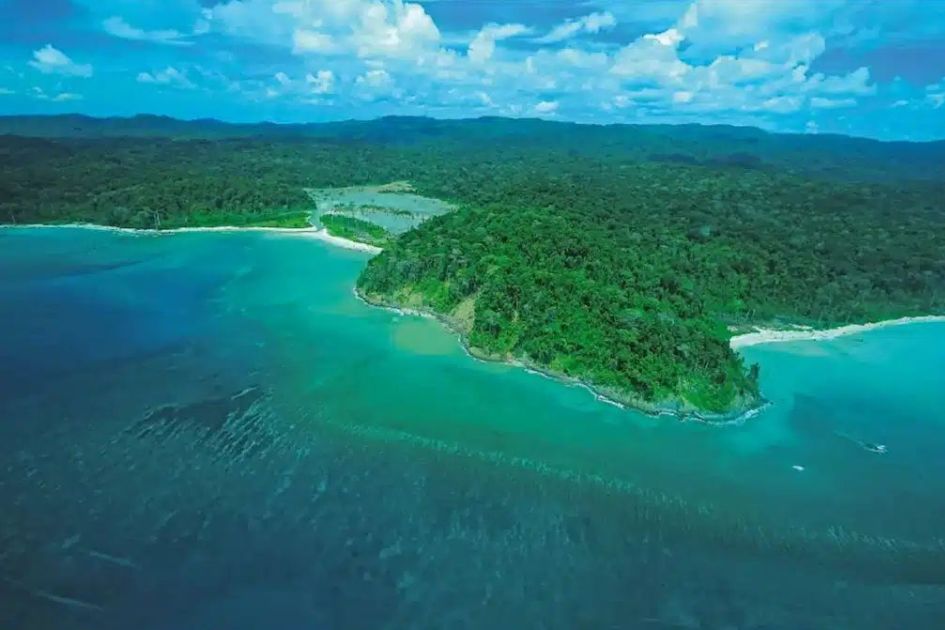
A major environmental debate has emerged over India’s proposed mega-development plan for the ecologically fragile Great Nicobar Island, where authorities plan to compensate for the felling of nearly one million rainforest trees by undertaking large-scale afforestation in the Aravalli hills of Haryana, around 2,400 kilometers away in a completely different ecological zone.
The ₹72,000-crore ($9 billion) project, led by the federal government, aims to transform Great Nicobar Island into a strategic economic and logistics hub. The plan includes an international transshipment port, a greenfield international airport, a power plant and a new township.
To enable construction, large stretches of tropical evergreen rainforest are expected to be cleared. Under India’s compensatory afforestation policy, the Ministry of Environment, Forest and Climate Change has approved a mitigation strategy involving plantation drives in Haryana, a semi-arid landlocked state far removed from the island’s tropical ecosystem.
At the center of the controversy is a broader question: whether ecological loss in one of the world’s most biodiverse island ecosystems can meaningfully be offset by planting trees in a geographically and ecologically unrelated region.
Ecological Concerns: “Mismatch” Between Ecosystems
Environmentalists, researchers and policy analysts have strongly criticized the approach, calling it a fundamental ecological mismatch.
Tushar Dash, a forest rights researcher, said the plan lacks scientific coherence:
“This proposal for compensatory afforestation in Haryana in lieu of this ecological and social loss in the Islands is devoid of any logic.”
Experts emphasize that Great Nicobar Island is part of one of the world’s richest tropical rainforest systems, home to unique endemic species such as the Nicobar megapode, giant robber crab and crab-eating macaque.
Kanchi Kohli, Senior Researcher at the Centre for Policy Research, warned that the policy approach risks normalizing ecological loss:
“The recent use of compensatory afforestation in Haryana for the Nicobar project does two things: it justifies the loss of biodiverse landscapes like the Nicobars and also accommodates the aspirations of states like Haryana to convert land into plantations or recreational tourism projects such as safari parks.”
Environmental researcher and author Pankaj Sekhsaria described the broader implications of the project:
“With the Great Nicobar Project, we will lose one of India’s most pristine landscapes… this development is being carried out in our name… the law is manipulated, bypassed. That feels like a betrayal.”
Government Position: Legal Compliance and Strategic Interest
Government officials defend the project as legally mandated and strategically necessary.
Under existing rules, compensatory afforestation must take place on non-forest land. Officials argue that since more than 80 percent of the Andaman and Nicobar Islands are already designated as protected forest or tribal reserve, suitable land for plantation within the region is extremely limited.
An official response presented in the Rajya Sabha stated: “Since the scope of plantation in Andaman and Nicobar Islands is very limited, therefore, the compensatory afforestation in the arid landscape and in the vicinity of urban areas would provide greater ecological value.”
The government also emphasizes the project’s national importance. According to submissions reviewed by the National Green Tribunal:
“The project has great significance not only for the economic development of the island and surrounding areas of strategic importance but also for defense and national security… potential ecological impacts are being effectively managed through a robust Environmental Impact Assessment process.”
Concerns Over Implementation in Haryana
Even within administrative circles, questions have been raised about the effectiveness of large-scale plantation drives in Haryana.
Ashok Khemka, a senior bureaucrat serving as Additional Chief Secretary for Science and Technology, noted concerns during a state review meeting:
“Despite large-scale forest plantations in Haryana, the forest cover over the last two decades is flat, with no increase. The state forest department should review its modus operandi before infusing large-scale funds into business-as-usual planting.”
Indigenous and Global Environmental Concerns
International conservation attention has also intensified, as Great Nicobar Island was declared a UNESCO Biosphere Reserve in 2013 due to its ecological significance.
Environmental groups warn that large-scale deforestation and infrastructure expansion could threaten critical habitats, including nesting grounds for the endangered leatherback sea turtle. Concerns have also been raised about the potential impact on Indigenous communities, including the Shompen and Nicobarese peoples, whose traditional territories and mobility patterns may be affected by large-scale construction.
Development vs Conservation Debate
The government frames the project as a strategic leap forward for maritime connectivity, regional trade and national security. Critics, however, argue that the environmental cost of transforming one of the world’s most biodiverse island ecosystems is being underestimated and inadequately offset.
As the project moves forward, it has become a focal point in a wider global debate: whether infrastructure-led development can be reconciled with ecological integrity or whether some environmental losses are, in practice, irreversible.
The Great Nicobar project now stands at the intersection of climate policy, biodiversity protection and geopolitical ambition, raising fundamental questions about how environmental “compensation” is defined in the 21st century.




