

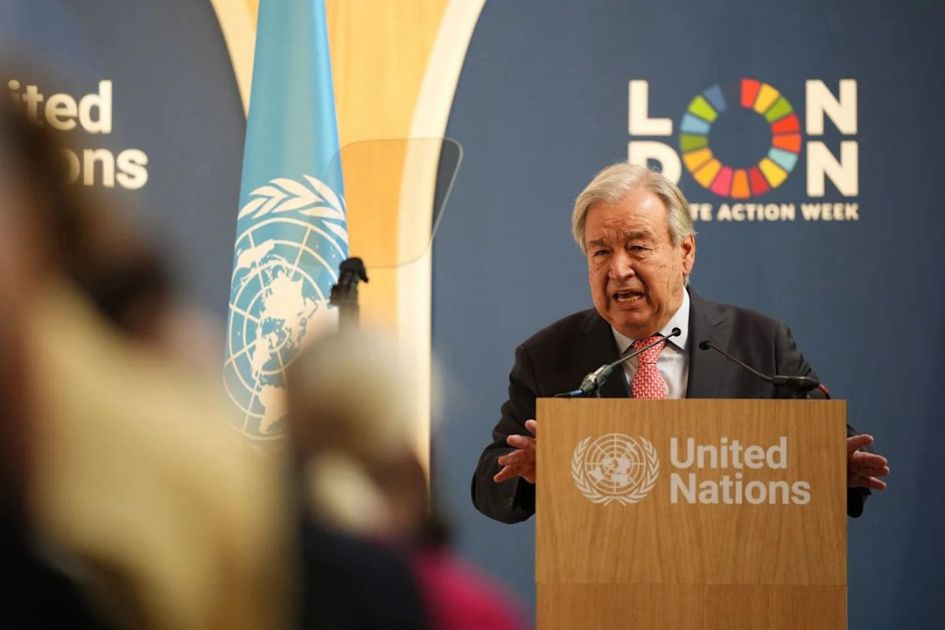

UN Secretary-General António Guterres warns worsening heatwaves, fossil fuel dependence and climate inequality are driving global instability, urging urgent clean energy investment, climate finance reform and faster emissions cuts.
London is “cooking,” the United Nations chief has warned, arguing that the world cannot continue doubling down on fossil fuels in the face of worsening climate change.
UN Secretary-General António Guterres referenced Charles Dickens’ novel A Tale of Two Cities in a major address at London Climate Action Week as the British capital sweltered under a severe heatwave.
Speaking at the event on Tuesday, Guterres said: “Crisis brings clarity and here in London, the city of Dickens, it is clear that our world is facing a ‘tale of two crises’.”
Europe is sweltering under a punishing and potentially record-breaking heatwave that has placed hospitals, transport systems and power grids under intense pressure, while the United Nations has issued one of its strongest warnings yet on the climate crisis.
Across several countries, emergency health alerts have been issued for elderly and vulnerable people as temperatures soar. Reports of heat exhaustion are increasing, outdoor work is being restricted in some areas and public services are being stretched by extreme conditions.
Opening London Climate Action Week, Guterres said the climate crisis, global energy instability and rising geopolitical tensions are not separate challenges but part of the same global failure driven by fossil fuels.
“These crises may seem separate, but they share the same destructive origin: fossil fuels,” he said, warning that continued delays are locking the world into deeper and potentially irreversible climate damage.
He urged governments to accelerate a “fast, fair transition” to clean energy, warning that every year of inaction worsens both climate risks and global instability.
MOTHER OF ALL ENERGY SHOCKS HITS DEVELOPING WORLD HARDEST
Guterres warned that the world is facing what he called the “mother of all energy shocks,” driven by instability in the Middle East and disruptions to global shipping and trade routes.
He said the impact is being felt most sharply in developing countries, where rising food prices, mounting debt pressure and slowing economic growth are deepening inequality.
“It is a debt shock, a food shock, a development shock,” he said, warning that climate and energy crises are reinforcing global injustice.
1.5°C LIMIT IN JEOPARDY AS CLIMATE TIPPING POINTS LOOM
The UN chief warned that the world is rapidly approaching the 1.5°C global warming threshold established under the Paris Agreement, beyond which scientists say climate impacts could become irreversible.
He highlighted intensifying heatwaves, collapsing ice sheets, rising sea levels and the existential threat facing small island nations, saying that even a temporary overshoot could trigger long-term damage.
“Every fraction of a degree matters,” he warned, urging immediate global action to limit temperature increases and shorten any overshoot period.
HEAT, DEBT AND CLIMATE INEQUALITY DEEPEN GLOBAL DIVIDE
Guterres stressed that the climate crisis is also a crisis of inequality, warning that developing nations are being left behind despite contributing the least to global emissions.
He said Africa, despite possessing vast renewable energy potential, receives only a small fraction of global clean energy investment because of high borrowing costs and limited access to finance.
He warned that climate change is already intensifying poverty, debt burdens and development gaps between rich and poor nations.
“NO EMBARGO ON SUNLIGHT”: RENEWABLE ENERGY BOOM OFFERS EXIT
Despite the crisis, Guterres said the world already has a clear path forward through clean energy.
He pointed to dramatic cost reductions since 2010, including solar power becoming nearly 90 percent cheaper, wind energy costs falling by more than 70 percent and battery storage costs dropping by around 95 percent.
He also noted that in many regions renewable energy is now cheaper than fossil fuels, making the transition not only necessary but economically inevitable.
“There are no embargoes on sunlight and no blockades on the wind,” he said.
AI DATA CENTRES UNDER SCRUTINY AS UN DEMANDS FULL TRANSPARENCY
In a major intervention, the UN chief also turned attention to the rapidly expanding artificial intelligence sector, warning that its environmental footprint is becoming a growing global concern.
He called on major technology companies to fully disclose the carbon emissions, water consumption and land-use impacts of their data centres, saying transparency is urgently needed.
Guterres warned that AI infrastructure is already becoming a major driver of electricity demand and said data centres should be powered entirely by renewable energy by 2030.
Without regulation, he cautioned, digital expansion could quietly accelerate the climate crisis.
SEVEN-POINT GLOBAL PLAN FOR SURVIVAL AND ENERGY INDEPENDENCE
Guterres outlined a comprehensive seven-point roadmap calling for immediate emissions cuts and a rapid global transition away from fossil fuels.
He urged an accelerated phase-down of fossil fuel subsidies, a major expansion of renewable energy and stronger action to reduce methane emissions, one of the most powerful short-term drivers of warming.
He also called for a fair and inclusive transition that protects workers and ensures developing countries are not left behind, warning that the shift must not deepen global inequality.
He stressed the urgent need to scale up climate adaptation measures, including stronger early warning systems and resilience planning to protect vulnerable communities from worsening climate shocks.
The UN chief pressed wealthy nations to deliver long-promised climate finance, including support for adaptation, loss-and-damage funding and affordable investment for developing countries facing high borrowing costs.
He also called for stronger action against climate misinformation and urged protection for scientists, journalists and environmental defenders, warning that disinformation is slowing global progress.
GLOBAL POWER DIVIDE DEEPENS AS CLIMATE FINANCE GAP WIDENS
Guterres warned that the global financial system is failing developing countries, making it harder for them to invest in clean energy despite possessing vast renewable energy resources.
He said Africa alone holds about 60 percent of the world’s best solar resources but receives only a tiny share of global clean energy investment.
He called for urgent reforms to international financial systems and stronger commitments from wealthy nations to deliver climate finance and long-term support.
“THE FUTURE WILL BE CHOSEN NOW” AS UN CALLS FOR URGENT ACTION
Closing his address, Guterres said the world stands at a decisive crossroads where inaction will carry devastating consequences.
“The transition will be either managed or chaotic, fair or unequal, a source of stability or greater division,” he warned.
He said the choices remain in the hands of global leaders, but the window for action is rapidly closing.




