

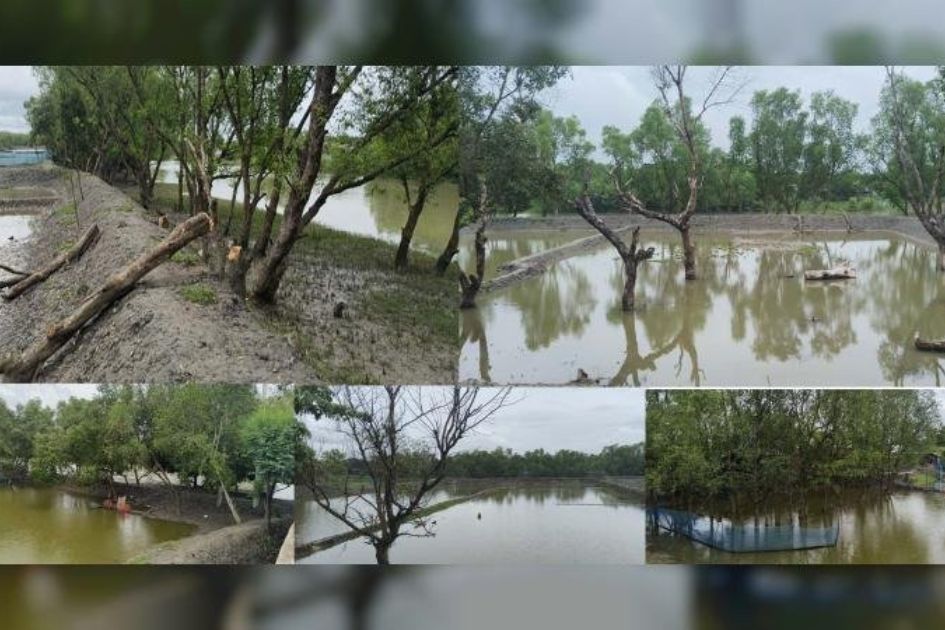



Illegal shrimp farming on Satkhira river chars is destroying social forestry, degrading biodiversity, increasing climate risks and prompting calls for urgent government action against alleged encroachment.
Large-scale alleged encroachment of river chars for shrimp farming in Shyamnagar upazila of Satkhira is destroying social forestry plantations and naturally grown vegetation, raising concerns over biodiversity loss, increased climate vulnerability and weak enforcement in one of Bangladesh’s most disaster-prone coastal regions.
The alleged encroachment is taking place in Paranpur village under Kaikhali Union, adjacent to the Ramjannagar-Kaikhali Bridge, where sediment deposits along the Malancha and Kalindi rivers have created new chars. Local residents allege that influential groups are occupying both sides of the chars to establish commercial shrimp enclosures by cutting embankments and clearing trees.
Shyamnagar, which borders the Sundarbans, is among Bangladesh’s most climate-exposed coastal upazilas. The area has repeatedly suffered devastating cyclones, including Sidr, Aila, Amphan and Remal, making the protection of riverine vegetation and coastal ecosystems critical for disaster risk reduction.
Residents alleged that a group of influential individuals from Paranpur village has formed a syndicate to occupy large sections of the government-owned char land. According to local accounts, natural boundaries and embankments are being cut to expand shrimp enclosures while thousands of trees under social forestry programmes and naturally regenerated vegetation are being felled.
Local people claimed that many of the alleged occupiers already own homesteads and substantial agricultural land but are attempting to expand commercial shrimp farming by occupying public property. They further alleged that residents who protest the encroachment have faced intimidation and threats.
When contacted, several of the accused denied the allegations, claiming they had legally obtained government settlement or lease rights over the char land for aquaculture. However, officials from the local land administration rejected those claims, stating that no lease or settlement has been granted for the disputed land.
According to local land officials, the occupied chars remain government property and any unauthorised occupation, tree felling or commercial use without approval is unlawful and subject to legal action under the country’s land administration framework.
Environmentalists warn that the destruction of river chars extends far beyond the loss of vegetation. The chars support important ecological functions by stabilising riverbanks, reducing erosion, acting as natural barriers against cyclones and storm surges and providing breeding and nursery habitats for numerous fish, shrimp and other aquatic species.
Local environmental activist Nurun Nabi Iman said the river chars and mangrove vegetation serve as critical breeding grounds for fish and shrimp that sustain thousands of fishing families living around the Sundarbans and adjacent coastal rivers.
“The destruction of these habitats will reduce fish reproduction, weaken biodiversity and threaten the livelihoods of thousands of professional fishers who depend on these rivers,” he said.
He also noted that government policy gives priority to allocating char land to landless families through long-term settlement programmes but alleged illegal occupation by influential groups is depriving genuine beneficiaries of that opportunity.
Environmental experts also warned that excavating char land to construct shrimp ponds could alter natural river flows, accelerate erosion and increase pressure on nearby embankments. They cautioned that riverbank erosion could threaten roads, culverts, embankments and residential areas during future monsoon seasons, resulting in substantial public expenditure for reconstruction.
They further warned that saline water used in shrimp farming may seep into surrounding agricultural land and freshwater sources, increasing soil salinity, reducing crop productivity and posing long-term risks to local food security.
The environmental degradation could also have wider economic consequences through declining fish catches, reduced income for artisanal fishing communities, damage to public infrastructure and higher disaster recovery costs as natural coastal protection continues to disappear.
Kaikhali Union Parishad Chairman Sheikh Abdur Rahim expressed concern over the alleged encroachment, saying the union is surrounded by rivers and remains highly vulnerable to climate-induced disasters.
“We have been working to establish social forestry and green belts along the river chars to strengthen natural protection for local communities. A small group of land grabbers is destroying these efforts for private profit,” he said.
He urged the upazila administration to immediately conduct mobile court operations, evict illegal occupiers and impose exemplary punishment on those responsible, warning that continued destruction could further endanger the Sundarbans-adjacent coastal landscape.
Repeated attempts to contact the Shyamnagar Upazila Nirbahi Officer (UNO) and the Assistant Commissioner (Land) for comment by telephone were unsuccessful.
However, Kaikhali Union Land Office official Rezaul Islam confirmed that no individual or organisation has received any official lease or settlement for the disputed char land.
“Nobody has been granted a lease for this char land,” he said.
“Anyone occupying the land, cutting trees or establishing shrimp enclosures is acting outside the law.”
He said the affected locations have already been identified and that an investigation report will be submitted shortly before legal and criminal proceedings are initiated against those found responsible.
The official also encouraged citizens to report the illegal occupation of government land, destruction of social forestry and other environmental offences through the Ministry of Land hotline (16122) or the National Helpline (333).
Environmental organisations and local residents have urged the authorities to launch immediate eviction drives, restore damaged social forestry plantations, strengthen monitoring of public land and take decisive legal action against those responsible, warning that failure to protect the river chars could further weaken the natural defences of one of Bangladesh’s most climate-vulnerable coastal regions.




