




Missile attacks across Gulf states and threats to Strait of Hormuz shipping raise fears of fuel supply disruptions, price spikes and worsening power shortages in energy-import dependent Bangladesh.
Escalating missile and drone attacks across key Gulf states have raised fears of a major energy crisis in Bangladesh, a country heavily dependent on Middle Eastern fuel imports, as tensions between the United States and Iran intensify and shipping through the strategic Strait of Hormuz faces potential disruption.
Iran on Sunday launched coordinated missile and drone strikes targeting Qatar, the United Arab Emirates, Kuwait, Saudi Arabia and Bahrain in retaliation for joint US and Israeli attacks on several Iranian cities. The conflict has prompted several countries in the region to close their airspace.
At the time of writing, Reuters reported, citing a European Union naval mission Aspides official, that ships were receiving VHF radio messages from Iran’s Revolutionary Guards warning that no vessel would be allowed to pass through the Strait of Hormuz. However, the official also said Tehran had not formally issued such an order.
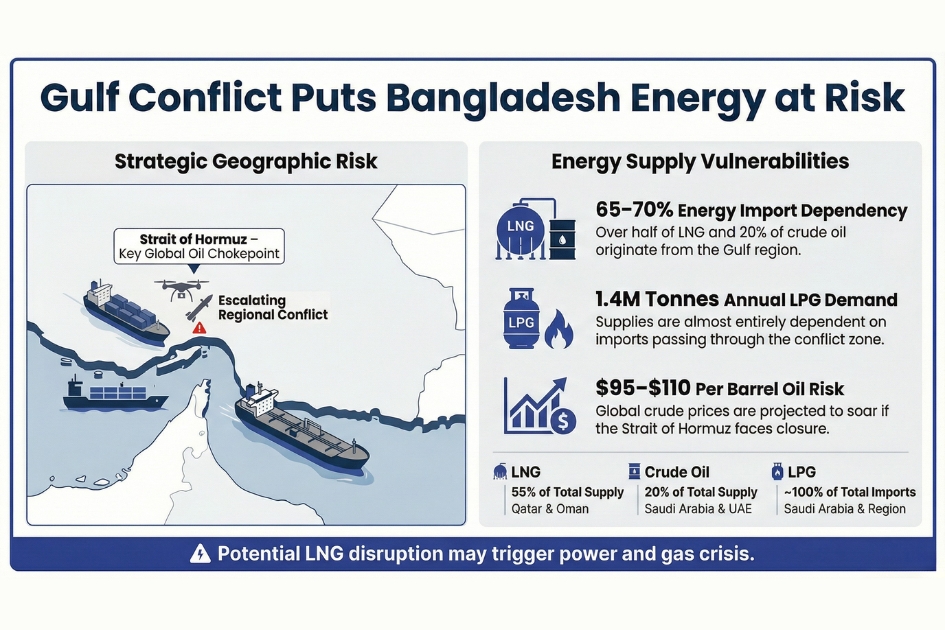
The Strait of Hormuz is the world’s most critical oil transit chokepoint, linking Gulf oil-producing nations with the Gulf of Oman and the Arabian Sea. Any closure could send global crude prices soaring to between $95 and $110 per barrel, according to several international research organizations.
Bangladesh imports 65 to 70 percent of its total energy needs, largely in the form of liquefied natural gas, crude oil and liquefied petroleum gas. Much of this comes from Qatar, Saudi Arabia, the United Arab Emirates and Oman. The country relies on Hormuz for maritime transport of these fuels.
About 20 percent of Bangladesh’s annual fuel demand is met by crude oil from two Middle Eastern countries. Around 55 percent of LNG supplies come from Qatar and Oman, while nearly all LPG imports originate from the region.
Energy analysts warn that if the conflict widens or becomes prolonged, Bangladesh’s fuel supply chain could face severe disruption.
“If war continues across the Middle East and Gulf region, oil prices will rise and that will negatively affect Bangladesh’s economy,” said Professor M. Tamim, energy expert and vice-chancellor of Independent University. “LNG supplies from Qatar could also be disrupted and that could trigger a serious gas crisis in the country.”
Bangladesh imports LNG under long-term agreements with Qatar and Oman. Nearly 40 percent of the LNG cargoes arriving annually originate from Qatar under a 15-year contract ranging between 1.8 million and 2.5 million tonnes per year.
Petrobangla said it is closely monitoring gas supply developments. However, officials declined to specify contingency measures if maritime routes become unsafe or inaccessible.
“The conflict has started in the Middle East. We import LNG from Qatar. If the route used to transport LNG is closed, that will increase our concerns,” said Petrobangla Director of Operations and Mines, engineer Mohammad Rafiqul Islam. “We are watching the situation around the clock and have instructed relevant officials to remain alert.”
On Sunday, an Iranian missile struck a US military base in Qatar. As a precautionary measure, Doha closed its airspace and temporarily suspended cargo ship movements, according to a report by The Peninsula.
Gas plays a central role in Bangladesh’s electricity generation. Any significant disruption in LNG imports could worsen load shedding during the upcoming summer season, sector insiders said.
Bangladesh Petroleum Corporation imports crude oil under long-term arrangements primarily from Saudi Arabia and the United Arab Emirates. It purchases Arabian Light crude from Saudi Arabia and Murban crude from the UAE, importing roughly 1.5 million tonnes annually from the two suppliers.
While BPC officials acknowledged the risks posed by a prolonged conflict, they said current reserves remain stable.
“For refined fuel, we see no problem until June. We are currently in a safe position,” said BPC Chairman Mohammad Rezanur Rahman. He noted that refined petroleum products are being sourced from Malaysia, China, Singapore and Indonesia, routes that do not involve the Strait of Hormuz.
Regarding crude oil shipments from Saudi Arabia and the UAE, he said, “We are monitoring the situation. At this moment, there is no shortage in our fuel reserves.”
Bangladesh also imports refined petroleum from Kuwait Petroleum Corporation, Oman’s OQ Trading Limited and the Emirates National Oil Company Limited.
The country’s annual LPG demand stands at at least 1.4 million tonnes, with a minimum monthly requirement of 120,000 tonnes. Supplies are almost entirely dependent on Middle Eastern imports, particularly from Saudi Arabia and neighboring states.
The domestic LPG market has been facing shortages since January this year. Business leaders warned that a prolonged regional conflict could further intensify the crisis and push prices higher.
Azam J. Chowdhury, chairman of East Coast Group and an industrial entrepreneur, said Bangladesh’s heavy reliance on Middle Eastern fuel makes it vulnerable.
“Gas, LPG and crude oil all come from that region. A large portion of these shipments pass through the Strait of Hormuz. If the war becomes prolonged, Bangladesh’s supply chain will face serious disruption and fuel prices may increase,” he said. “The government should prepare accordingly and maintain advance communication with alternative suppliers such as Malaysia and Indonesia.”
The government said it is closely monitoring the evolving situation and assessing its potential impact on the energy sector.
Power, Energy and Mineral Resources Minister Iqbal Hasan Mahmud said a high-level meeting had been called at 11 am Monday to review the crisis.
“The situation in the Middle East and Gulf region is not positive. We are monitoring developments closely,” he said. “We are also considering plans to import from alternative sources so that no crisis arises in Bangladesh’s energy sector.”




