


Though extinct from Bangladesh’s forests since 1940, nilgai has been seen frequently in the border areas of Panchagarh and Thakurgaon districts
Blue bulls – locally known as nilgai – are the largest antelope of Asia. They can be found throughout India, Nepal and eastern Pakistan, but quite a rare sight in Bangladesh. The animal is not blue, nor is it a bull.
Due to climate change, the animal has been extinct from Bangladesh’s forests since 1940. But in recent years, nilgai has been seen frequently in the border areas of Panchagarh and Thakurgaon districts.
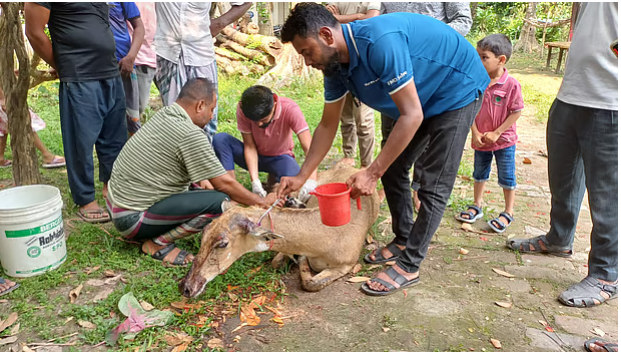
But people have not been kind to this animal. Whenever they stumble into the locality, people chase them. Some die, others are rescued by the forest department officials and treated for injuries.

A few days ago, the residents of Panchagarh Sadar upazila saw a nilgai in a corn field. They chased it away. Later, forest department officials rescued the injured female Nilgai, and began treating her at their office.
In the last five years, four nilgai have come to the district by crossing the border. One of them died after being chased by residents, and one disappeared shortly. Locals chased and caught two of them.
Forest department officials and zoologists say the animal, which has become extinct in Bangladesh, is entering the country through India by crossing the border. However, most of the nilgai are getting injured while crossing the barbed wire border fence.
Many believe these nilgai are crossing the border in search of food, after getting separated from their group, or due to possibly adverse situations.
Extinct due to climate change
Nilgai was once plentiful in Bangladesh. A hundred years ago, a lot of nilgai were seen in different regions across the country, especially in Dinajpur, Thakurgaon and Panchagarh.
But due to the impacts of climate change, the animal has not been seen in the country’s forests since 1940. So, the nilgai was declared extinct in Bangladesh.
The male nilgai have horns. Their skin color is slightly darker. Females do not have horns, and their skin is slightly brown.
Female nilgai reach maturity in two years, while males take five years. They give birth to one to three cubs at a time. After giving birth, the mother nilgai takes full responsibility for the cubs’ safety and care.
Nilgai generally prefers to avoid humans. For this reason, they live in coastal forests. These animals cross the India-Bangladesh border due to food habits, adverse circumstances, or after getting separated from their group.
To preserve these wild animals, the forest department or the concerned departments should conduct various programs to make the common people of the border area aware.
Since Panchagarh is a border region, various wild animals including nilgai occasionally arrive here from India. But there is no separate officer in the forest department for rescuing or conserving wild animals.
Experts say nilgai roam freely in the vast forests of Rajasthan, Uttarakhand, Tamil Nadu, Kerala and West Bengal in India. These nilgai are crossing the border from those regions and entering Bangladesh.
However, since the environment is not very favorable for nilgai migration in the border regions of Bangladesh, they are moving near human settlements and taking shelter in croplands.
9 nilgai arrived in 7 years
Nine nilgai were seen in Panchagarh and Thakurgaon districts from September 2018 till date. Most of them have been sent to various safari parks. Some have been killed by the public.
On April 9, villagers chased and caught an injured female nilgai in the East Joydharbhanga area of Chaklahat union, near the Indian border in Panchagarh Sadar upazila. Later, forest department officials rescued the nilgai with the help of BGB and treated it.
Three days later, the nilgai was sent to Dulahazara Safari Park in Chakaria, Cox’s Bazar.
Earlier, on May 21, 2023, a nilgai was seen in a corn field in Atwari upazila of the district, but the locals could not catch it. The nilgai later escaped. On March 17, 2021, a nilgai died after being chased by villagers in Mirzapur area of Atwari upazila.
Being chased by villagers
Five nilgai were found in the neighboring district of Thakurgaon from September 4, 2018, to November 13, 2023. Among those, a nilgai died after being chased by locals in Ranisankail upazila.
Another nilgai was slaughtered by local villagers. The other three injured animals were rescued. There have also been multiple reports of nilgai rescues from Natore, Naogaon and Chapainawabganj districts of the northern region.
According to the Wildlife Management and Nature Conservation Department of Rajshahi Divisional Forest Office, at least five nilgai have been sent to Gazipur Safari Park from the northern part of the country in the last few years. There are currently 12 nilgai there.
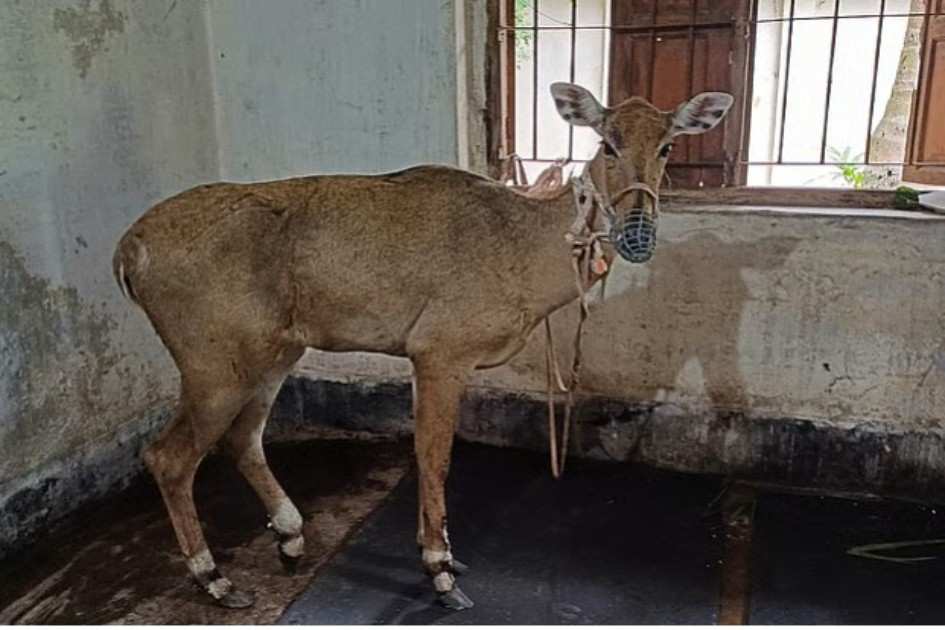
Besides, a male nilgai from Gazipur Safari Park has also been sent to Dulahazara Safari Park in Chakaria of Cox’s Bazar, as a companion to the female nilgai rescued in Panchagarh on April 9. The nilgai rescued in Panchagarh last Sunday will also be sent to Dulahazara Safari Park.
Public awareness key to saving nilgai
Villagers chase nilgai that come near human settlements due to a lack of awareness. There is a need to hold awareness meetings and seminars on wildlife conservation with the residents of the border regions.
However, local forest department officials say, due to a lack of skilled manpower, they are having difficulties in rescuing nilgai that are wandering near settlements.
Even none of the workers here have any such training. There is no separate room or cage for keeping any wild animals. Therefore, manpower is very much needed to rescue and preserve wild animals in Panchagarh.
Forest officials say if the nilgai that are currently entering Bangladesh through the Indian border can be preserved in a safari park and allowed to breed, then the nilgai will return to Bangladesh’s forests.
So, the residents of border regions across Bangladesh should refrain from chasing or attacking nilgai. Besides, killing such wild animals is also a punishable offence under Bangladeshi law.




