

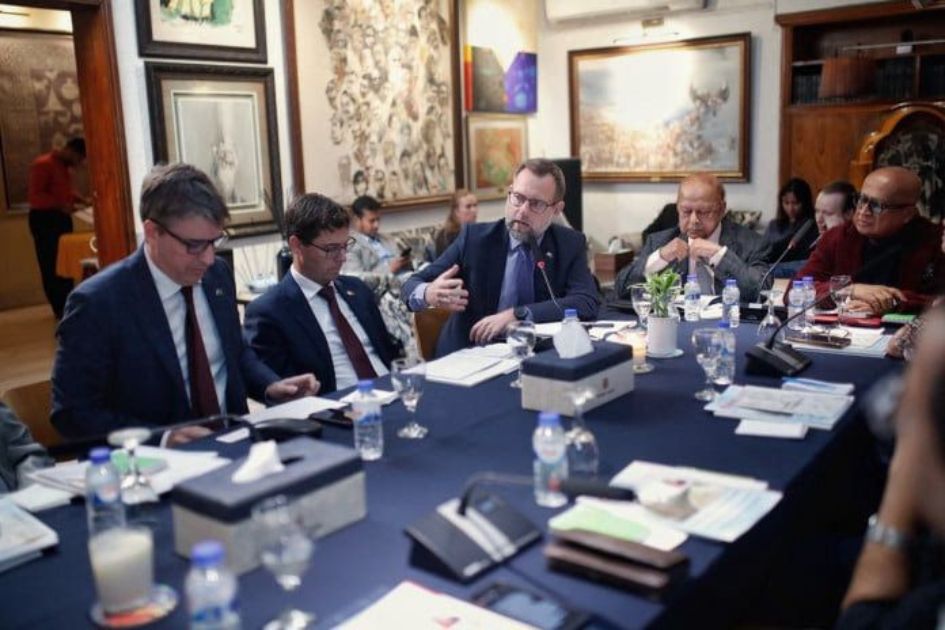



Nordic ambassadors highlighted trust, institutional reform and green investment as key pillars for a stronger Bangladesh partnership, emphasizing sustainable growth, competitiveness and long-term cooperation beyond traditional development assistance.
Ambassadors of Denmark, Norway and Sweden have underscored the importance of building sustainable prosperity through stronger cooperation, trust, institutional resilience and green economic transformation. They reaffirmed their commitment to deepening long-term engagement with Bangladesh as the country advances toward its post-LDC graduation transition and seeks investment-led sustainable growth.
The message came during a symposium titled “Bangladesh and Nordic Countries: Prognosis for Partnership” held in Dhaka on Monday under the Cosmos Foundation’s Ambassadors’ Lecture Series. The event brought together diplomats, policymakers, academics and researchers to discuss the future of Bangladesh-Nordic relations.
Danish Ambassador Christian Brix Møller, Norwegian Ambassador Håkon Arald Gulbrandsen and Swedish Ambassador Nicolas Weeks jointly said that relations between Bangladesh and the Nordic countries are entering a new phase, shifting from traditional development cooperation to trade, innovation, green investment and shared prosperity.
Trust as the “Nordic Gold”
The envoys emphasised that trust, strong institutions, green growth, workers’ rights, predictable governance and long-term stability are central to sustaining future cooperation.
They described trust as the “Nordic gold,” calling it the region’s most valuable asset and a transferable foundation for durable international partnerships, including with Bangladesh.
The symposium was chaired by scholar and diplomat Iftekhar Ahmed Chowdhury. Cosmos Foundation Chairman Enayetullah Khan delivered the welcome address, while Catherine Grace Gardner Khan opened the event.
From Aid to Investment-Led Partnership
Speakers highlighted a clear transition in Bangladesh-Nordic relations from aid-based cooperation to a more balanced partnership focused on investment, technology transfer and sustainable industrial growth.
Enayetullah Khan noted that the Nordic region brings strong expertise in renewable energy, green technology, digital governance, sustainable urban planning and circular economy solutions, with both sides offering complementary strengths.
He proposed five priority areas for future cooperation: green energy partnerships, sustainable textiles and circular fashion, digital transformation and smart governance, climate adaptation and blue economy initiatives and knowledge-driven collaboration.
Institutions, Investment and Long-Term Stability
Norwegian Ambassador Gulbrandsen said future investment decisions would depend on competitiveness, infrastructure, skilled labour and above all, predictable and trusted institutions.
He stressed that strengthening the credibility and efficiency of state institutions, including governance systems, the judiciary, financial institutions and law enforcement agencies, is essential for sustainable development and investor confidence.
He also noted that long-term stability and reconciliation are important for Bangladesh’s continued progress while emphasising that such processes remain the country’s internal responsibility.
Green Transition and Opportunities After LDC Graduation
Danish Ambassador Møller said Bangladesh has achieved a remarkable transformation, evolving from one of the world’s poorest countries into a dynamic emerging economy.
He noted that the next phase of development will be more challenging but also more opportunity-driven, particularly as Bangladesh navigates its LDC graduation transition and strengthens global competitiveness.
“Trust reduces transaction costs, enables reform and attracts quality investment,” he said, describing it as “hard infrastructure” essential for sustainable prosperity. Denmark, he added, aims to move beyond aid toward an investment-based partnership.
Swedish Ambassador Nicolas Weeks highlighted that LDC graduation presents both challenges and opportunities, especially in attracting investment and improving productivity.
He said Sweden will continue working with Bangladesh on sustainable production systems, economic diversification and innovation, noting that openness has long driven Sweden’s own growth as well as its partnership with Bangladesh.
Longstanding Ties and Evolving Cooperation
The envoys recalled that Denmark, Norway and Sweden recognised Bangladesh as a sovereign state on 4 February 1972, noting that the partnership has steadily evolved over five decades.
They said both Bangladesh and the Nordic countries are changing and so is their relationship, moving from development assistance to trade, green growth, innovation and long-term strategic cooperation.
Participants at the symposium included senior policymakers, diplomats, academics and researchers from institutions such as BIISS, the University of Dhaka, Bangladesh University of Professionals (BUP), AIUB and the Bangladesh Enterprise Institute (BEI).
The discussion concluded with a shared call to build a “transformational partnership” anchored in trust, sustainability and mutual prosperity, aligned with Bangladesh’s next development chapter.




