

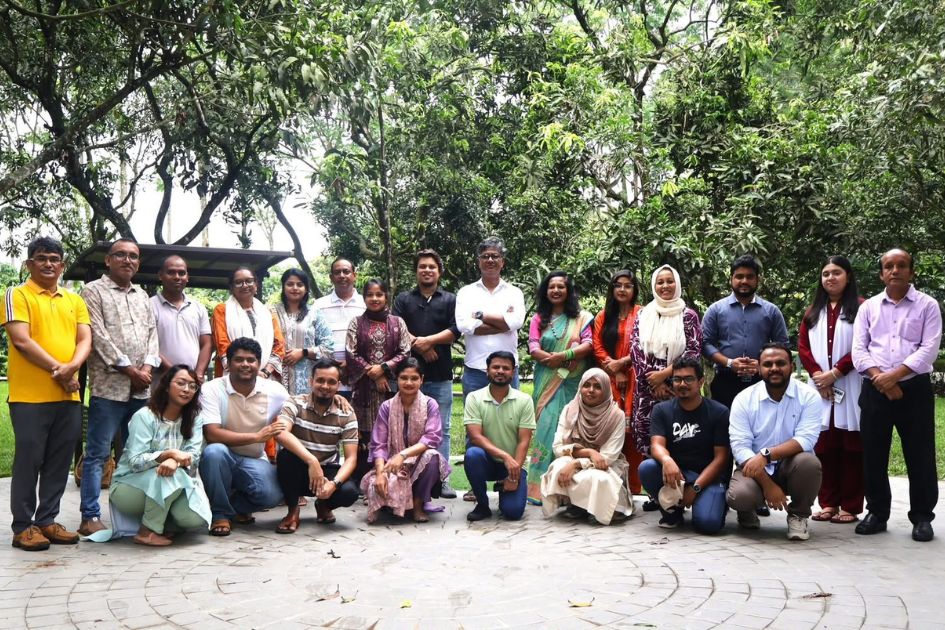



Representatives from Plan International Bangladesh, Manusher Jonno Foundation and eight divisional women’s rights organisations took part in interactive sessions focused on gender, power, inclusive communication and accountable leadership.
A two-day training on gender and inclusive leadership was held in Gazipur, Bangladesh, from July 8 to 9 for partners and divisional collaborators of Swadhinata: Freedom of Expression for Digital Democracy (FREEDOM), a project funded by the European Union, led by Plan International Bangladesh and implemented by Manusher Jonno Foundation (MJF).
The training was organised by Plan International Bangladesh and facilitated by Nasrin Nahar, Program Specialist, Gender, Diversity, Inclusion and Protection (GDIP) at Plan International Bangladesh.
Designed as a participatory learning programme, the training combined discussions, reflection and practical exercises to help participants examine how gender, power and social expectations influence leadership, communication and decision-making.
Participants explored the distinction between sex and gender and discussed how social norms and values shape gender roles, access to opportunities and participation in public life.
The sessions also examined dominance and power dynamics, including how formal authority, social position and organisational culture can influence whose voices are heard, whose concerns are prioritised and who remains excluded from decision-making.
Gender representation in the media and the language used in the development sector were also discussed. Participants reflected on how words, images and common narratives can reinforce stereotypes, portray people as passive recipients or overlook the agency and diversity of women, young people and marginalised communities.
The training encouraged the use of respectful, inclusive and gender-sensitive communication grounded in people’s lived realities.
Participants also discussed the links between inclusive leadership, accountability, intersectionality, shared decision-making and meaningful participation. The sessions focused on how leaders can challenge discriminatory practices, create space for diverse perspectives and strengthen organisational systems to better respond to people with different identities and experiences.
Representatives from MJF and eight divisional women’s rights organisations attended the training. They included Association of Voluntary Actions for Society (AVAS) in Barishal, PROTTYASHI in Chattogram, Breaking the Silence (BTS) in Dhaka, Badabon Sangho in Khulna, Paribartan Unnayan Sangastha (PUS) in Mymensingh, Barendra Economic Development Organization (BEDO) in Rajshahi, Integrated Social Development Organization (ISDO) in Rangpur and Reliant Women Development Organization (RWDO) in Sylhet.
According to the organisers, the training forms part of the Swadhinata project’s efforts to strengthen gender-responsive and inclusive leadership across its partnership network, with a focus on advancing freedom of expression and digital democracy by recognising unequal power relations, protecting diverse voices and supporting meaningful participation across Bangladesh.




