

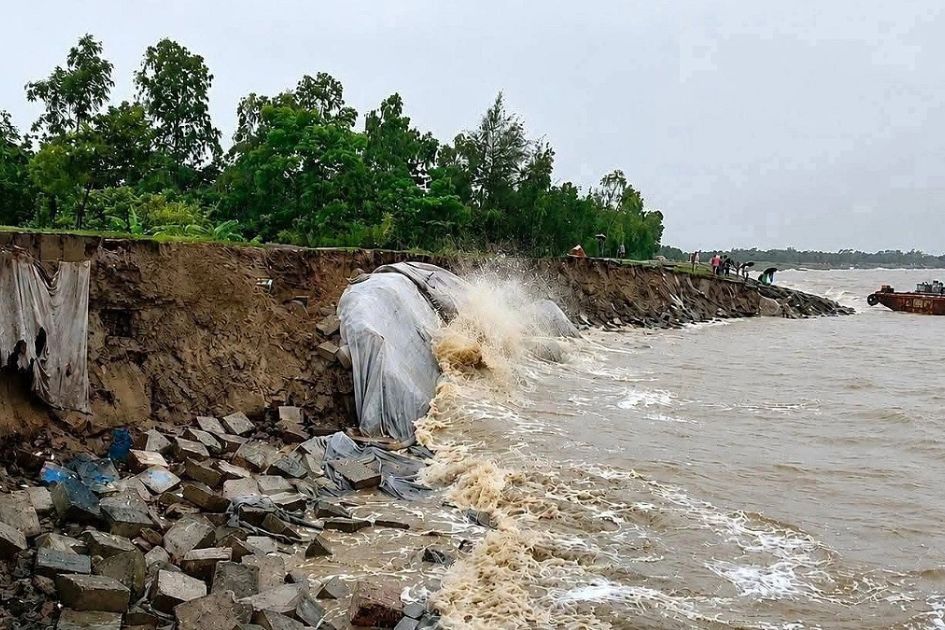

Investigations and technical studies point to construction quality, maintenance failures and climate-related coastal pressures as key reasons for the rapid deterioration, while thousands of homes, roads and public facilities face growing exposure.
A coastal embankment in Bangladesh’s southeastern Banshkhali upazila that was rehabilitated at a cost of Tk 293.60 crore to protect communities from cyclones and storm surges has largely collapsed into the Bay of Bengal within four years of completion, leaving thousands of hectares of land and critical infrastructure at risk.
Residents along the coast now live in fear whenever strong winds or heavy rain occur, while experts say the embankment failed because it was not built or maintained to a sustainable standard. The Bangladesh Water Development Board (BWDB), however, said the government had not allocated sufficient funding for an ideal design and blamed natural causes for the damage, insisting there were no flaws in the design.
Studies and reports examining the embankment failure and long-term solutions say inadequate soil compaction during construction and water seepage through holes created by rats and crabs were among the main causes of the collapse. Researchers have recommended assessing the stability of coastal embankments under extreme natural conditions, determining sufficient embankment height to prevent overtopping during storm surges and large waves and designing structures based on the expected thrust force exerted by seawater.
According to the Implementation Monitoring and Evaluation Division (IMED) project completion report, the project titled “Rehabilitation of damaged infrastructure under Polders No. 64/1A, 64/1B and 64/1C” began in May 2015 and was completed in June 2022. The project included protecting 10 kilometres of embankment slopes with concrete blocks, reconstructing two kilometres of embankment and carrying out 3.5 kilometres of protective work along the Sangu River. It aimed to protect about 15,901 hectares of land.
BWDB data show that only nine kilometres of the 37-kilometre embankment stretching from Premashia to Chhanua in Banshkhali are permanent. The remaining 28 kilometres consist of unprotected earthen embankments.
Although the IMED report said the embankment height was to be raised to between 7.20 and 9 metres, that work was not completed. Allegations of substandard construction materials emerged while work was under way. In 2020, the Bangladesh University of Engineering and Technology (BUET) tested 11,036 concrete blocks and recommended rejecting 3,787 of them after identifying them as extremely substandard.
A visit on Saturday to Premashia and Kadam Rasul in Khankhanabad union revealed extensive erosion. Concrete blocks had collapsed into piles on the beach, while geotextile bags placed to prevent erosion had torn open, exposing the sand beneath. Deep cracks were visible even in sections that remained intact.
The most severe damage was found in Premashia and west of the Khankhanabad land office, where only one to one-and-a-half feet of the embankment remained. Sand-filled bags placed to reinforce the structure were also sinking into the sea. In Hachiyapara of Kadam Rasul, no trace of the concrete blocks remained. Near the Boro Mawlana Mazar area, the beach and the embankment were almost level, while only small sections of the embankment survived in the Azim Uddin Mawlana Bari and Kala Gazipara areas. No new work had been carried out in Haliyapara of Ratnapur, where only the old, weak embankment remained.
Mohammad Robiul Islam, a resident of Dongra in Khankhanabad union, said: “Before the embankment was built, we could not cultivate our land for a long time because of saline water. It did not even last two years. Now there is new fear over the embankment. During the floods, our biggest fear was whether it would collapse because it had already become so narrow. If it had broken, nothing could have been saved.”
Mohammad Jalal Uddin, a fisherman from Khankhanabad, has lost his homestead five times because of embankment failures and said he remains anxious even in his current shelter.
The embankment failure has put 44 bridges, 57 culverts, 7,167 houses, 231 mosques and temples, 15 madrasas, 31 school buildings and 45 school-cum-cyclone shelters at risk. Also threatened are 24 union parishad buildings, 18 hospitals and health centres, nine agricultural warehouses, 553 kilometres of roads, 4,666 shops, 12 sawmills and 5,380 acres of agricultural land facing salinity and flooding.
Research conducted under a Japan International Cooperation Agency (JICA) pilot project, a study presented at the Sixth International Conference on Geotechnical Engineering in Virginia in the United States, research by BUET’s Department of Water Resources Engineering and a BWDB report found that storm surges have become more powerful because the Bay of Bengal is narrowing toward the north, reducing floodplain areas. The studies also identified regular wave action, tidal fluctuations, saline flooding, inadequate maintenance and embankment designs that did not account for climate change as contributing factors.
Researchers recommended constructing embankments using coastal models that calculate wave impacts, planting grass and trees and using modern concrete blocks to improve durability.
Dr Ainun Nishat, former professor at BUET and emeritus professor at BRAC University, said: “The embankment was not properly designed and it was not built according to the correct design. After that, it was not maintained either. As a result, it collapsed shortly after the work was completed. The officials involved in this project must be brought under the law. Otherwise, embankments will continue to be built and then collapse.”
Referring to embankments constructed in the 1960s that remain intact, he added: “If an embankment is built with the correct design, it can last for half a century.”
BWDB Executive Engineer Dr Tanjir Saif Ahmed offered a different explanation.
“The estuary of the Sangu River is undergoing rapid geographical changes, causing the setback distance of the coastal embankment from the shoreline to decrease alarmingly. Excessive erosion has developed at the foundation of the embankment in the estuary, threatening its safety,” he said.
This post is republished from Daily Agamir Somoy.




